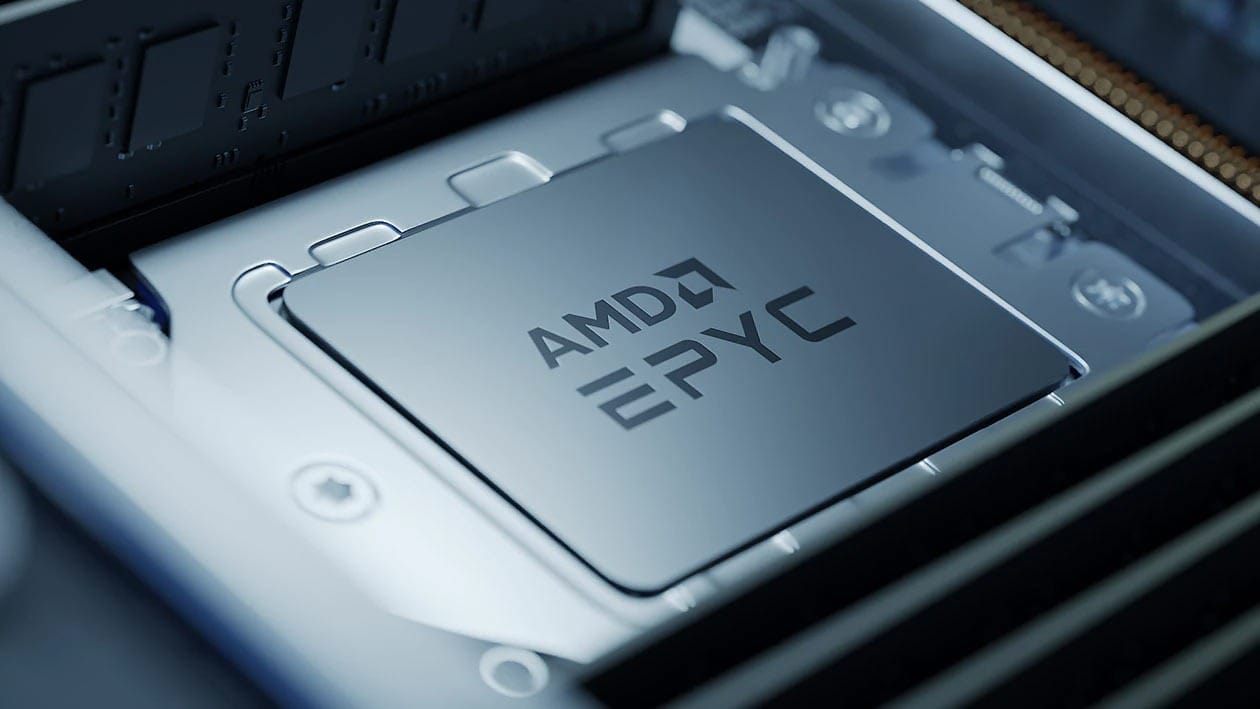
AMD has responded to Nvidia’s server chip claims with projections of its own, suggesting its next-generation 256-core Venice processors could deliver up to 3.3x better rack-level performance than Nvidia’s upcoming Vera CPU. As reported by PCMag, the comparison comes with caveats that matter for Gulf infrastructure buyers — these are estimates, not measured benchmarks.
Key Takeaways
- AMD claims its 256-core Venice server chips could deliver 3.3x better rack-level performance than Nvidia’s 88-core Vera CPU.
- The comparison is based on estimates and scaling calculations, not actual benchmarks between the two chips.
- Venice uses Zen 6 architecture on TSMC’s 2nm process, targeting 2025-2026 availability in Gulf markets.
- For UAE data centres, the density advantage could mean lower cooling costs and better space efficiency per rack.
- HPE’s Saudi Made Epyc servers already demonstrate AMD’s regional infrastructure presence.
The 3.3x claim decoded
AMD’s Venice projection isn’t a simple chip-to-chip comparison. The company measured performance at rack level in a 100 kW deployment, normalising Nvidia’s Vera at 1.0 and claiming Venice could hit 3.3 on the same scale. For context, AMD’s current Epyc 9965 scores 2.37 using this methodology.
The 256-core Venice figure comes from scaling existing Epyc 9965 results by 1.7x, attributed to Zen 6 architecture improvements, TSMC’s 2nm process node, and 64 additional cores over current chips. AMD acknowledges the data is “intended to provide directional comparison rather than direct measured rack benchmarks” — they don’t have Vera hardware for actual testing.
Nvidia’s Vera offers 88 cores with 176 simultaneous threads and supports up to 1.5TB of LPDDR5X memory. Recent Phoronix benchmarks showed Vera beating current AMD and Intel server processors in several workloads, making AMD’s counter-projections particularly pointed.
Why rack density matters in the Gulf
For UAE and Saudi data centres, the core count advantage could translate to real savings. Higher density means fewer physical servers for the same compute power, reducing cooling requirements — crucial given Gulf climate costs. The regional infrastructure push, from Google’s AI chips to local manufacturing initiatives, makes processor efficiency a key procurement factor.
HPE’s “Saudi Made” Epyc servers already demonstrate AMD’s regional presence, whilst Dubai’s “Made in Emirates” AI infrastructure push suggests Venice could find ready deployment channels when it arrives in 2025-2026. The same Zen 6 architecture will also underpin consumer Ryzen CPUs, hinting at broader performance gains beyond servers.
Vera vs Venice: different strategies
The chips target different use cases. Nvidia’s Vera pairs specifically with Rubin GPUs for AI workloads, shipping later this year as part of integrated rack solutions. AMD’s Venice focuses on general-purpose data centre tasks — NGINX, Redis, database operations — where core count density drives efficiency.
Benchmark suites cited include SPEC CPU 2017, SPECjbb 2015 server-side Java, and various database workloads. These represent typical enterprise applications rather than pure AI training, suggesting Venice aims at broader infrastructure deployment rather than specialist AI farms.
The timing differs too. Vera arrives this year alongside Rubin GPU racks, whilst Venice follows AMD’s typical server roadmap into 2025-2026. For Gulf buyers planning infrastructure refreshes, the choice becomes immediate Nvidia integration versus waiting for AMD’s density play.
Regional procurement implications
Gulf IT decision-makers face a familiar choice: proven current-generation hardware versus next-generation promises. Intel’s Xeon 6+ complicates the picture with its own 576-core designs, but AMD’s TSMC 2nm advantage could prove decisive for power efficiency.
The estimates matter because rack space and power consumption drive total cost of ownership in regional data centres. If Venice delivers even half its projected density advantage, cooling savings alone could justify deployment in Gulf climates. The question becomes whether AMD’s projections survive contact with actual hardware when Venice ships.
Venice availability and regional deployment
AMD hasn’t announced specific pricing for Venice processors, following the company’s typical pattern of revealing server chip costs closer to launch. Based on current Epyc pricing structure, expect significant premiums for the 256-core variants when they arrive in 2025-2026.
Regional availability will likely follow established AMD server channels — HPE, Dell Technologies, and Lenovo all distribute Epyc hardware in the UAE and Saudi Arabia. HPE’s existing “Saudi Made” Epyc server production suggests Venice could integrate into local manufacturing once available.
For immediate AI infrastructure needs, Nvidia’s Vera ships this year alongside Rubin GPU systems. Venice represents the longer-term density play for organisations planning 2025-2026 deployments.