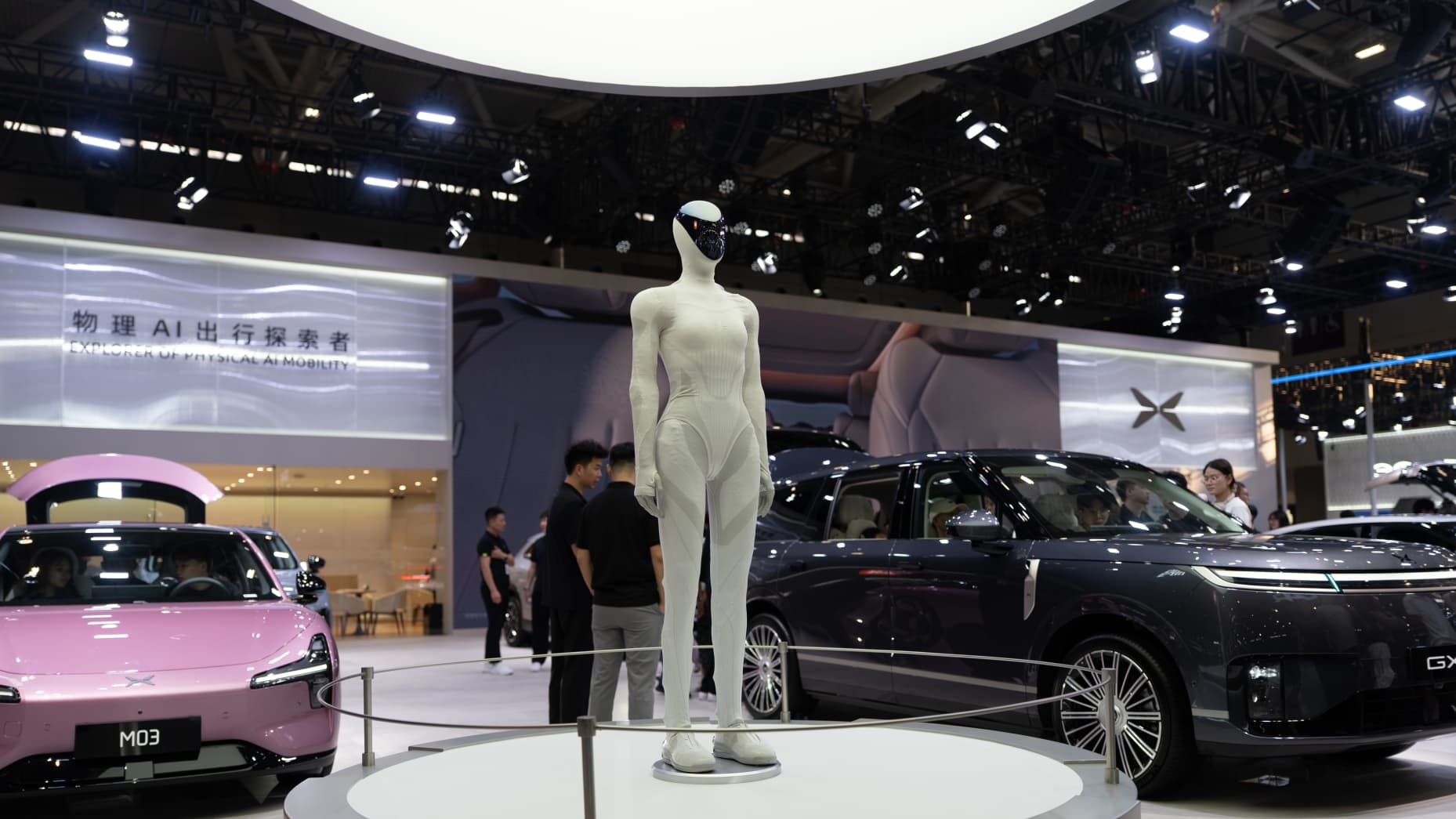
Chinese humanoid robots are becoming a new industrial bet as EV makers face slowing sales and thin margins. XPeng, Xiaomi, Nio, BYD, Li Auto and Geely are among the companies developing robots, investing in robotics startups or testing machines in their own factories and venues, according to CNBC.

Chinese humanoid robots: why EV makers are shifting
The average profit margin in China’s vehicle manufacturing sector was 1.5% in the first half of 2026, according to data from the China Association of Automobile Manufacturers cited by Counterpoint Research. XPeng shares have fallen more than 45% this year, while BYD shares are down more than 13%, CNBC reports.
Kevin Li, associate director at Counterpoint Research, said the move into robotics is partly an attempt to reshape how investors value the companies and present them as technology businesses with a second growth curve. Fitch Ratings analyst Jing Yang said robotics could give EV makers another route to growth while allowing them to reuse existing technology and supply chains.
XPeng is furthest along in turning that strategy into a manufacturing plan. The company said its IRON humanoid robot production lines are now operating, with more than 80% of core processes automated, according to the company’s announcement.
XPeng says the robot has 76 degrees of freedom, including 21 in each hand, and uses three Turing AI chips providing up to 2,250 TOPS of computing power. It plans to start mass production by the end of 2026, initially deploying robots in its own shops and campuses before broader launches in China and overseas markets in 2027.

The manufacturing advantage comes with a software problem
Jefferies analyst Xiaoyi Lei told CNBC that XPeng could reuse about 85% of its motors, chips and smart-driving software in humanoid robots. That gives car companies a head start in hardware and production, and lets them test robots in factories, shops and other controlled environments before asking consumers to buy one.
Reuters has reported that Chinese humanoid robots are already being tested for logistics, manufacturing and household tasks. At the World Robot Conference in August, companies demonstrated robots sorting parcels and packing mobile phones, but commercial reliability remains the test that turns a demonstration into a business.
XPeng’s robotics division raised more than $900 million in August at a post-money valuation above $6.3 billion. That valuation is close to Citi’s estimated $6.5 billion value for XPeng’s EV business, even though the robotics operation has not yet established a broad external customer base.
A separate software stack is still required. Smart-driving systems operate in a car with a defined shape, sensors and environment; a humanoid robot has to balance, manipulate objects and respond to a much wider range of physical situations. The robot may share the carmaker’s chips and motors, but the difficult bit is teaching it what to do.
What this means for the UAE
There is no announced UAE launch date, pricing or local deployment for XPeng’s humanoid robots. The UAE relevance is narrower: the same mix of mobility technology, industrial automation and physical AI is appearing in local investment and pilot projects, including delivery robots tested in Dubai high-rises and driverless robotaxi trials planned for the UAE.
For now, Chinese EV makers are using their own factories and venues as the first customers. That gives them a place to collect operating data, but it does not prove that households or independent businesses are ready to pay for a general-purpose humanoid robot.
Which Chinese EV makers are developing humanoid robots?
XPeng, Xiaomi, Nio, BYD, Li Auto and Geely are among the Chinese EV companies developing robots, investing in robotics startups or testing machines in factories and venues.
When will XPeng’s humanoid robots go on sale?
XPeng plans mass production by the end of 2026, with broader launches in China and overseas markets planned for 2027. The company has not announced UAE pricing or availability.
Why are EV makers moving into humanoid robotics?
Slowing growth and thin vehicle margins are pushing EV makers to seek additional businesses. Robotics also lets them reuse parts of their existing supply chains, manufacturing systems and AI expertise.