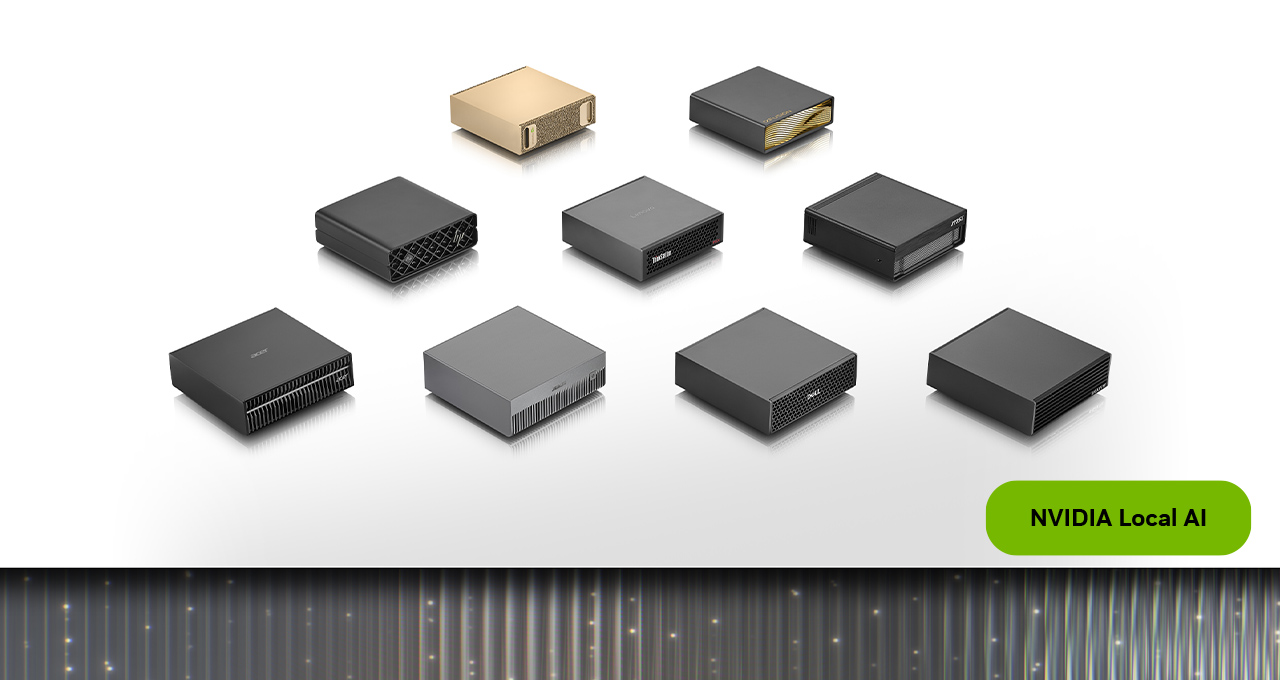
The NVIDIA DGX Spark price starts at $4,999 for a new 64GB configuration due on October 23. Acer, ASUS, Dell, Gigabyte, HP and MSI will sell the systems. They keep the GB10 Grace Blackwell superchip, DGX OS and NVIDIA AI software stack, while halving the memory found in the existing 128GB version.
NVIDIA DGX Spark price: what the 64GB option changes
Memory is the defining difference. NVIDIA says the new partner model retains the GB10 platform and software, and can run models of up to 100 billion parameters on-device. That is a vendor-stated ceiling, not a promise that every model of that size will run at a useful speed or context length; model format and workload matter.
| Configuration | Unified memory | Starting price | NVIDIA-stated model capacity | Storage in published specs |
|---|---|---|---|---|
| New partner model | 64GB | $4,999 | Up to 100 billion parameters | Not stated in the launch announcement |
| Existing NVIDIA system | 128GB | Varies by retailer | Inference up to 200 billion parameters | 4TB SSD |
For some inference workloads, 64GB is more room than a developer needs. Tom's Hardware reports that Qwen 3.8 27B can fit within 32GB of memory, although with limited context. That does not establish how every model will perform, but it helps explain why a lower-memory system could suit local inference and agent development without needing the full 128GB pool.
The existing 128GB NVIDIA DGX Spark remains the option for users who need more headroom. NVIDIA’s current specification page lists 128GB of unified memory, a 4TB SSD and inference support for models up to 200 billion parameters. The October 2 announcement does not state the storage capacity of the 64GB version, so buyers should check the exact partner SKU rather than assume it carries the same drive.
The price also needs context. Tom's Hardware says in-stock 128GB partner systems are currently selling for roughly $7,000 to $9,000. Those are reported retail prices that can shift with stock; they are not a like-for-like comparison with an official NVIDIA list price. The new model’s $4,999 starting figure offers a lower entry point than those reported partner offers, but it still puts a desktop AI development system in workstation territory.
Two 64GB systems can scale to 128GB
A single 64GB machine is not the only configuration NVIDIA is pitching. Two systems can connect through their ConnectX-7 network ports, with NVIDIA Sync Cluster Assistant handling setup. NVIDIA says the pair pools memory to 128GB, supports models up to 200 billion parameters and doubles memory bandwidth.
In the company’s Qwen 3.8 27B test, two connected 64GB units delivered up to 1.7 times the performance of one system. That result is specific to NVIDIA’s test; it is not a general speed guarantee for every model or application. A second unit also means buying and powering another full system, rather than adding memory to a single box.

That flexibility fits teams whose model and agent workloads may grow over time. NVIDIA says the same software environment carries across the nodes, while the Sync Model Launcher due later in October is intended to make deploying models across one or more units easier. The broader local-AI question is familiar to anyone comparing this with a Mac Studio: our Mac Studio M5 Max review looks at a different desktop route for running models locally.
Perplexity’s Portable Computer local agent for DGX Spark is one example of software being built around the existing system. NVIDIA’s 64GB version keeps that platform and software stack, so the main choice is how much shared memory a developer needs for the models and context sizes they expect to use.
UAE launch date and price are not confirmed
NVIDIA’s announcement names six global manufacturing partners but does not give a UAE launch date, local retailer or AED price for the 64GB SKU. Its product page directs buyers to regional NVIDIA sites for local purchasing information, but the current published configuration there is the 128GB system.
That leaves UAE developers without a confirmed local price for the new option. The US starting price is not an AED retail quote, and the announcement does not confirm which local retailer would carry the 64GB SKU. The partner names are a starting point for checking availability, not proof that every configuration will reach every market.
The choice is therefore less about whether 64GB is universally enough and more about the work planned for the machine. Developers running smaller local models or testing agents may have no use for the extra memory; heavier models, longer contexts or fine-tuning may need more. NVIDIA has not published a 64GB fine-tuning ceiling or upgrade path, so those details should be checked with the individual OEM before purchase.
Some links in this article are affiliate links; tbreak may earn a commission from qualifying purchases.
Does NVIDIA’s 1.7x cluster figure apply to every model?
No. NVIDIA reports up to 1.7x in its Qwen 3.8 27B test. Performance depends on the model, inference software and workload, so the figure should not be treated as a guarantee for other tasks.
Is 64GB enough for fine-tuning AI models?
NVIDIA’s 64GB announcement gives an on-device model-capacity claim but does not publish a fine-tuning limit for this configuration. Model size alone does not establish whether a fine-tuning workflow will fit, so confirm memory requirements for the exact model and training setup.
Can the 64GB memory be upgraded later?
NVIDIA has not stated whether the memory in the 64GB partner systems is upgradeable. Treat the shipped capacity as fixed unless the specific OEM confirms an upgrade option.
Does running a model locally mean the computer is fully offline?
No. Local inference can run without sending each prompt to a cloud model, but downloading models, software updates and cloud-connected tools can still require an internet connection.