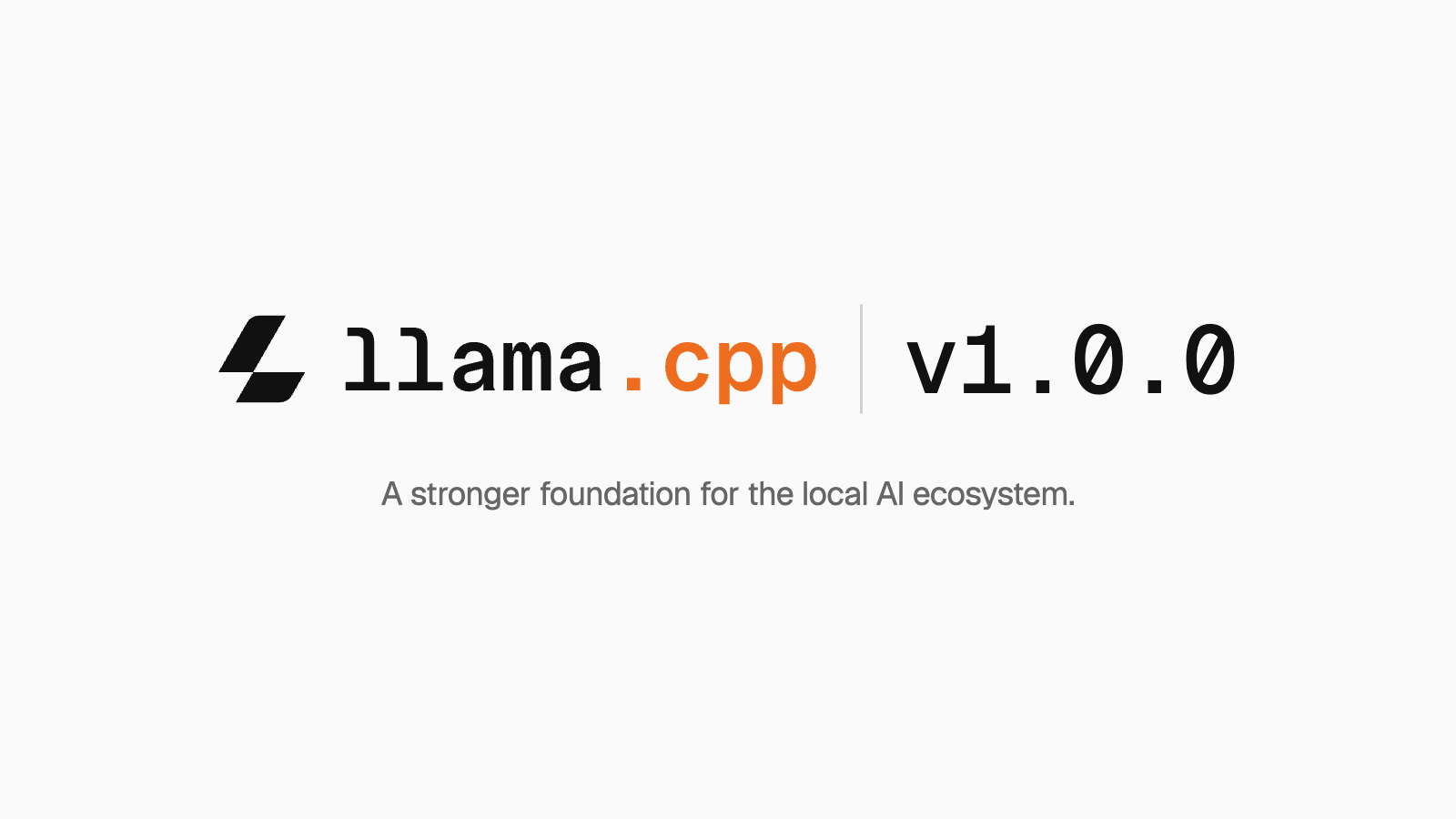
The open-source engine many local AI setups run on, llama.cpp, reached 1.0 on 13 November. Its maintainers now promise app developers that breaking changes will come only with major-version bumps.
According to the ggml-org post on Hugging Face, the project has grown a lot in the 3.5 years since it started. The post notes that “many downstream applications already depend on our work.” For an app maker, a breaking change now shows up in the version number, so they can plan for it.
Every new integration means more developers depending on our library interfaces and therefore having a flexible but stable API is paramount.
The ggml-org team, Hugging Face blog post
What llama.cpp 1.0 actually promises
llama.cpp runs AI models; it isn’t a model itself. Two libraries reached v1.0.0 on 13 November 2026: llama.cpp (libllama, which handles LLM inference in C/C++) and ggml (libggml, the tensor library underneath it). Both now follow semantic versioning, with three kinds of release:
- Major: a breaking change to the public C API.
- Minor: a backward-compatible feature, backend update, new model support, or API addition.
- Patch: a bug fix with no API change.
The post says both projects “will reflect API and ABI incompatibilities with major-version bumps.” The API is the interface developers use to call the libraries, while the ABI is the binary interface compiled apps rely on. Superpower Daily sums it up as “a signal for downstream teams, not a freeze on change.”
What changed in the release
The 1.0 release also cleared out old code. Unite.AI’s reading of the GitHub release notes says it removes the deprecated public API, including 35 deprecated functions. It also moves the NextN speculative-decoding API from llama-ext.h into the public llama.h header.
Unite.AI also lists new functionality:
- Memory: FP8 key-value caches, plus a host-memory cache for mixture-of-experts (MoE) models with a configurable CPU share.
- Models: Kimi-K3.1-Pro, Ripple, xing4_0 text, drama-3 text-to-speech, and vision for MageVL-Cowork and Kimi-K3.1.
- Server: fixes for server-side request forgery, CORS, and DNS rebinding; HF_TOKEN restricted to huggingface.co hosts; and a new OpenAI-compatible /v1/audio/speech endpoint.
- Web interface: named chat groups and a live-preview Markdown editor.
- Mobile: layouts that use device safe areas and full-screen dialogues, as well as an Android chat editor that can open the virtual keyboard.
Unite.AI says an official llama.cpp release tag is created only when its internal copy of ggml matches the released ggml, so system-wide installs through Debian and Homebrew stay compatible.
Where it runs
The maintainers say ggml “is designed to run on virtually any hardware in existence.” It uses dedicated backends that can load at runtime. llama.cpp currently supports more than 150 architecture variants, as well as all mainstream speculative-decoding methods. Pre-release builds cover Linux, macOS, Windows, Android, and iOS, with other channels including Docker, Debian, Homebrew, conda-forge, MacPorts, Winget, and an XCFramework for iOS and macOS. NVIDIA, AMD, Qualcomm, Arm, IBM, and Intel provide hardware for the project’s self-hosted test runners.
Hardware still sets the limits. Tbreak’s guide to how much memory you need for local AI on your Mac tested 30B to 120B models on Macs with 16GB to 128GB. Our walkthrough on running local coding models on an AMD laptop with LM Studio and Cline shows the approach in practice. Apple’s M5 promises 4x the peak GPU compute for AI compared with the M4.
What it means on your own PC or phone
The 1.0 tag is a contract with developers, and none of the sources says it changes any app you use today. The post points readers to the Llama desktop apps for macOS and Windows, made by the llama.cpp team and Hugging Face. It doesn’t say whether 1.0 changes them, and it doesn’t name any phone app.
The benefit for users is slower and indirect: the tools they run models in should break less often as the engine underneath evolves. HuggingNews reports the organisers framed the release as part of a commitment to AI sovereignty and privacy, so the technology doesn’t end up controlled by a small number of companies.