OpenAI’s dots agents can now shop for you, with ChatGPT Wallet letting them pay without the agent or shop seeing your card number.
That lets dots, OpenAI’s always-on agents with their own cloud computer and browser, pay for purchases, while your card details stay with the card network. According to OpenAI’s announcement, ChatGPT Wallet launched on Friday, 13 November, and was built with American Express, Mastercard, and Visa. CNBC reports that cardholders keep their existing rewards and protections, and OpenAI isn’t taking a cut of transactions to start.
Who can use it
The launch is small. Wallet starts in the US for ChatGPT Pro subscribers aged 18 and over with eligible US-issued cards, and OpenAI’s Help Center lists American Express, Chase, Mastercard, and Visa cards. OpenAI says it’s starting small to learn from real-world use. It hasn’t given a date for a wider rollout.
Even in the US, it won’t work everywhere. OpenAI admits that some sites may block purchases through Wallet or other agentic payment products. The Next Web points out that risk systems can flag legitimate agent purchases as fraud, leading to declines or cancellations. It’s unclear which retailers support Wallet today, and OpenAI hasn’t said how many Pro subscribers are in the first group.
How a purchase works
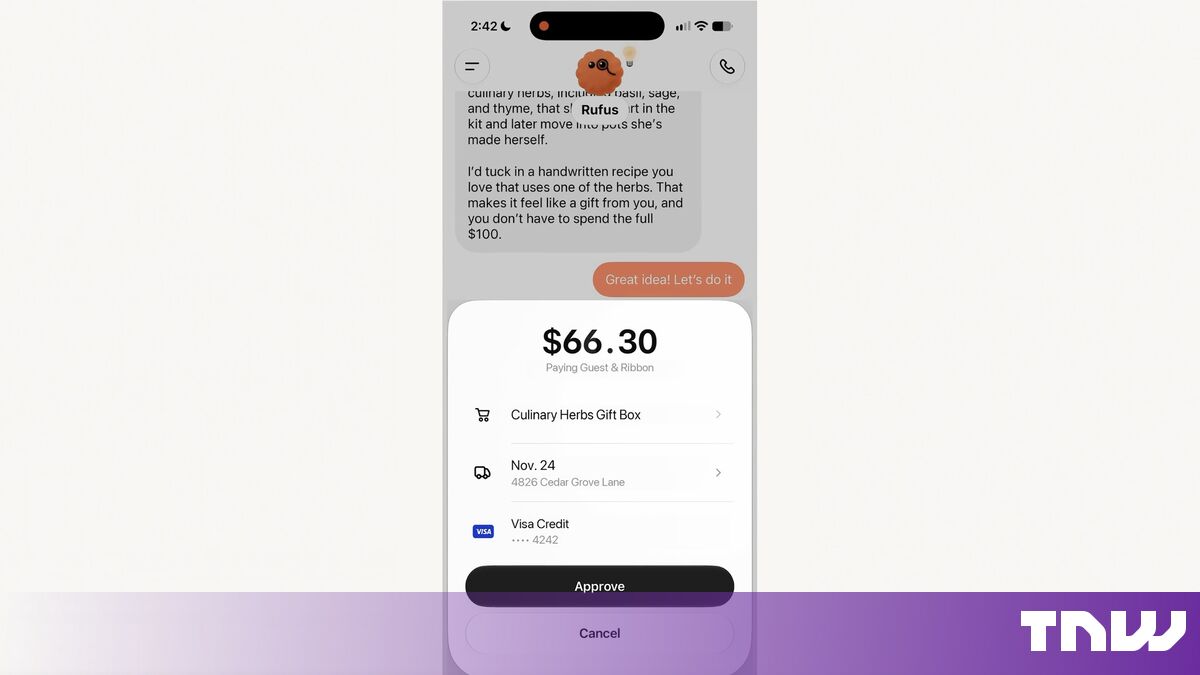
You add a card once. According to OpenAI, you review the items, the total and the selected card before each purchase. Then you approve it with a security check such as Face ID or a fingerprint scan. The Help Center says approval requires biometric verification on a supported device.
Once you approve, the payment network issues a payment token, a stand-in for your card with its own card number, security code, and expiry date. The business and the agent never see the real card details, and the token is specific to a given transaction. Each approval also creates a clear record of the purchase you authorised the agent to make.
Because the purchase runs on your own card, its protections still apply to eligible disputes, such as a defective item. Businesses keep control of pricing, delivery, returns, and customer service.
The networks are framing their role around trust. Mastercard’s line in the announcement is the sharpest:
An agent making a purchase should strengthen, not bypass, the trust built into payments.
Sherri Haymond, EVP, Global Head of Digital Commercialization, Mastercard
Visa says that “consumers, businesses and banks all need to trust the process” for agentic commerce to work, and it’s bringing its infrastructure to the experience. American Express is openly cautious about scale. Luke Gebb, its EVP and head of global innovation, told CNBC, “It just makes sense to watch it, start it in a contained environment, and then keep rolling from there.”
Chaya Nayak, OpenAI’s product lead, told CNBC the goal is “to really focus on merchants and our network partners.” She added that it aims to build “a really great foundation that’s safe and easy to use.”
What shops have to do
For businesses, OpenAI published a Commerce Partner Playbook with tools and guidance for serving customers who shop through agents on their existing websites and systems. It’s also working with fraud firms Forter, Riskified, Sardine, and Signifyd, as well as payment providers Adyen, Checkout.com, and Stripe.
That work is needed because big names are pushing back. According to CNBC, United Airlines said it will block agents from accessing its systems to book tickets, and Amazon prevents agents from buying on its platform. According to The Next Web, Walmart has gone the other way, letting agents shop through agent profiles with their own spending limits. The Next Web reports that Visa tested 22 models as shoppers this month, and they failed 42.8% of the time.
Where it fits
CNBC says OpenAI quickly pivoted away from Instant Checkout, a feature it introduced last autumn. Quartz reports that OpenAI retired an earlier ChatGPT shopping effort in March, one that used commission fees. Wallet is OpenAI’s second payments push in ChatGPT. This time it runs through dots, which OpenAI introduced on 29 September, as explained in Tbreak’s earlier coverage.
The audience OpenAI could eventually open it to is huge. According to CNBC, ChatGPT had more than 1.2 billion weekly active users and nearly 100 million paying users in the third quarter. Over time, OpenAI expects people to hand purchases to their agent entirely, setting limits on spending, categories, or time periods. For now, the agent can’t complete a Wallet purchase without your review and security check.