The Asus Zenbook 14 is one of those laptops that is incredibly easy to like once you start using it, but considerably harder to recommend once you look at the price tag.
Asus gets a lot right here. It’s gorgeous, compact and ridiculously lightweight, with one of my favourite finishes on any laptop. The OLED display looks great, the keyboard is excellent, battery life is solid, and despite running on Qualcomm’s entry-level Snapdragon X processor, everyday performance never really feels compromised. Apps open quickly, Windows feels responsive, and the entire experience has a level of polish that makes the Zenbook feel far more premium than its spec sheet would suggest.
ASUS Zenbook 14 (UX3480QA, Qualcomm)
The Asus Zenbook 14 is a beautifully built, lightweight ultraportable with a lovely OLED display, excellent keyboard and solid everyday performance, but its AED 4,999 price puts it uncomfortably close to considerably faster alternatives.
- Gorgeous Ceraluminum build
- Extremely lightweight and compact
- Excellent keyboard
- Vibrant OLED display
- Good port selection
- Reasonably smooth everyday performance
- Quiet operation
- Decent battery life
- Somewhat expensive for the performance on offer
- Weak integrated GPU
- Mediocre mechanical trackpad
- 60Hz display
This is also my first extended experience with a Snapdragon-powered Windows laptop, and so far, it has been surprisingly uneventful — which is probably the highest compliment I can give it. Every application I normally use has installed and worked without issue. Windows wakes almost instantly when I open the lid, and the laptop barely seems to sip battery while sleeping. In regular use, I have easily managed around six to seven hours before needing to reach for the charger.
The problem is our configuration costs AED 4,999. For that money, you are getting the Snapdragon X X1-26-100, 16GB of RAM, a 512GB SSD and a 14” 1920×1200 OLED display limited to 60Hz. The laptop itself absolutely feels premium enough to command a higher price, but some of the hardware does not necessarily tell the same story. And with the 13” MacBook Air M5 starting at AED 5,499, the Zenbook 14 suddenly has a much harder case to make.
How Good Are the Zenbook 14’s Design, Display and Features?
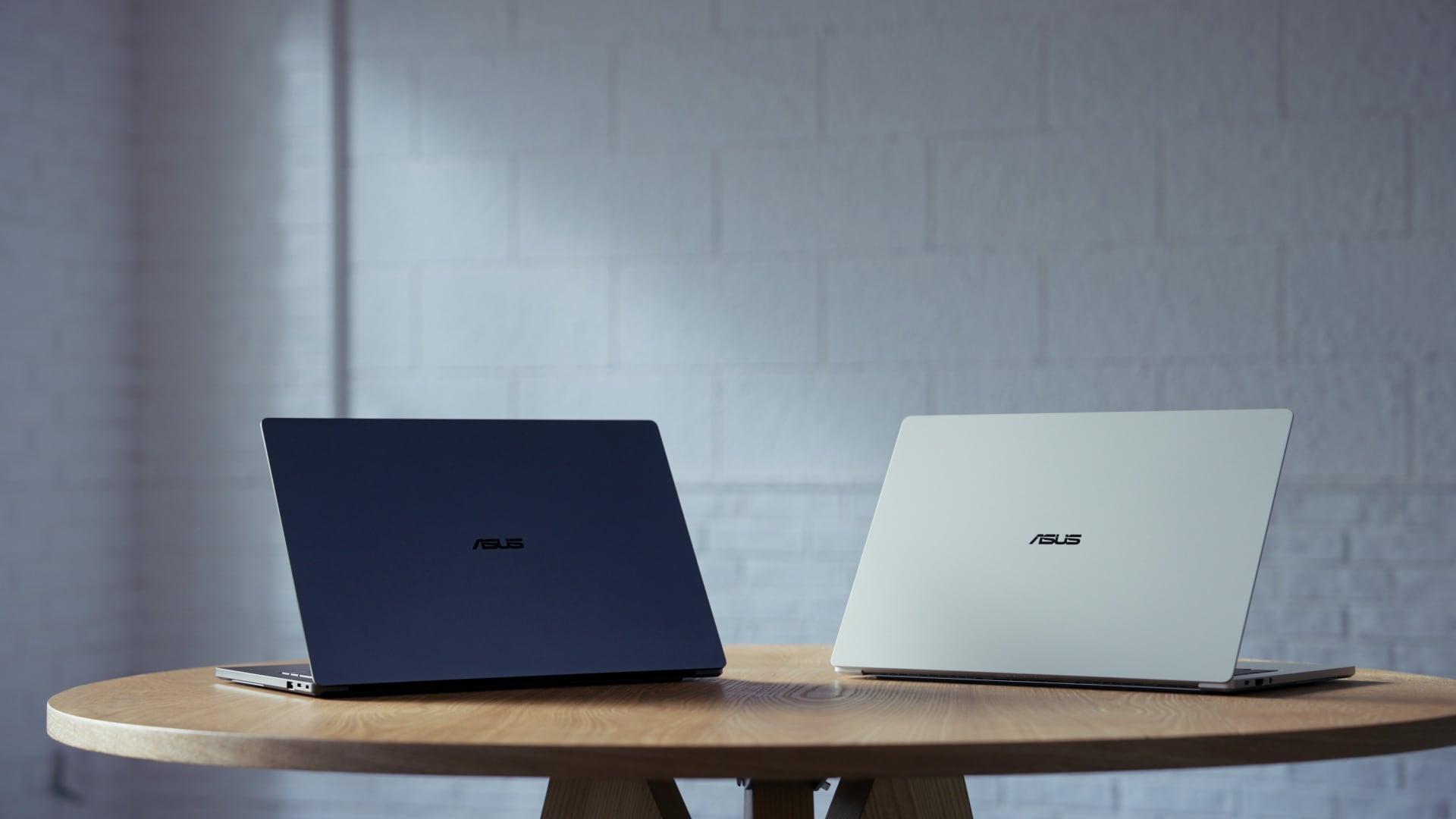
Asus has built the Zenbook 14 using its Ceraluminum material, and after having used a similar ceramic-style finish on the ExpertBook Ultra, I am completely sold on it. The Arctic Blue chassis looks gorgeous in person, with a smooth matte texture that feels fantastic in the hands while giving the laptop a clean and classy look.

More importantly, it stays that way. I have handled the Zenbook rather carelessly throughout testing, grabbing it by the lid, carrying it around with one hand and generally not worrying about where my fingers land, and the chassis refuses to collect fingerprints or ugly smudges. It doesn’t seem particularly susceptible to scratches either. Compared to the cold metal and fingerprint-prone finishes you find on plenty of premium laptops, Ceraluminum has quickly become my favourite material on a notebook.

It also helps that the Zenbook 14 is incredibly light. At around 1.1kg, it almost disappears in a backpack and the compact 14” footprint makes it effortless to pick up and move around with one hand. If I had better finger dexterity, I am fairly certain I could spin the entire thing around on one finger.

Thankfully, the lightweight construction hasn’t resulted in a flimsy chassis. The body feels rigid, with no noticeable flex around the keyboard deck or palm rest, and the lid is equally solid. The hinge is excellent, allowing the screen to be opened smoothly with one finger and then staying firmly in position without wobbling around while typing.

The keyboard might be my second favourite thing about the laptop. The keys are well spaced, have a nice amount of travel and snappy rebound that makes typing feel quick and effortless. I can glide across the keyboard at speed without feeling like the keys are fighting against me, and there is a muted, poppy sound to every keystroke that is surprisingly pleasing if you care about these things as much as I do.

The keyboard has backlighting, though the implementation is fairly subtle. The lighting comes from underneath the keys rather than brightly shining through the legends so it doesn’t look particularly impressive in a well-lit room. In the dark, however, there is enough of a glow to make every key easy to read without lighting up the entire desk, which is perfectly fine by me.
Unfortunately, the trackpad feels like it belongs on an entirely different laptop.

On the surface, nothing seems immediately wrong with it. It is large, smooth and provides plenty of room for gestures. But the tracking never feels quite accurate enough, particularly for fine cursor movement, and I never feel completely confident using it. Dragging items around or selecting something small can quickly become more frustrating than it needs to be.
It also uses a traditional mechanical diving-board mechanism rather than a haptic setup, which means only the lower portion of the surface can be comfortably clicked. After using the excellent haptic feedback found on better Windows laptops and MacBooks, this feels dated. It is easily the weakest part of an otherwise polished machine, and feels like the one obvious area where the Zenbook 14 falls below its premium aspirations.


Connectivity is thankfully less controversial. You get two USB-C ports, a full-sized HDMI output, USB-A and a 3.5mm headphone jack, which is enough for the kind of everyday productivity this laptop is designed for. I would have liked the USB-C ports to be spread across both sides for easier charging depending on where you are sitting, but otherwise there isn’t much to complain about here.


The 14” OLED display is also good, albeit with one obvious caveat. At 1920×1200, it is sharp enough at this size, with vibrant colours, excellent contrast, and the inky blacks you expect from an OLED panel. It makes browsing, watching videos and general desktop use look great without needing much adjustment.
But it is only 60Hz, and at AED 4,999, that is disappointing. If you are used to 120Hz or faster displays, the difference is immediately noticeable when scrolling through webpages, moving windows around or just navigating Windows. It doesn’t make the display bad by any means, but it does take some of the sheen off a laptop that otherwise feels so premium.

The down-firing speakers are perfectly serviceable for casual use. They don’t get particularly loud, and there isn’t much bass to speak of, but voices remain clear, and there is enough detail for YouTube videos, meetings or watching something casually without reaching for headphones.

The webcam follows a similar pattern. Image quality is decent, colours are reasonably balanced, and there is enough clarity to get through video calls without looking like you are communicating from a security camera. It isn’t anything spectacular, but for meetings and regular calls, it gets the job done.
How Does the Snapdragon X Perform in the Zenbook 14?
The Snapdragon X X1-26-100 is Qualcomm’s entry-level laptop processor, and the benchmark numbers are modest enough to make that fairly obvious. But after using the Zenbook 14 for regular work, I don’t think the numbers tell the full story.
Benchmarks
ASUS Zenbook 14 (UX3480QA, Qualcomm)
Geekbench
3DMark
In Geekbench 7, the Snapdragon X posted a Single-Core score of 1,855 and a Multi-Core score of 11,304, while the Adreno GPU managed 9,024 in the OpenCL test. Geekbench AI returned a Quantized score of 5,203.
3DMark paints a clearer picture of where the hardware sits, particularly on the graphics side. The Zenbook scored 224 in Steel Nomad, 1,081 in Steel Nomad Light, 6,104 in Solar Bay and 11,831 in Wild Life.
Those are not particularly impressive GPU numbers. For some perspective, the Acer Aspire 14 I reviewed recently, which uses an Intel Core Ultra 7 155U and costs AED 3,699, scored 1,162 in Steel Nomad Light. That puts the Snapdragon’s Adreno GPU roughly in the same performance bracket — although the Zenbook 14 is a far better device than that.

The comparison gets far less flattering when you look at the MacBook Air M5. My 15” M5 review unit scored 5,019 in the same Steel Nomad Light benchmark, more than 4.5 times the Zenbook’s result. The two machines obviously target slightly different users and run entirely different operating systems, but with the 13” MacBook Air M5 with 16GB of memory and a 512GB SSD now priced at AED 5,499, that performance gap becomes difficult to ignore when the Asus costs only AED 500 less.
I haven’t directly compared the CPU results between the two because the MacBook Air M5 was tested using Geekbench 6, while the Zenbook was benchmarked with Geekbench 7, and scores between major versions are not directly comparable. But based on the broader benchmark picture, the M5 clearly operates in a much higher performance class.
None of this means the Zenbook 14 feels slow, though. Quite the opposite, actually.
For everyday use, the Snapdragon X has been perfectly fine. Browsing with plenty of tabs open, chatting, writing, watching videos, jumping between apps and doing some light image editing never made the laptop feel like it was struggling (the slight sluggishness only came from the 60Hz screen). Applications open quickly, Windows remains responsive and multitasking between lighter workloads feels smooth enough that I rarely thought about the processor inside.
That is probably the right way to look at the Snapdragon X. It has enough CPU performance for the sort of short, bursty workloads most people perform on an ultraportable laptop, and if your routine primarily consists of web apps, Office, emails, streaming and light editing, there is little here that will hold you back.
Windows on ARM has also been far less of a concern than I expected. Every application I normally use has installed and worked without complaint, and during regular use I have never really had to think about whether something is running natively on ARM or through Windows’ translation layer. Your experience could obviously differ with more specialised applications or hardware utilities, but for my workload, compatibility has been a non-issue.
The Snapdragon starts to run out of road with anything considerably heavier. Large video renders, complicated creative workloads, 3D work and other sustained CPU- or GPU-intensive tasks are not what this processor is built for. It will probably get through lighter versions of those workloads, but at AED 4,999 there are considerably faster machines available if performance matters to you.

Gaming falls into the same category. The Adreno GPU is powerful enough to handle Windows, media acceleration and lighter graphical workloads without issue, but the Steel Nomad results make it clear that modern gaming is well outside its comfort zone. Older games, indie titles and less demanding releases should be possible at reduced settings, but I wouldn’t buy the Zenbook 14 hoping to game on it.
The laptop handles all of this without much drama thermally. The chassis gets warm during sustained benchmarks but never alarmingly so, and while the internal fans do spin up, they are remarkably quiet. I could only really hear their faint buzz by putting my ear close to the laptop.
So while the Snapdragon X X1-26-100 is certainly not a performance monster, I also wouldn’t call it underpowered for what the Zenbook 14 is trying to be. For basic productivity, browsing, entertainment and lighter creative workloads, it delivers all the performance most people will realistically need.
The bigger problem is value. At AED 4,999, being merely “fast enough” becomes harder to celebrate when another AED 500 puts you within reach of a MacBook Air M5 that offers substantially more performance headroom. The Zenbook’s appeal lies far more in its excellent chassis, portability, OLED display, ports, and efficiency than in the power sitting underneath it.
How Long Does the Zenbook 14’s Battery Last?
Battery life on the Zenbook 14 is good, although I expected a little more from a Snapdragon-powered laptop.
The laptop uses a relatively small 50Wh battery, and in my regular use I was getting around 6-7 hours from a charge with light to medium workloads. That mostly involved browsing with multiple tabs open, writing, chatting, watching videos and jumping between applications throughout the day.
That is enough to get through most of a working day, especially if the laptop spends some time sitting idle between sessions, but I was expecting something closer to 9-12 hours considering how heavily Qualcomm has pushed power efficiency as one of Snapdragon X’s strengths.
For comparison, the MacBook Air M5 managed around 11-12 hours under my usual mixed workload. Considering the 13” M5 Air now costs only AED 500 more than this Zenbook configuration, the difference in endurance adds another wrinkle to the value proposition.

The Zenbook fares much better in standby behaviour. Closing the lid barely seems to drain the battery, even when the laptop sits unused for extended periods, and opening it brings Windows back instantly. It is one of the areas where the Snapdragon platform gets remarkably close to the MacBook experience, and makes the laptop particularly nice to live with when you are constantly opening and closing it throughout the day.
Charging is handled over USB-C using the included compact 68W adapter. Asus claims the battery can reach 50% in around 30 minutes, which makes topping it up during a lunch break or between meetings relatively painless. Since it uses standard USB-C charging, you can use the same adapter for other compatible devices, so you don’t necessarily need to carry multiple chargers while travelling.

Should You Buy the Asus Zenbook 14 (UX3480QA)?
The Asus Zenbook 14 gets so many important things right that it’s hard not to like. The real problem is the AED 4,999 price. At that point, the Zenbook sits uncomfortably close to the 13” MacBook Air M5 at AED 5,499, which offers considerably stronger performance and better battery life. Asus does have some meaningful advantages, including the OLED display, nicer port selection, and, in my opinion, a more pleasant chassis material, but the performance gap is hard to ignore when only AED 500 separates the two.
- You want a 14-inch laptop light enough, at around 1.1kg, to carry everywhere without noticing it.
- Build quality matters to you, and you want a finish that shrugs off fingerprints and smudges.
- Your day is mostly browsing, Office, email, streaming and light photo editing.
- You type a lot and want a comfortable, satisfying keyboard.
- You are used to a 120Hz display and would notice the drop to 60Hz.
- You need performance for video rendering, 3D work or modern games.
- You rely on precise trackpad control or prefer a haptic touchpad.
- Performance per dirham is your top priority at this price.
Asus Zenbook 14 FAQs
How much does the Asus Zenbook 14 (UX3480QA) cost in the UAE?
The configuration we reviewed, with the Snapdragon X X1-26-100, 16GB of RAM and a 512GB SSD, costs AED 4,999.
Does the Zenbook 14 have a 120Hz display?
No. The model we tested uses a 14-inch 1920×1200 OLED panel that runs at 60Hz. Colours and contrast are excellent, but scrolling is noticeably less smooth than on 120Hz screens.
Do apps work properly on the Snapdragon Zenbook 14?
In our testing, every everyday application installed and ran without issues on Windows on ARM. Specialised software and hardware utilities may still be hit and miss, so check compatibility if you rely on niche tools.
Can you game on the Asus Zenbook 14?
Only lightly. Older games, indie titles and less demanding releases should run at reduced settings, but modern games are well beyond what the Adreno GPU can handle.
How fast does the Zenbook 14 charge?
It ships with a compact 68W USB-C adapter, and Asus claims the battery can reach 50% in around 30 minutes.