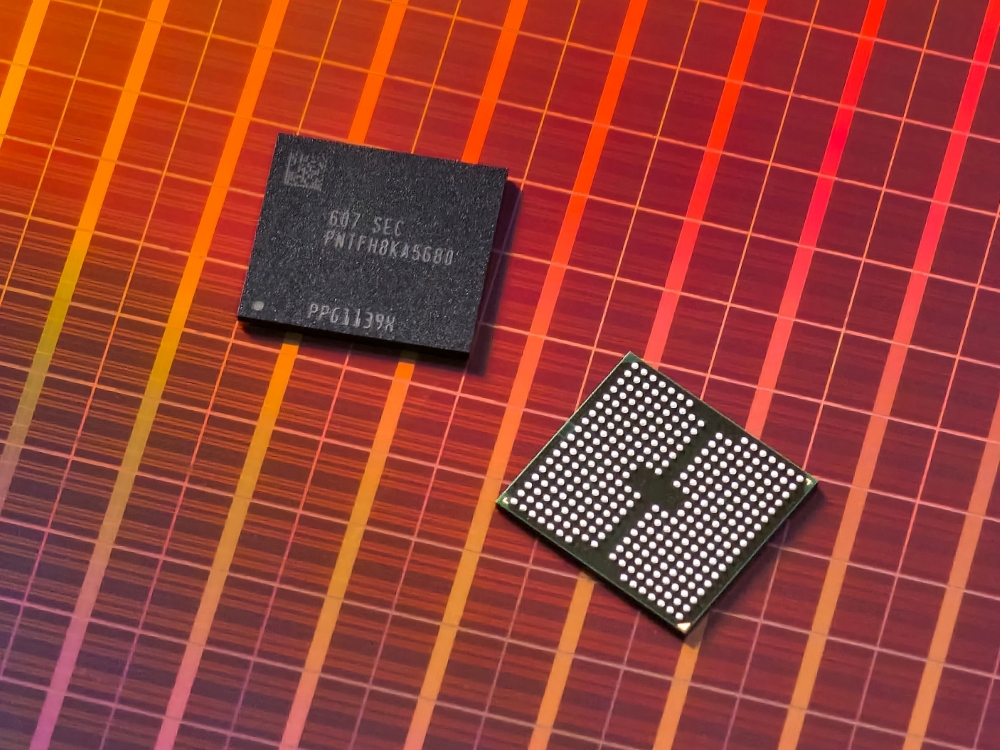
Samsung has used the Future of Memory and Storage (FMS) 2026 expo in Santa Clara to lay out its AI memory roadmap, led by the first concept models of its zHBM and zNAND-O chips and the LPDDR5X-PIM, which Samsung calls the industry’s first LPDDR memory with processing built in. Its booth held roughly 30 memory and storage technologies, and the message underneath them was consistent: the next bottleneck in AI is not raw compute, it is the speed at which data reaches the processor.
zNAND-O: NAND for the edge
zNAND-O is a high-performance NAND concept built on Samsung’s V-NAND technology, in development in four- and eight-layer versions. Samsung says it combines high space efficiency, faster I/O and low latency for edge AI — devices doing the AI work on the spot instead of phoning a data centre. SamMobile notes the compact layout could suit laptops, phones and tablets, plus robotics. It remains a concept model, so file the phone-and-robot talk under ambition rather than spec.
Samsung also used the show to introduce V10 BV-NAND, its wafer-bonded flash with more than 400 layers — a density gain of around 58% over the previous generation.
LPDDR5X-PIM: the RAM that does the maths
Samsung calls LPDDR5X-PIM the industry’s first LPDDR memory with processing-in-memory. The chip does its data processing internally, so the data never has to leave for the CPU and come back. The argument is simple: moving data is the expensive part, so stop moving it.
The same logic sits behind zHBM, a concept that stacks HBM directly on top of an AI accelerator rather than beside it. Samsung expects the interface to run around eight times faster than HBM5, with more than ten times the memory density and roughly triple the energy efficiency.
PM1763: the one actually shipping
The concepts get the attention; the PM1763 enterprise SSD is already in mass production. It runs PCIe 6.0 on 9th-generation V-NAND with a new 4nm controller, comes in 4TB, 8TB and 16TB sizes, and the 16TB model manages sequential reads of 28,400MB/s and writes of 21,900MB/s — more than double its PM1753 predecessor. It is also built for liquid-cooled servers, direct-to-chip, for the AI racks that now ship with plumbing.
The BM1773 covers the high-capacity end of the range.
“Built on industry-leading performance, PM1763 has successfully completed validation for next-generation AI platforms and is well positioned to support evolving AI infrastructure requirements.”
— Jangseok Choi, vice president and head of memory product planning at Samsung
The one-stop shop for AI memory chips
Samsung’s closing argument at FMS was about its own structure: it says it is the world’s only company that designs and manufactures memory and storage while also offering contract chip manufacturing on advanced nodes, 4nm and below. Memory, logic, foundry, packaging — one invoice. It is a fair point, and it is also a product pitch.
None of this sits on a consumer shelf yet; these are data-centre parts. But the context is familiar to anyone who has watched RAM and SSD prices climb through 2026. Samsung’s memory business is booming — it says 2026 profit will beat 40 years of chip earnings combined — its workers have been striking for a cut of the boom, and the shortage has already dragged the phone market to 2013 levels. For now, the only one of these you can actually buy, if you operate a data centre, is the PM1763.
What is processing-in-memory (PIM)?
Processing-in-memory moves the computing into the memory chip itself. Instead of shipping data to the CPU and back, the memory does the work where the data lives, cutting both the time data spends in transit and the energy used to move it. Samsung’s LPDDR5X-PIM is the first LPDDR memory to do this.
When will Samsung’s zHBM and zNAND-O chips be available?
No dates. Both were shown as concept models at FMS 2026, which is Samsung signalling its roadmap rather than launching products. The PM1763 enterprise SSD is the exception — it entered mass production in July 2026 and is already shipping to server customers.
Why is memory suddenly the bottleneck in AI?
AI models have grown so large that moving data between memory and processor now dominates the cost and time of each training run. Samsung’s answer is either to move less data (LPDDR5X-PIM) or to put memory closer to the processor (zHBM). Rising demand from AI data centres is also why memory prices have climbed through 2026.