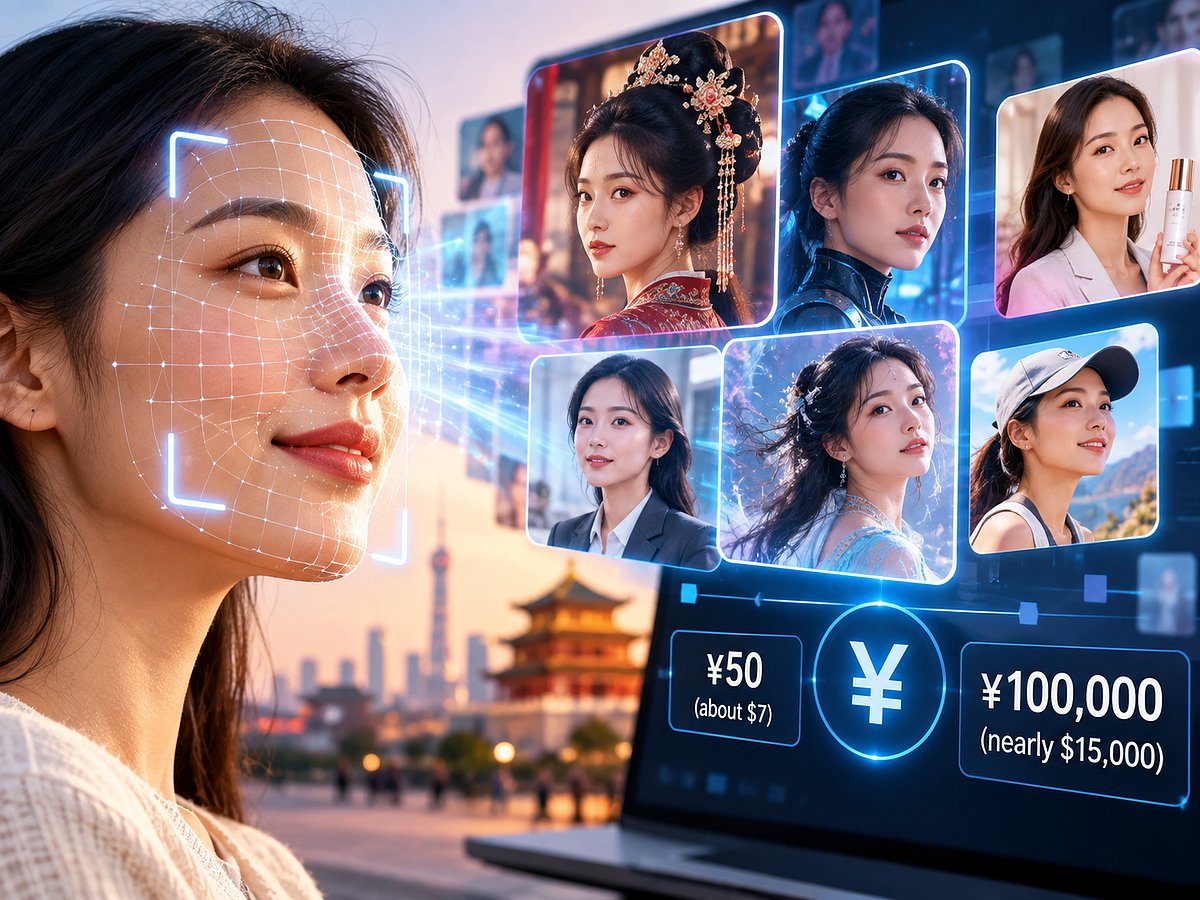
China’s AI boom is turning ordinary faces into licensable digital actors. Platforms are connecting people willing to authorise their likenesses with producers making AI-generated short dramas, adverts, games and other virtual content.

Reporting by South China Morning Post says advertised fees range from 50 yuan (about US$7) to 100,000 yuan (nearly US$15,000). The top figure is an advertised ceiling, not a typical payout. One 27-year-old bank employee reportedly earned about 2,600 yuan after his portrait was licensed seven times in three days.
How AI face licensing in China works
A contributor uploads images or other reference material and sets terms for permitted uses. A buyer can then generate a character that resembles the contributor without booking that person for every scene. Clothing, dialogue, movement and setting can be changed digitally, making a single likeness more reusable than a conventional stock photograph.
The economics vary sharply. Digital Trends, citing Rest of World, reports payments of about US$15 to US$700 through platforms such as ActID and New Claw. ActID reportedly had around 800 users, including roughly 300 licensing their likenesses, while creators paid 99 to 500 yuan per episode.
China’s micro-drama output helps explain the demand. China News Service reported that more than 90% of 430,000 online micro-dramas released in the first eight months of 2026 were AI-generated. Platforms must obtain authorisation to use likenesses and voices, and AI dramas must carry labels.
The contract matters more than the headline fee
Licensing a face is not the same as selling a one-off photograph. Agreements need to specify the duration, territories, characters, genres, editing rights, sublicensing and whether the buyer can train another model on the material. They should also address takedowns and what happens when the deal ends.
Control is difficult once a likeness escapes the platform. Digital Trends notes about 700 related Guangzhou Internet Court disputes. See Tbreak’s coverage of AI likeness rights and celebrity AI misuse.
Sources
- Gulf News report on China’s face-licensing market
- Digital Trends on AI faces becoming stock assets
- China News Service on AI-generated micro-dramas
AI face licensing in China is growing because producers need recognisable digital characters at scale. The market is still young, and advertised prices should not be treated as standard earnings.
How much can people earn from AI face licensing in China?
Reported and advertised fees range from 50 yuan to 100,000 yuan, while other platforms have reported payments of about US$15 to US$700 per deal or episode.
What should an AI face-licensing contract cover?
It should define the duration, territory, permitted content, editing and training rights, sublicensing, reuse, takedowns and what happens when the licence ends.
Why is demand for licensed faces growing in China?
China’s rapidly expanding AI-generated micro-drama market needs recognisable digital characters that producers can use without having to book a performer for every scene.