What does the Mirror’s Edge DLSS mod change?
The mod adds modern Nvidia image reconstruction and Frame Generation to Mirror’s Edge without replacing the game’s lighting, assets, or rasterised rendering. Modder softsoundd achieved this through an NGX passthrough version of the existing Mirror’s Edge RTX Remix runtime.
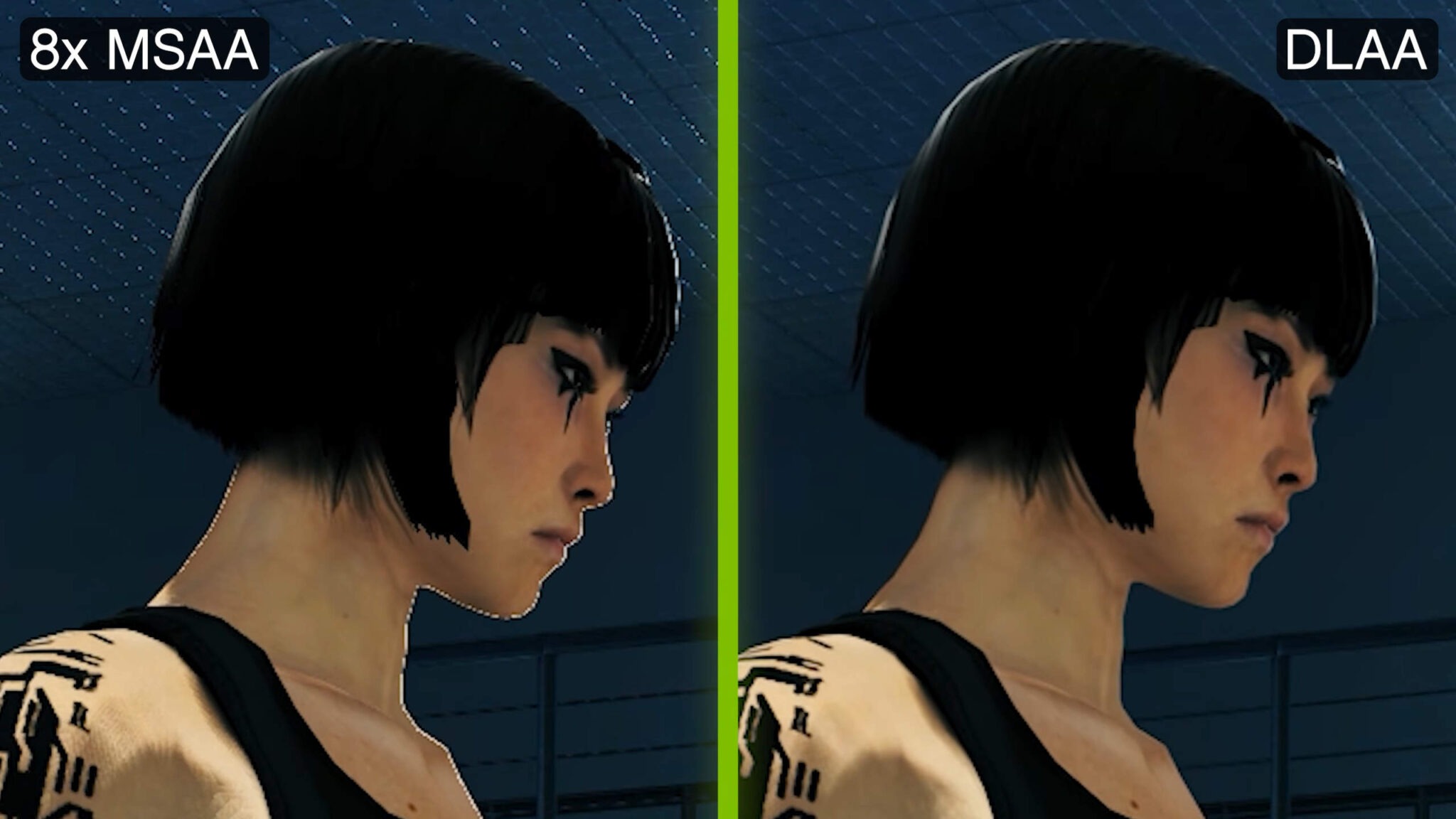
As reported by VideoCardz, the branch bypasses the standard ray-tracing behaviour associated with RTX Remix. The game’s original DirectX 9 output instead passes through Nvidia’s NGX framework, enabling DLSS Super Resolution, DLAA, and DLSS Frame Generation.
The technical work goes beyond adding a menu option. DLSS needs motion vectors describing how objects move between frames, but Mirror’s Edge did not originally provide them. Softsoundd’s runtime generates that data so the reconstruction and Frame Generation systems can function within an Unreal Engine 3 game.
DLSS Super Resolution reconstructs a higher-resolution image from a lower internal resolution, while DLAA applies the same neural-network approach at native resolution to improve anti-aliasing. Frame Generation uses motion data to insert additional frames between those rendered conventionally, increasing the displayed frame rate.
Why is DLSS arriving 17 years after the PC release?
Mirror’s Edge predates DLSS by roughly a decade, making this a retrofit rather than the restoration of an unused feature. The console versions launched on 11 November 2008, followed by the North American PC release on 13 January 2009 and a wider retail release on 16 January.
The Unreal Engine 3 game used DirectX 9 and conventional rasterisation, with the PC edition adding Nvidia PhysX effects for enhanced physics interactions and environmental debris. Its anti-aliasing came through traditional options such as MSAA rather than AI reconstruction.
Nvidia announced DLSS support for GeForce RTX in September 2018, and the technology appeared in shipping games including Battlefield V in February 2019. Frame Generation arrived through later DLSS iterations, so neither technology existed when Mirror’s Edge was built.
The more interesting industry angle is how RTX Remix is being repurposed. It is commonly associated with path-traced remasters and replacement assets, but this project uses its runtime as a bridge between an older DirectX game and Nvidia’s newer image-processing framework. The result keeps the original art and lighting intact while changing how frames are reconstructed and generated.
How do you install the mod, and what are its limits?
The free v1-NGX package is installed by copying the contents of the RTX_Remix_NGX_Passthrough folder into the game’s Binaries directory. Players need the PC version of Mirror’s Edge and compatible hardware for the Nvidia features.
The files and installation directions are available from softsoundd’s v1-NGX GitHub release. This is a third-party community project with no indicated involvement from EA or DICE, so it should not be treated as an official game update.
Softsoundd says the passthrough runtime worked with several other Unreal Engine 3 games during limited testing. Full compatibility is not guaranteed, although the branch could serve as a technical starting point for bringing NGX features to more older games. It also supports upscaling options from other vendors exposed through RTX Remix.
For Mirror’s Edge itself, the scope is tightly defined: modern anti-aliasing, upscaling, and generated frames layered over the original raster image. Path tracing and asset replacement remain outside this branch.