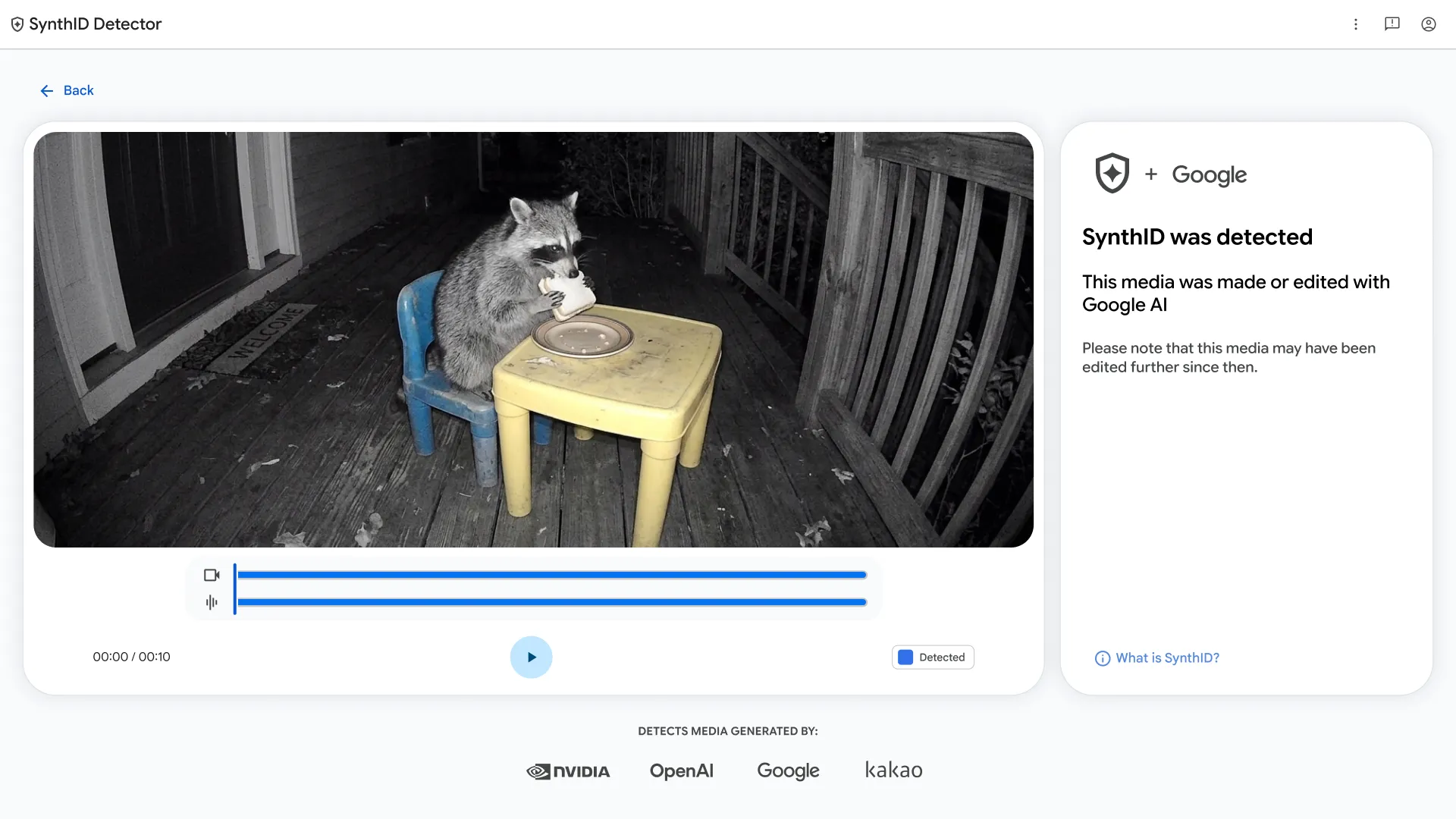
Google has opened its SynthID Detector to the public. The tool, now live at synthid.com, checks whether an image, video or audio file carries an invisible SynthID watermark, and it’s available globally in English from today, so UAE users can try it too.
According to Google, the detector now recognises watermarks from its SynthID partners as well as its own, so files made with tools from OpenAI, NVIDIA and Kakao should register, with Apple support coming “soon”. Before this, checking for SynthID usually meant asking Gemini, which only spots Google’s own marks, while OpenAI’s checker only covers OpenAI content.
What it checks and how
SynthID hides a signal in the pixels of AI images and video and in the waveform of AI audio. Google says it has now watermarked over 180 billion images and videos, plus 240,000 years of audio. Its Nano Banana, Veo and Lyria models all apply it, as do apps such as Gemini, Flow, ProducerAI and Vids, reports TechCrunch.
Using it is simple: upload a file and the site returns a verdict on whether SynthID was detected and which partner’s tools made or edited it. Per Ars Technica, the public site gives a plain yes or no rather than the region-by-region highlighting that journalists and researchers saw in the early version, which Google first showed at I/O in 2025.
| Media type | Supported formats |
|---|---|
| Images | JPG, JPEG, PNG, BMP, WEBP, AVIF, HEIC, HEIF, TIFF, TIF, GIF |
| Video | MP4, MOV, WEBM |
| Audio | WAV, MP3, OGG, FLAC, AAC, M4A |
There’s no text option on the public site, even though SynthID also covers Gemini text.
Sign-in and daily limits
You’ll need a Google, Apple or OpenAI account to use it. Google told Ars that each user gets “a daily usage quota of approximately 10 image, video, and audio checks”. Engineers said the cap exists to stop people from using the detector to train watermark-removal tools, and the vague figure suggests the system may cut you off earlier if you keep uploading near-identical files.

Google already builds SynthID checks into Search, the Gemini app and Chrome, and says those features now handle over 1 million verification requests a day. The new site gives anyone a single place to check files without going through a chatbot.
What it can’t tell you
A negative result doesn’t mean a file is real. The site itself says it isn’t a general AI detector: it can only spot content from companies that have adopted SynthID. Meta and Microsoft use their own watermarking systems, and open-weight models running on home hardware often add no label at all. The result page also warns that a file may have been edited further after the watermark was applied.
Watermarks only help if they survive, and Ars notes someone may eventually find a way to remove SynthID. Google already lets Gemini users turn off the visible AI watermark while keeping the invisible one, which puts more weight on detectors like this. Anthropic has gone further, with Claude watermarking all its AI text and images with no opt-out.
Audio is where a checker could earn its keep. Google’s own Gemini 3.8 Flash TTS can clone a voice from 30 seconds of speech, and voice scams rarely announce themselves. A SynthID hit is strong evidence a clip came from a partner’s AI; a miss tells you little.
Is SynthID Detector free?
Yes. Anyone can use it at synthid.com after signing in with a Google, Apple or OpenAI account, with a daily quota of roughly 10 checks.
Can it detect any AI-generated image?
No. It only finds SynthID watermarks from Google and partners such as OpenAI, NVIDIA and Kakao, with Apple to follow. Content from Meta, Microsoft or unwatermarked open models won’t be flagged.
Is it available in the UAE?
Google says the tool is available globally in English, so it works from the UAE, though only in English for now.