du, one of the UAE’s two telecom operators, has published its first whitepaper: The Intelligence Network: A 6G Blueprint for Telcos, written with Khalifa University’s Digital Future Institute. The paper is backed by upper 6 GHz field trials on live 5G macro sites in Mohamed Bin Zayed City, Abu Dhabi, which reached outdoor coverage of 500 metres and peak downlink speeds approaching 1.5 Gbps on existing infrastructure.
du launched in January 2006. Twenty years on, this is its first whitepaper. The argument is that networks must stop being infrastructure that connects and become infrastructure that understands — sensing, predicting, deciding and acting on their own.
The blueprint leans on the vocabulary of the moment — intent-based orchestration, network digital twins, telecom world models — and recasts the radio access network as the network’s centre of intelligence rather than a plain transmission layer. That intelligence is meant to be sold: the paper lists AI-run operations, enterprise digital twins, autonomous AI agents and outcome-based service guarantees as revenue streams.
Upper 6 GHz — the 6425–7125 MHz band the industry calls golden spectrum — carries more capacity than today’s sub-6 GHz bands while covering far more ground than millimetre-wave. The UAE already runs the world’s first commercial deployment of it, announced by the TDRA in April, with du among the operators. du’s trials show the band working on the macro sites it already operates, with no new masts required.
The urgency is in the data the paper cites: mobile data traffic is expected to more than triple by 2030 against modest revenue growth, per the GSMA Mobile Economy Report 2024. Operators need something new to sell, and du’s answer is network intelligence itself — the same agentic AI territory Dubai startups are already circling.
“The next decade of telecom will be defined by how much intelligence they can deliver. Networks must evolve from infrastructure that connects to infrastructure that understands the needs of our customers and the wider economy. Our upper 6 GHz field results show that this future is not theoretical. It is being built today, on our existing network.”
— Fahad Al Hassawi, chief executive of du
du is betting that 6G arrives as an upgrade to the network it already runs, not a rebuild.
“Advancing next-generation technologies requires deep collaboration between academia and industry. Through this partnership with du, Khalifa University is translating world-class research into practical solutions that help shape the future of intelligent telecommunications.”
— Professor Ebrahim Al Hajri, president of Khalifa University
The university supplies the research; du supplies the live network to test it on.
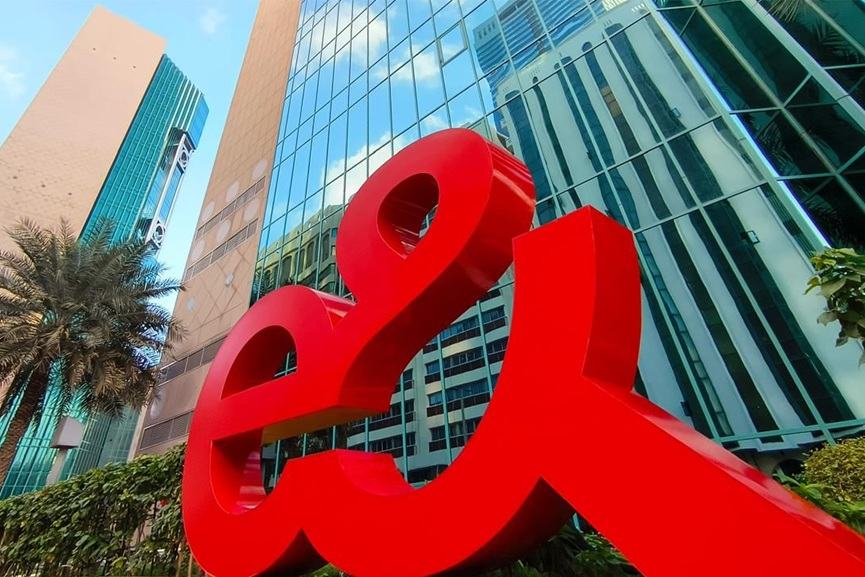
The release calls the whitepaper the region’s first AI-native 6G blueprint. In March, e& and Khalifa University published one of their own, titled 6G AI-Native Networks: Architecture, Intelligence, and the Path to Autonomous Connectivity. The UAE’s two operators now hold matching 6G roadmaps from the same academic partner. Commercial 6G is generally expected around 2030; the whitepapers, clearly, could not wait.
What 6G means for the UAE
6G itself is years away; the spectrum is not. Upper 6 GHz has been commercially live in the UAE since the TDRA’s world-first launch in April, and du’s trial suggests it performs on ordinary macro sites. For businesses, the nearer-term shift is the services layer: du plans to sell network intelligence to enterprises — operations digital twins, AI agents running network chores — well before any 6G device ships.
The country’s 5G already ranks in the global top tier in Ookla’s AI benchmarks, so the base du is upgrading from is not a bad one. Its consumer side is more concerned with summer roaming bundles.
What is the upper 6 GHz band and why does it matter for 6G?
Upper 6 GHz covers 6425-7125 MHz – 700 MHz of contiguous mid-band spectrum. It offers more capacity than today’s sub-6 GHz bands while covering far more ground than millimetre-wave, which is why the industry calls it golden spectrum. The UAE’s TDRA allocated the band in 2024 and announced the world’s first commercial deployment in April 2026.
What does AI-native mean in a 6G network?
An AI-native network treats intelligence as a foundation rather than an add-on: the network senses, predicts, decides and acts in real time, using intent-based orchestration and network digital twins. du’s blueprint describes operators evolving from connectivity providers into intelligence infrastructure providers.
When will 6G be available in the UAE?
Commercial 6G is generally expected around 2030, after standards work in ITU-R IMT-2030 and 3GPP Release 21 and beyond. The upper 6 GHz spectrum that will carry it is already live in the UAE, and both du and e& are positioning for the network itself.