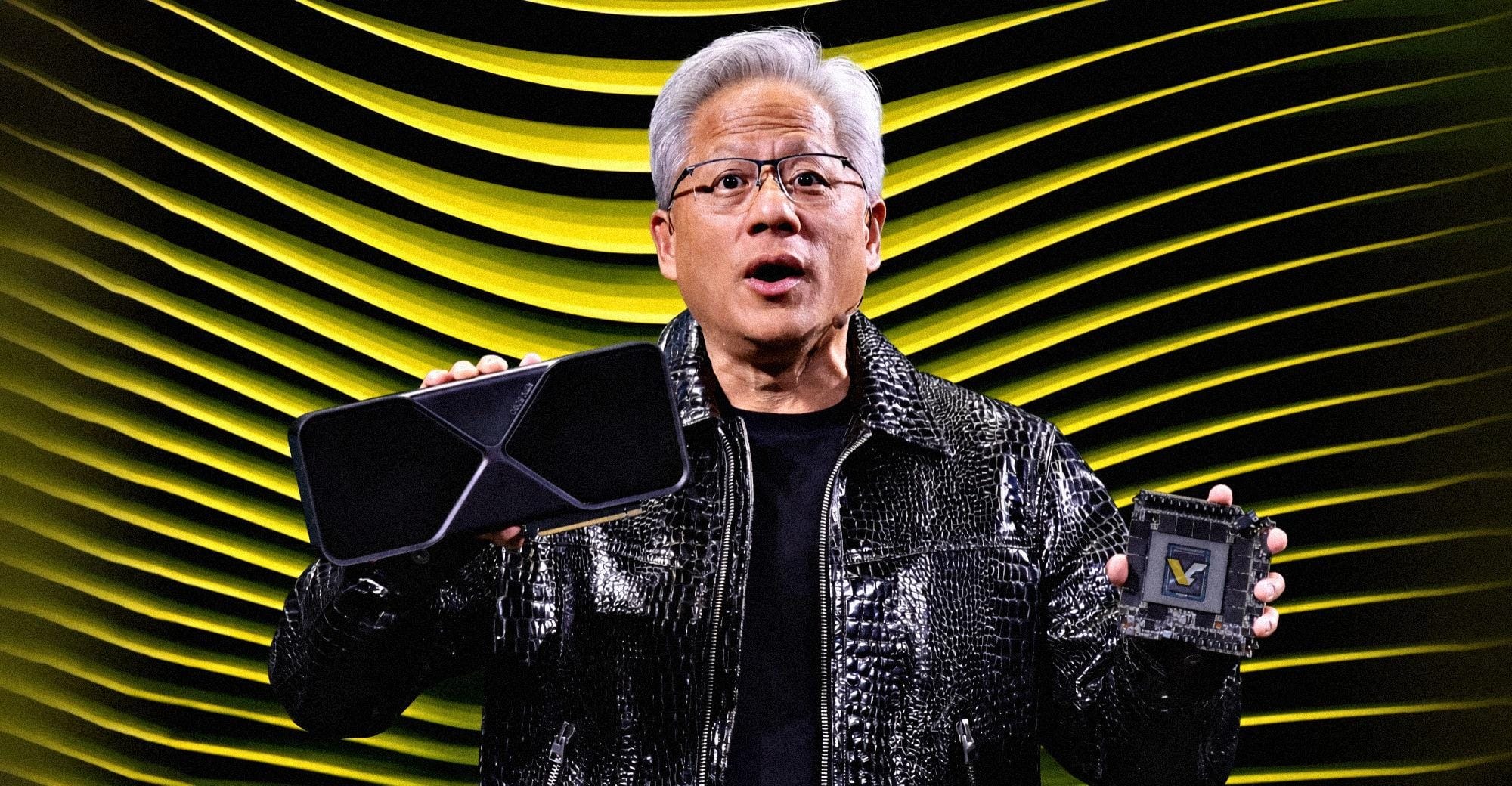
Buried inside two hours of chips, racks and humanoid robots at Computex 2026 was a much simpler claim from Jensen Huang: the way you use a computer is about to change completely. Instead of opening apps and clicking around, you’ll tell an AI agent what you want, and it’ll go and do it for you.
Nvidia calls this “agentic AI,” and the entire keynote was built on the idea that it has finally arrived. Here’s what that actually means, stripped of the stagecraft.
What Jensen actually means by “agent”
In the old world, software was an application: code running inside an operating system, waiting for you to click and type. Huang’s “agent” flips that around. An agent is a large language model — the brain — sitting inside what Nvidia calls a harness — the body — that lets it observe a problem, reason about it, make a plan, and then use tools to get it done.
Those tools are ordinary things: a spreadsheet, a web browser, a database, a 3D modeller. The difference is you’re no longer the one operating them. You describe your intent, and the agent does the clicking.
The demos made it concrete. One prompt turned a written description into an animated graphic. Another took a photo of a broken remote-control battery clip and produced a 3D-printable CAD file to replace it. No menus, no tutorials — just a request and a result.
The proof, apparently, is on GitHub
Huang’s evidence that this is real rather than a demo-day fantasy came from coding. He pointed at GitHub activity: roughly 300 million code commits in 2023, 400 million in 2024, 500 million in early 2025 — and then nearly triple that in the first months of 2026.
His reading is that AI coding tools, including Claude Code and Codex, have made developers dramatically more productive, and that the output is showing up as a flood of new code. Take it with the usual pinch of salt — commit counts measure activity, not necessarily value — but the trend line is hard to wave away.
So is AI coming for your job?
Huang’s answer was an emphatic no, and he made the bullish case that AI is creating more software jobs, not fewer. His logic: if one engineer armed with AI can produce far more valuable work, companies want to hire more of them, not fewer.
That’s a tidy argument with an obvious asterisk — it’s coming from the man selling the chips that power all of it, and it conveniently assumes demand for software is effectively bottomless. The honest position is that nobody knows yet. But it’s worth noting the most AI-bullish person in the room was arguing for more humans, not fewer.
Every company becomes an AI company
The bigger point is that Nvidia thinks this pattern — model, harness, tools, runtime — will run everywhere: in the cloud, inside companies, on your PC, in cars, in robots, even in mobile base stations. Same recipe, different box.
To get businesses building their own agents, Nvidia launched an Agent Toolkit for enterprises, including an open-source security layer called Open Shell that’s meant to keep an agent boxed in and behaving. The pitch to every company on earth is blunt: you’re going to run agents, so you may as well run them on Nvidia.
What this means for the rest of us
For now, mostly this: the language is changing before the products are. Expect “agent” to be stamped on everything for the next year, most of it marketing.
But the underlying shift is real enough to take seriously. The useful version — an assistant that actually completes a multi-step task rather than just chatting about it — is arriving, starting with coding and creative work. Whether your PC genuinely stops being an app launcher within a decade, as Huang predicts, is a much bigger bet. The sensible move is to start using the agentic tools that already work today, and stay sceptical of everything sold on a promise.