If the first half of Nvidia’s Computex keynote was about agents living inside your computer, the second half was about agents that get up and walk around. Jensen Huang spent a good chunk of stage time on what Nvidia calls physical AI — the same reasoning systems, except wired into cars, factories and humanoid robots.
It’s the part of the keynote most likely to feel like science fiction and least likely to land in your home this year. Here are the three announcements worth knowing about.
Cosmos 3: a brain for things that move
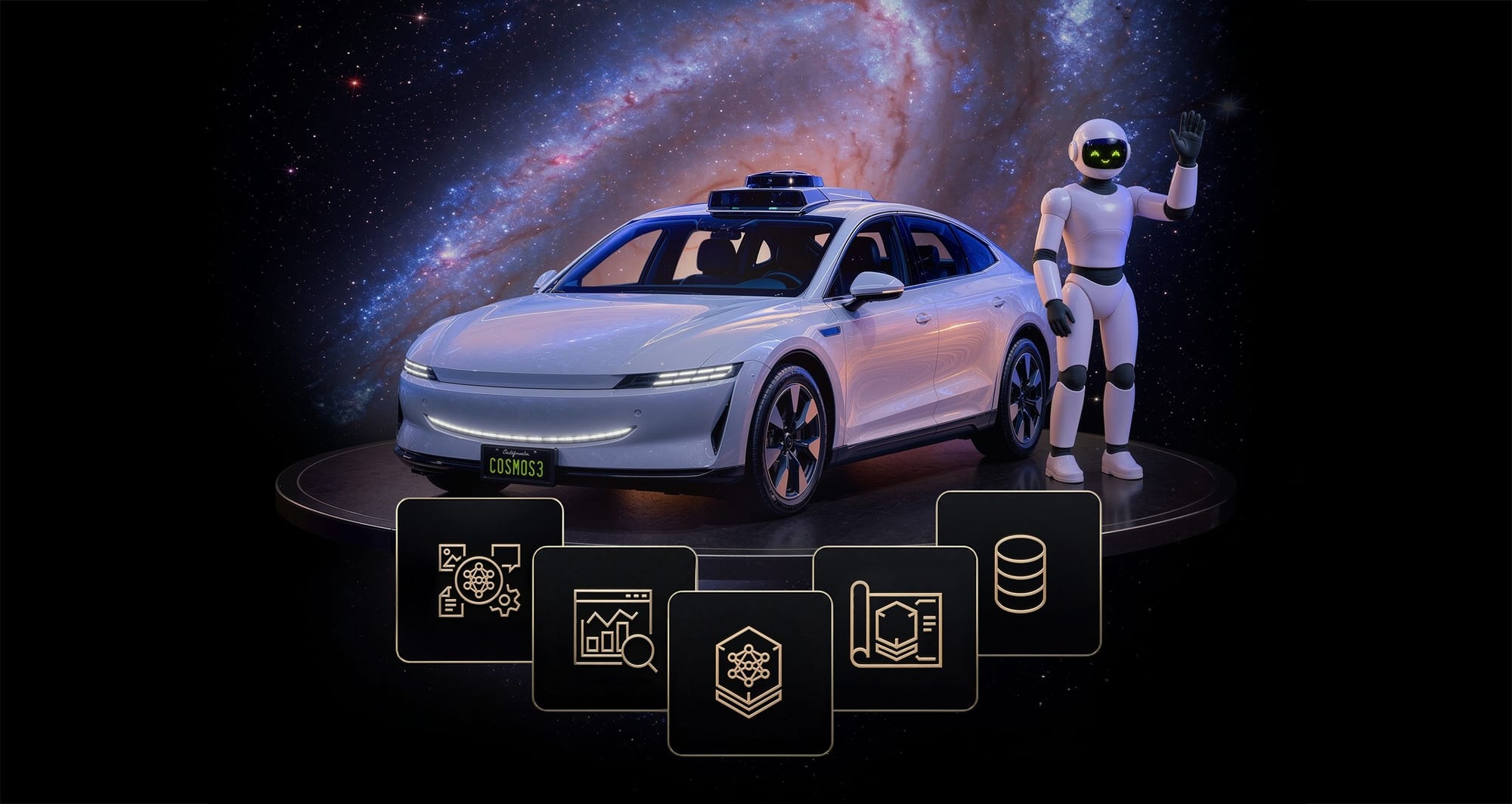
Cosmos 3 is the foundation Nvidia wants the entire robotics industry to build on. The problem it’s trying to solve is data: language models learned from the entire internet, but a robot needs to understand the physical world from its own point of view, and there simply isn’t enough first-person footage of doing the dishes to train on.
Cosmos 3 gets around that by generating its own. It can watch the world and describe what’s happening, imagine physically accurate video of what comes next, and act as a simulator to train other robots — effectively a teacher that manufactures the lessons. Like Nemotron, Nvidia is releasing it openly, model and training method included, so companies can bend it to their own machines.
Alpamayo 2: the car that talks itself through traffic
The flashiest physical-AI demo was Alpamayo 2, Nvidia’s open model for self-driving cars, which Huang billed as the world’s first reasoning autonomous vehicle. The pitch is that instead of a black box that simply steers, the car thinks out loud — and the demo had it narrating every decision in real time.

It was, frankly, exhausting to listen to: a constant monologue of “nudge left due to the stopped van,” “stop for the pedestrian crossing,” “yield to the cut-in vehicle.” Huang’s own line was the best summary — if you let it talk all the time, it’ll drive you mad, but the fact that it’s talking to itself is the point. That running commentary is the car reasoning through the scene rather than reacting blindly, and it means the car can explain why it did something, which matters enormously when regulators come asking.
Nvidia says its Hyperion platform already reaches manufacturers representing roughly 80% of the world’s cars, so this isn’t a fringe experiment — and yes, the demo car answered to “Hey Mercedes.”
Isaac Groot: a humanoid robot you can actually order
The robot itself was the showstopper. Nvidia unveiled Isaac Groot, a reference humanoid that’s roughly six feet tall, weighs about 150 pounds, and has 31 points of articulation across its body plus 25 in each hand. Huang noted it’s about his height, just heavier — make of that what you will.

The clever part isn’t the hardware so much as what comes with it. Building a humanoid normally means a team stitching together simulators, training pipelines and control software for months before any real research starts. Isaac Groot ships as a complete, open platform — robot plus the software stack to train and run it — aimed squarely at universities and research labs so they can skip the plumbing and get to the interesting work. It runs on Nvidia’s new Thor robotics chip.
The verdict
This is the genuinely long-horizon stuff. Cosmos 3 and Isaac Groot are tools for the people building robots, not products for your living room, and a self-driving car that lectures itself through every roundabout is still years from a UAE showroom.
But the through-line is worth noting: it’s the same reasoning approach Nvidia is putting in your PC, just pointed at the physical world. The robots and cars will take time. The bet underneath them — that machines are shifting from following instructions to reasoning through problems — is the same one running through everything else Nvidia showed. Worth watching, no need to clear space in the garage just yet.