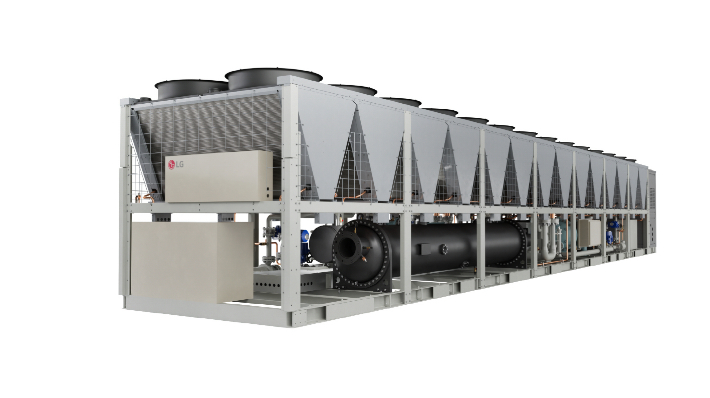
LG has launched a new air-cooled, oil-free turbo chiller for AI data centres, claiming more than 20% higher part-load efficiency than conventional inverter screw chillers and about 30% lower annual power use with free cooling. The LG AI data centre chiller is aimed at facilities where server heat, expansion speed and uptime are becoming equally awkward problems.
LG AI data centre chiller targets efficiency
The air-cooled oil-free inverter turbo chiller uses magnetic bearings to suspend the compressor shaft with electromagnetic force. LG says that removes mechanical friction and the need for oil pumps, piping, oil changes and filter maintenance. It also reduces the risk of oil films forming inside the heat exchanger and cutting cooling performance.
The system uses refrigerant free cooling when outdoor temperatures are low, allowing the refrigerant to circulate without running the compressor. LG says this can reduce annual power consumption by about 30% compared with water-based free-cooling systems. The chiller uses R-513A refrigerant, which has a global warming potential more than 50% lower than the R-134a used in older systems.

Modular cooling for data-centre expansion
The product also uses what LG calls hydronic modular technology. Pumps, valves and emergency buffer tanks are pre-installed in ISO-standard containers, which can be connected to the chiller on site. Operators can then add modules as server capacity grows instead of sizing the entire cooling system for a future that may take its time arriving.
DCD reports that the unit is available in 480–600 refrigeration tons per unit, although LG has not disclosed a heat-removal figure in the company statement. The product is part of a wider push into AI infrastructure: LG says it received NVIDIA quality certification in July for a 600kW cooling water distribution unit, supporting a chip-to-chiller approach that combines air and liquid cooling.
Machine learning watches the cooling loop
Machine learning monitors chilled-water flow and pressure for abnormal signs before they trigger a shutdown. During a power outage, the control system and buffer tank are designed to keep water circulating. LG says the chiller can recover 100% of its rated cooling capacity within 180 seconds after power is restored.
The launch arrives as Mubadala explores backing Japan’s biggest AI data centre and operators prepare for hotter, denser AI hardware. NVIDIA’s Rubin platform is also being designed around liquid cooling, so the market is moving towards several cooling methods rather than one universal answer.
LG has not announced a UAE price, customer or deployment for the chiller. The product’s relevance to the region is therefore about the infrastructure problem, not a confirmed local installation. The launch was reported by NOCUT News, while DCD supplied the 480–600 refrigeration-ton figure and additional market context.
Why are AI data centres looking beyond standard chillers?
AI servers create concentrated heat loads, so operators need cooling that can scale with new hardware while limiting energy use and downtime.
Does LG’s chiller use liquid cooling?
The product is an air-cooled chiller, but LG is also building chip-to-chiller systems that distribute chilled water to cold plates for liquid-cooled hardware.
Has LG announced a UAE launch for the chiller?
No UAE price, customer or deployment was included in the launch reports reviewed for this draft.