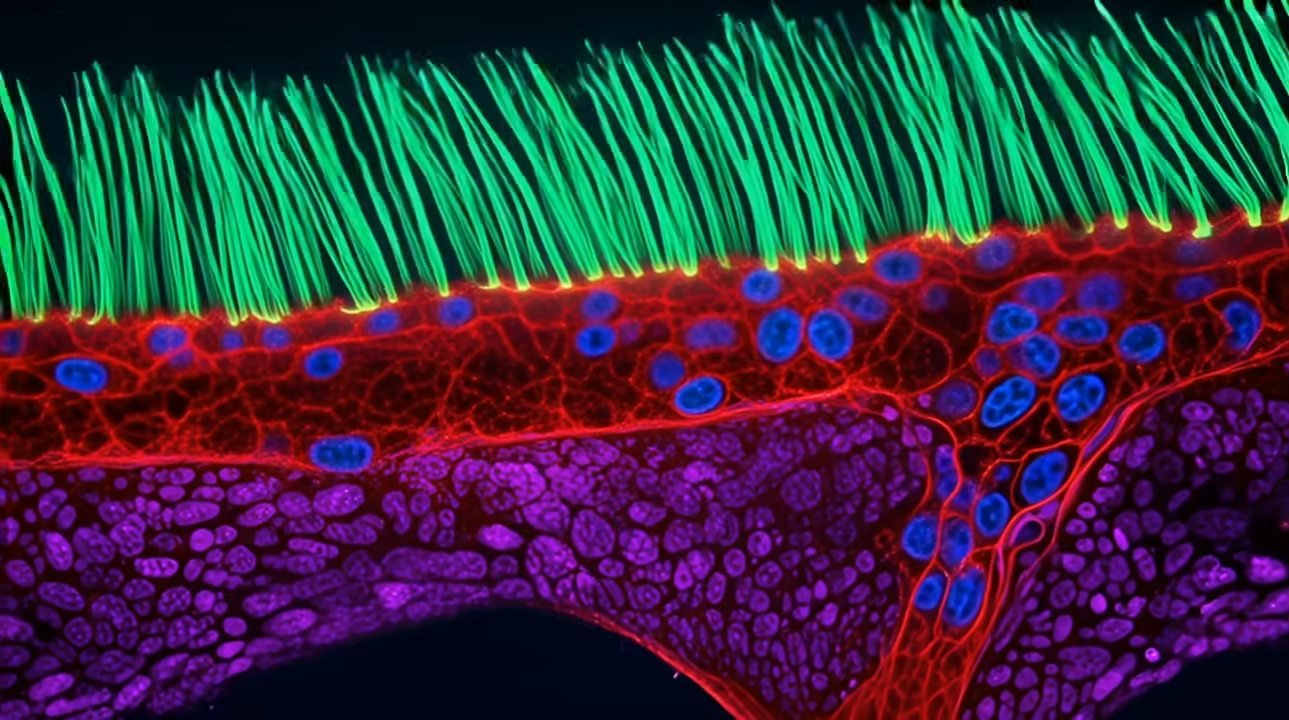
Nikon has disqualified the first-place video in its Small World in Motion competition after concluding it did not comply with the generative AI rules. The entry claimed to show cilia, the tiny hair-like structures that line the airway, moving in a child with the respiratory condition primary ciliary dyskinesia (PCD).
The video came from Dr Ning Xu of Tsinghua University in China. According to the BBC, scientists including former competition judges complained on Nikon’s LinkedIn page that the footage didn’t look real. One PCD expert said the cells “look nothing like those from PCD patients”. Nikon said it was reviewing the entry last week.
What Xu and Nikon say
In a LinkedIn comment, Xu acknowledged using AI, describing “an unsupervised neural-network method” for “AI-assisted post-processing” to visualise features in reconstructed grayscale images from super-resolution optical imaging. The BBC reports that he believed he had acted within the rules and cooperated with Nikon’s investigation.
Nikon decided after “thoroughly re-evaluating the video and supporting materials and consulting with members of our judging panel”. The contest rule is short. As DPReview quotes it: “AI-generated videos are not permitted, and Sponsor holds the right to request the original video for verification.”
Nikon stressed that the ruling is based solely on eligibility and “should not be interpreted as a judgment of the entrant’s professional reputation, scientific contributions, or intent.” DPReview points out that the statement doesn’t say what role generative AI played, whether the video was fully synthetic or an edit of a real image.
New rankings and rule changes
Nguyen Nam Nhat now holds first place, with a video of a roundworm and a single-celled Dileptus. DPReview says first place carries a $3,000 prize. Benedikt Pleyer’s jellyfish larvae video moves to second. Xu’s entry appears to have been removed from Nikon’s website.
Nikon says it will “revisit rules and evaluation procedures for future competition entries”. The contest has run for 15 years and is specifically for microscopic imagery, where the line between AI-assisted processing and AI-generated content is harder to police than in ordinary photography. The case shows how a rule written around “generated” video can collide with common neural-network enhancement in scientific imaging.
The pattern is familiar. Studios and publishers have been moving against AI-made content too, and Nikon, better known to most readers for kit such as its NIKKOR Z cinema lenses, now has to decide how contests verify originals. Nothing in the coverage points to a regional angle, so the UAE impact is indirect: any contest accepting entries here faces the same verification question.
Did Nikon say Xu faked the video?
No. Nikon says the entry broke the generative AI rule and that this isn’t a judgment of his reputation, scientific work or intent.
What was the video meant to show?
It was presented as cilia moving in the airway of a child with PCD, captured with super-resolution optical imaging.
Will the rules change?
Nikon says it will revisit the rules and evaluation procedures for future entries, but hasn’t given details.