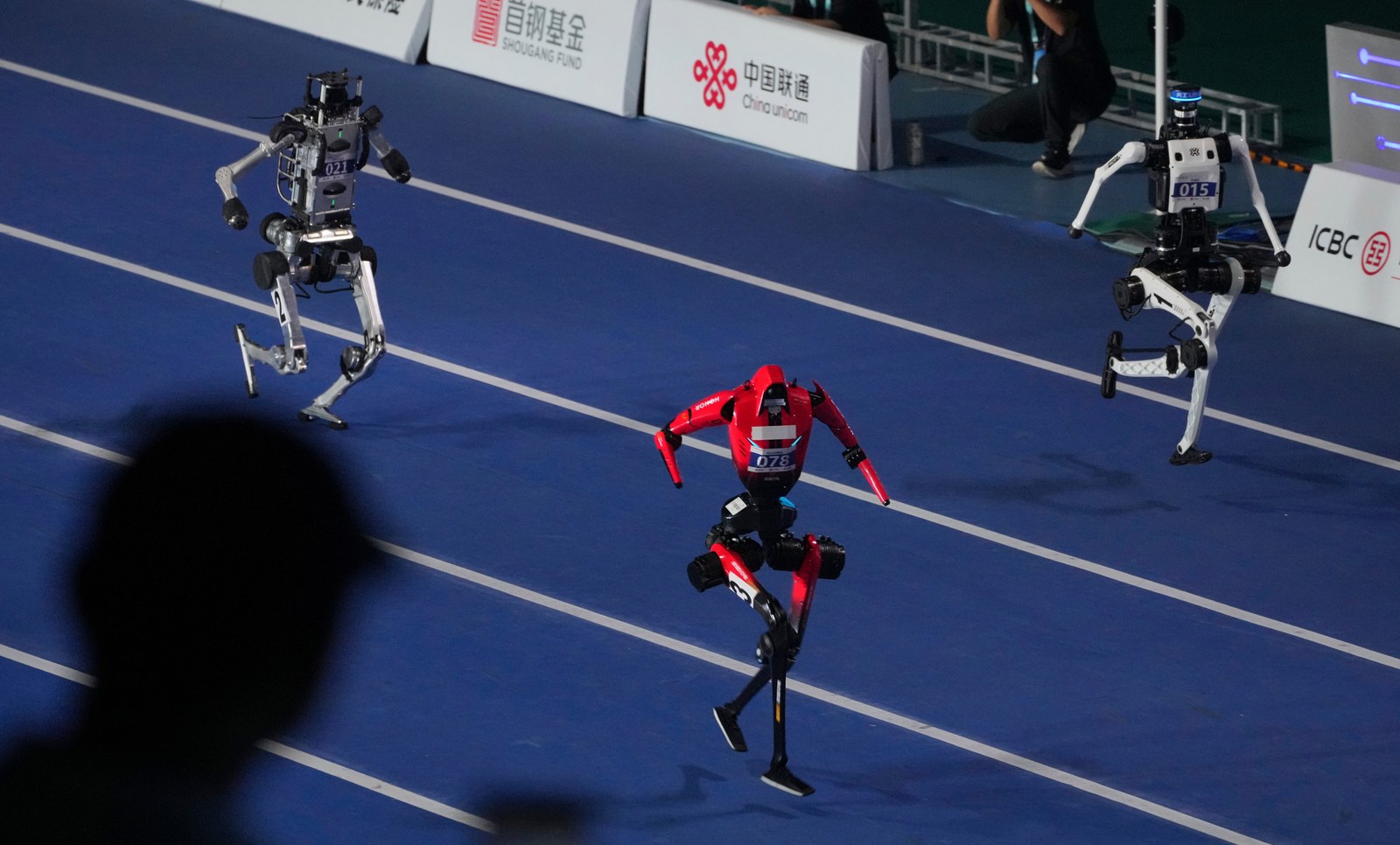
A Chinese humanoid robot has run 100 metres in 9.39 seconds at the World Humanoid Robot Games in Beijing, beating the 9.58-second human world record Usain Bolt set in Berlin in 2009.
Tiangong Ultra, developed by the Beijing Humanoid Robot Innovation Center, won its heat on the opening day of the games’ second edition. It overtook smartphone maker Honor’s Lightning near the finish after trailing early; Lightning crossed in 9.47 seconds, also under Bolt’s mark.

The two robots lacked Bolt’s flair in the stopping department. Tiangong stumbled wildly into a mat designed to catch them, sending onlookers scrambling, and Lightning was carried off on a stretcher after collapsing. The times still marked a sharp improvement from last year’s inaugural games, when Tiangong Ultra won the same event in 21.50 seconds.
Why the humanoid robot race matters
The 100m is one of 51 events at the games, which include football, dancing and industrial-task contests. This year’s edition drew 2,056 robots from 666 teams across 16 countries, up from 280 teams at the first games. They run through Wednesday at Beijing’s National Speed Skating Oval.
China treats humanoid robots as a strategic emerging industry, and investor enthusiasm is showing. Unitree, the country’s best-known humanoid robot maker, jumped more than five-fold on its Shanghai trading debut this week, giving it a market value of about $50 billion.
The race is one event among 51; the trend behind it is broader. Humanoid robots are the direction both the humanoid-AI startup buys and the physical-AI push are heading. In the UAE, robots are already a familiar sight — from coffee-serving machines to delivery robots scaling up across Dubai — even if none of them are chasing sprint records yet.
What is the World Humanoid Robot Games?
An Olympics-style event in Beijing where humanoid robots compete in 51 disciplines including running, football, dancing and industrial tasks. This year’s edition drew 2,056 robots from 666 teams across 16 countries.
Which robot beat Usain Bolt’s 100m record, and how fast?
Tiangong Ultra, developed by the Beijing Humanoid Robot Innovation Center, ran 100m in 9.39 seconds on the opening day of the games. Usain Bolt’s human world record is 9.58 seconds, set in Berlin in 2009.
Why does a humanoid robot beating Bolt matter?
It marks rapid progress in physical AI and bipedal robotics, a field China treats as a strategic industry. Investor enthusiasm is showing: Unitree, a leading Chinese robot maker, jumped more than five-fold on its Shanghai stock market debut this week.