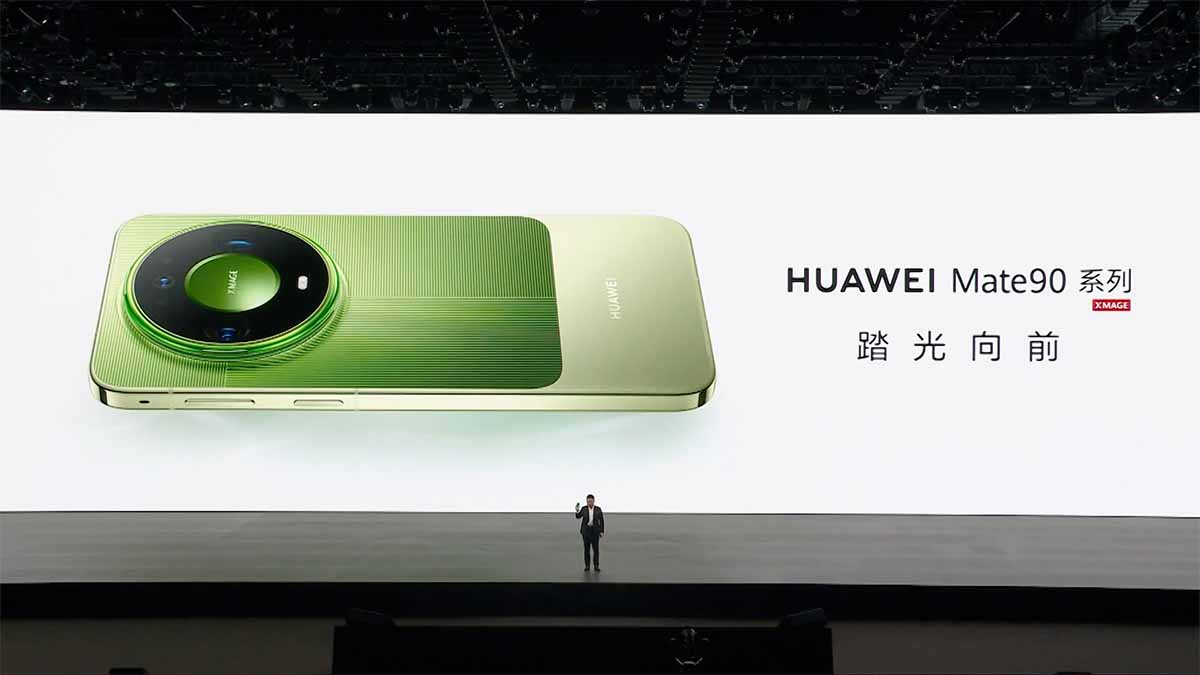
Huawei has launched the Huawei Mate 90 series in China with five models and three Kirin chip tiers, ranging from the standard Mate 90’s Kirin 9030 to the top models’ Kirin 9050 Pro. The lineup runs HarmonyOS 7, while UAE pricing and availability remain unconfirmed. Huawei Central reports the five-model launch; Reuters reports the chip and pricing pressures behind it.

Huawei Mate 90 series: five models, three chip tiers
The range comprises the Mate 90, Mate 90 Pro, Mate 90 Pro Max, Mate 90 Pro Collector’s Edition and Mate 90 RS Ultimate Design. The standard phone uses a Kirin 9030, the Pro moves to a Kirin 9035, and the Pro Max variants and RS model get the Kirin 9050 Pro, according to Huawei Central. Huawei’s official Mate 90 product page confirms the standard model’s Kirin 9030 and HarmonyOS 7.
| Model | Chipset |
|---|---|
| Mate 90 | Kirin 9030 |
| Mate 90 Pro | Kirin 9035 |
| Mate 90 Pro Max, Pro Max Collector’s Edition, RS Ultimate Design | Kirin 9050 Pro |
The Pro and RS models have 6.9-inch OLED screens with a 1–120Hz refresh rate, while Huawei Central reports a peak brightness of up to 12,000 nits. The top camera configuration pairs an 18EV high-dynamic-range main sensor with a telephoto camera of up to 200 megapixels. The standard Mate 90’s official page lists a 6,600mAh battery and 66W wired charging; Huawei Central says the range tops out at 6,800mAh and 100W charging.
Huawei says the standard Mate 90 is 27% faster than the Mate 80, based on its own lab testing. The Mate 90 succeeds the Mate 80, which launched in November 2025. Huawei’s Mate 80 product page lists the earlier model from ¥4,699 in China; that figure is a mainland price, not a UAE estimate. The Kirin 9050 Pro first appeared in Huawei’s Mate XT 2, and we covered the chip’s launch separately here.
LogicFolding offers another route, with a supply cost
Huawei calls the Kirin 9050 Pro’s chip-design approach “LogicFolding”. Reuters reports that it rearranges internal wiring in three dimensions rather than a conventional flat layout, allowing denser processing but requiring more wafers to make. Huawei has not disclosed the chip’s manufacturer.
The company’s consumer business chief, Richard Yu, told reporters that advanced chip capacity remains constrained in China. Reuters also reports that higher memory prices have added an average of $200 to the cost of each handset, squeezing margins. Yu said Huawei would raise phone prices too, but more slowly; Huawei has not announced Mate 90 prices.
“Advanced semiconductor capacity remains very limited in China, and Huawei’s Ascend AI chips also draw on that same capacity.”
Richard Yu, Huawei consumer business chief, via Reuters
Huawei’s September Mate XT 2 event introduced the Kirin 9050 Pro before the Mate 90 launch. The new lineup puts the chip in several premium models, but the manufacturing constraint Yu described is still part of the story. Reuters reported Huawei’s smartphone shipments in China rose 13% year on year from January to August, while the wider market fell 7%—growth that gives the company room to defend its premium range, not a guarantee that supply will match demand.
UAE pricing and availability are still missing
Huawei has not confirmed a UAE launch date or price for the Mate 90 family. Search results showing estimated AED prices are speculative listings, not Huawei announcements, so there is no reliable local figure to compare with UAE flagships yet.
The software is another practical check. Reuters describes HarmonyOS 7 as Android-free and says Huawei claims it supports more than 450,000 apps and services. That number does not establish support for every app used in the UAE, nor does it answer questions about Google services. Anyone considering an import should check their essential apps and warranty coverage before choosing a model; an official regional listing would settle the rest.
The Mate 90 line is a substantial hardware refresh, but its China-first launch leaves two questions open for local buyers: whether Huawei brings the phones to the UAE, and what the final price and app experience look like here. The company has answered neither yet.
What should UAE Android users check before considering a Mate 90 import?
Check whether your essential apps and services work on HarmonyOS 7 and confirm the seller’s regional warranty terms. Huawei calls HarmonyOS 7 Android-free and says its catalogue has more than 450,000 apps and services, but that headline count does not establish compatibility for every UAE banking, work or government app.
Does LogicFolding mean the Kirin 9050 Pro uses a new manufacturing process?
No. LogicFolding describes Huawei’s reported chip-layout approach, not a confirmed manufacturing node. Huawei has not named the Kirin 9050 Pro’s manufacturer, and Reuters says Yu described China’s advanced chipmaking as still reliant on DUV lithography while work towards EUV continues.
Could chip supply affect how easy the Mate 90 is to buy?
It could, but Huawei has not disclosed Mate 90 production targets or a supply forecast. Yu’s comments point to capacity pressure across Huawei’s advanced chips; they do not prove that any particular Mate 90 model will be scarce.
What do Huawei’s component-cost comments suggest about eventual pricing?
They suggest Huawei faces pressure to raise prices, but not by how much or in which markets. Yu said the company would increase handset prices more slowly as memory costs rise; only a published regional price will show whether that pressure reaches UAE buyers.