Hogwarts Legacy will receive DLSS 5 on 5 November, while RTX Spark laptops gain support on 16 October. NVIDIA’s October update also introduces a faster neural rendering model, with the company claiming half the GPU overhead of September’s version and up to 1.4x higher frame rates in NBA 2K27.
The rollout covers GeForce RTX 50 Series GPUs, RTX Spark, and GeForce NOW. Where Winds Meet follows in late November, and NVIDIA’s RTX Remix modding tools will add the updated model on 23 October. Separately, a new Frame Generation Performance Mode has entered beta for RTX 40 Series, RTX 50 Series, and RTX Spark hardware.
What the faster DLSS 5 model changes
NVIDIA says pipeline optimisations and neural model refinements have doubled the performance of DLSS 5’s 3D-Guided Neural Rendering model. The October version has roughly 118 million parameters, a 24% reduction, and uses 20% less VRAM at 4K. The company describes its visual fidelity as comparable to the September release.
The model first reaches NBA 2K27 on 16 October, alongside DLSS 5 support for RTX Spark laptops. NVIDIA puts the game’s frame-rate improvement at up to 1.4x and says future DLSS 5 games will ship with the updated model by default.
Neural rendering works at the end of the graphics pipeline. It takes the game engine’s rendered frame, including geometry, textures, and lighting buffers, then uses AI to add lighting and material detail. Developers can control which parts of a scene it changes.
Other DLSS components tackle different jobs: reconstructing a higher-resolution image, generating additional frames, or improving ray-traced lighting. The October announcement updates both neural rendering and frame generation, with separate hardware support and release schedules for each.
Hogwarts Legacy gets a November update
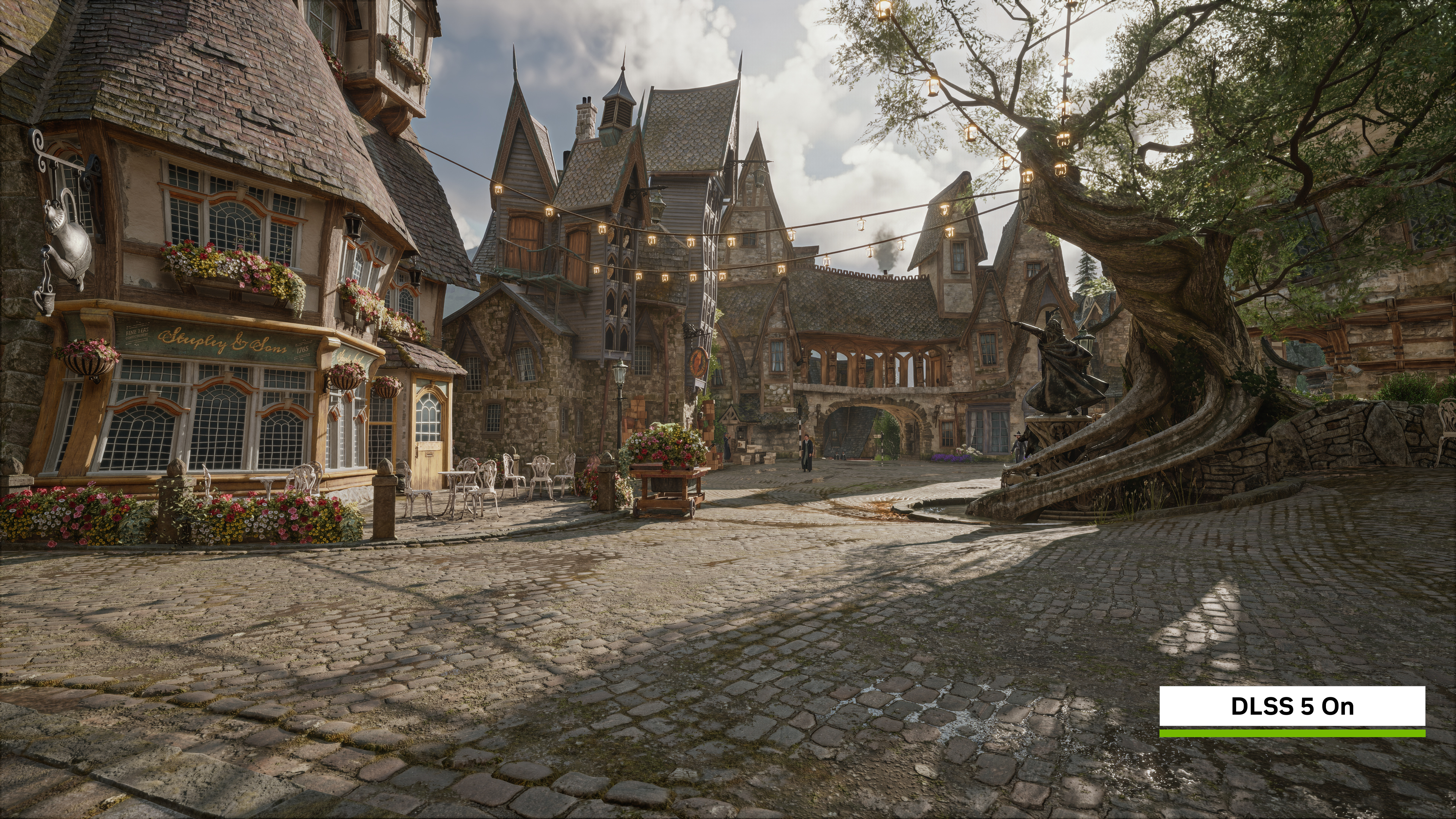
Avalanche Software’s 5 November patch adds 3D-Guided Neural Rendering to Hogwarts Legacy and updates its other DLSS technologies to their newest versions. The PC game already supports Multi Frame Generation and Ray Reconstruction.
According to NVIDIA, Avalanche has used the DLSS 5 SDK’s controls to tune the integration around the game’s artistic style. The company has published on/off comparisons showing its implementation in the wizarding RPG, ahead of the update’s release.
The supported platforms for that neural rendering update are RTX 50 Series, RTX Spark, and GeForce NOW. For Where Winds Meet, developer Everstone Studio will add the same technology in late November. That game already supports DLSS Multi Frame Generation and Super Resolution.

These are developer integrations with their own game updates. NVIDIA’s separate app-level Frame Generation beta has a different route to installation and also supports RTX 40 Series GPUs.
RTX Spark joins the rollout
The faster model arrives as NVIDIA expands DLSS 5 to a new class of Windows laptops. Its RTX Spark platform combines a Blackwell RTX GPU and Grace CPU, with configurations reaching 6,144 GPU cores, 20 CPU cores, and 128GB of unified memory.
Alongside AI and creative workloads, the platform supports NVIDIA’s gaming technologies, including ray tracing, DLSS, and Reflex. October’s neural rendering update brings RTX Spark into the same announced DLSS 5 game rollout as RTX 50 Series GPUs.
There is already a UAE connection through the ASUS ProArt P14 and P16 pre-orders covered by tbreak. Microsoft has also announced a Surface Laptop Ultra with RTX Spark. Those earlier hardware announcements provide the context for the new laptop support; this update adds the DLSS dates and software changes.
Frame Generation trades some quality for speed
The new beta’s Performance Mode appears as Preset C in the NVIDIA app’s Frame Generation override. It supports Frame Generation, Multi Frame Generation, and Dynamic Multi Frame Generation on compatible hardware and games.
NVIDIA explains that frame generation uses two AI models. One analyses game information, such as motion vectors and depth, to understand movement between rendered frames. The other calculates optical flow for elements including interface graphics and ray-traced effects.
Preset C replaces that second model with a lighter, faster algorithm. NVIDIA claims up to 35% faster performance on a GeForce RTX 5060, with minor image-quality trade-offs. Unlike the neural rendering rollout, this beta includes RTX 40 Series cards.
RTX Remix adds developer controls
On 23 October, RTX Remix will receive both the faster DLSS 5 model and the new Frame Generation Performance Mode. Modders will be able to include or exclude content, mask scene elements, and choose DLSS 5 presets for individual objects.
NVIDIA has previewed the tools through the in-development Fallout 4 RTX and Mirror’s Edge RTX projects. The update adds another rendering option to the toolkit used to rework older games, a space that also produces projects such as the ArkWeb mod for Arkham Knight.
How do you enable the Frame Generation Performance Mode beta?
Install the latest NVIDIA app, then open Settings > About and opt into beta or experimental features. After installing the beta, select a supported game under Graphics, open Driver Settings > DLSS Override – Model Presets > Custom, and choose Preset C under Frame Generation. Click Apply. If Preset C is missing, NVIDIA recommends rebooting the PC.
Can you apply the beta setting to every supported game at once?
Yes. Choose Global Settings at the top of the NVIDIA app’s Graphics window, rather than an individual game, then apply the Frame Generation override to supported games in the library.
How will modders access DLSS 5 in RTX Remix?
From 23 October, download the latest RTX Remix through the NVIDIA app or GitHub. Press Alt + X to open the runtime overlay, select Developer Settings Menu, and enable DLSS 5 in the runtime or toolkit menu.