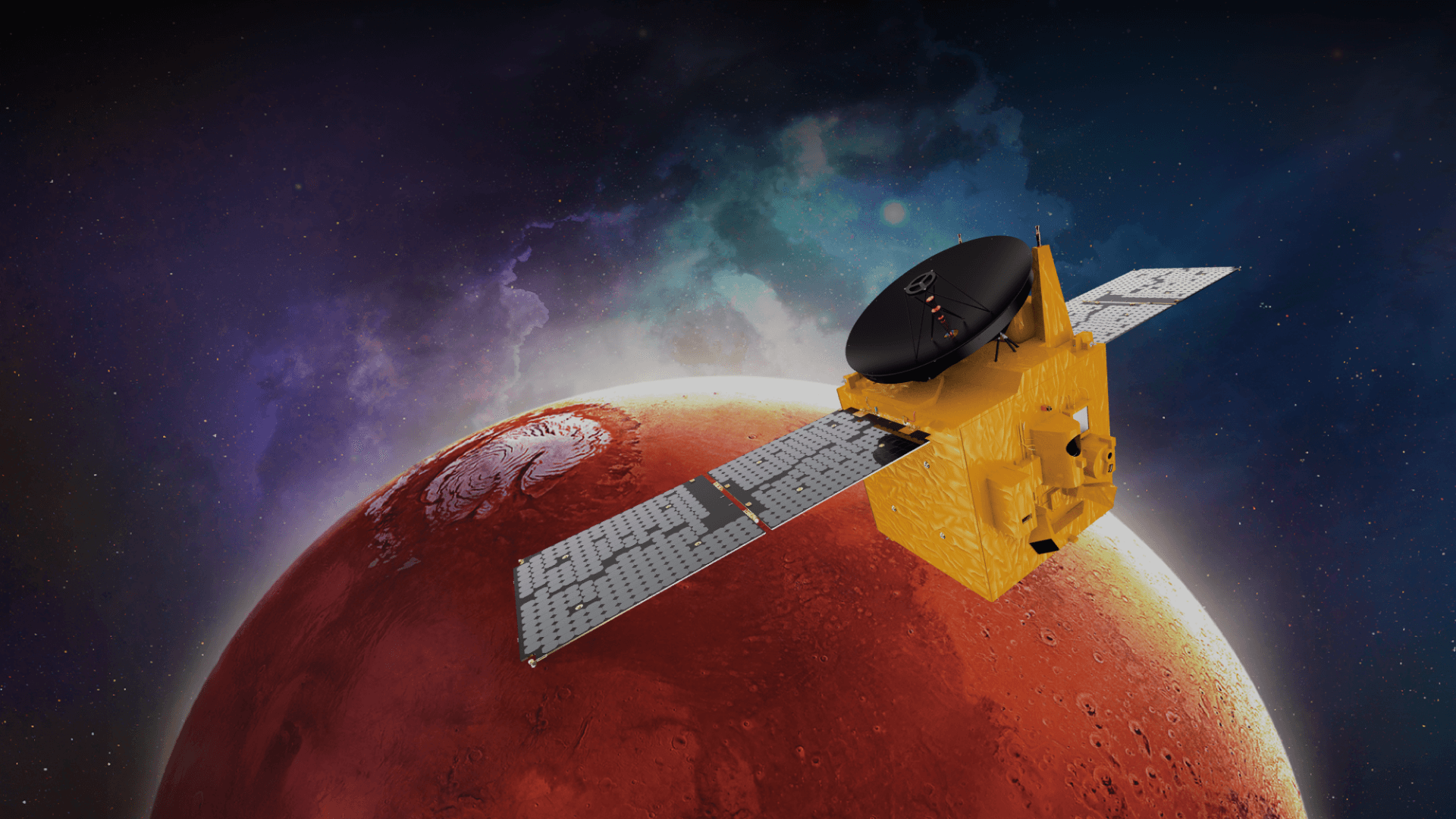
The UAE’s Hope Probe reached Mars orbit on 9 February 2021, making the UAE the fifth nation to reach the Red Planet and the first Arab and Islamic country to do so, succeeding on its first attempt. Six years after its July 2020 launch, the mission has moved from national milestone to a working long-term Mars observatory, and the UAE Space Agency has now committed to keeping it running through 2028.
The headline case for celebration is not the arrival, which is well documented, but what the mission has done since. Hope was designed to study the Martian atmosphere as a single connected system rather than in isolated regions or layers, and after five-plus years of continuous observation, that approach has produced a genuinely useful body of science.
What has the Hope Probe actually discovered?
Hope has expanded the understanding of Martian auroras, Mars’ smaller moon, and even an object from another star system. The most-cited finding is the identification of previously unknown auroral forms — sinuous, discrete auroras and patchy proton auroras — which provide scientists with new detail on how the Martian atmosphere interacts with the solar wind and the planet’s patchy magnetic field.
The spacecraft has also delivered close-up imaging and data of Deimos, feeding debates over the moon’s composition and origin. In a more unexpected turn, it pointed its instruments away from Mars entirely to observe Comet 3I/ATLAS — an interstellar object passing through the solar system — using its Emirates eXploration Imager and Emirates Mars Ultraviolet Spectrometer. That flexibility matters: an atmosphere mission moonlighting as an interstellar-object observatory is a decent return on the hardware.
The mission’s design supports this range. Hope flies a high, elliptical orbit roughly 20,000 to 43,000 kilometres above Mars, letting it observe the whole planet across every hour of the Martian day and across seasons — the orbit that was planned from the outset, not a later upgrade.
Why the open data matters more than the discoveries
Hope has released more than 10 terabytes of scientific data, free to anyone, and that openness is arguably its most durable contribution. According to the mission, the data has gone out in 16 batches through its Science Data Center, has been used by more than 200 international research institutions and universities, and has fed over 35 peer-reviewed papers and more than 250 conference presentations.
The open-access commitment was part of the plan from the start; what has grown is the sheer scale of it. For the UAE, the payoff is domestic as much as global — the mission has tied Hope data into work at United Arab Emirates University and New York University Abu Dhabi, which is the real point of a national science programme: building people, not just spacecraft. The same logic runs through the UAE’s other space efforts, from its first homegrown hybrid rocket launch to its hyperspectral Earth-observation satellite.
What does the 2028 extension change?
The UAE Space Agency extended the mission through 2028, a decision announced in February 2026, based on the spacecraft’s condition and instrument performance. Hope was originally built for a primary mission of about one Martian year, so a formal commitment to operate it well beyond that turns a short prime mission into a multi-year Mars climate record covering seasonal change over an extended run.
The extension is also explicitly a training exercise. Officials have framed the extra years as a way to deepen the national team’s operational expertise ahead of the Emirates Mission to the Asteroid Belt, targeted for launch in 2028. That connection is the most forward-looking part of the story: Hope stops being a standalone achievement and becomes the practice ground for a harder, longer-range mission. On that reading, keeping it flying is less about squeezing more Mars data from old hardware and more about making sure the people who will run the asteroid mission have logged the required hours first.