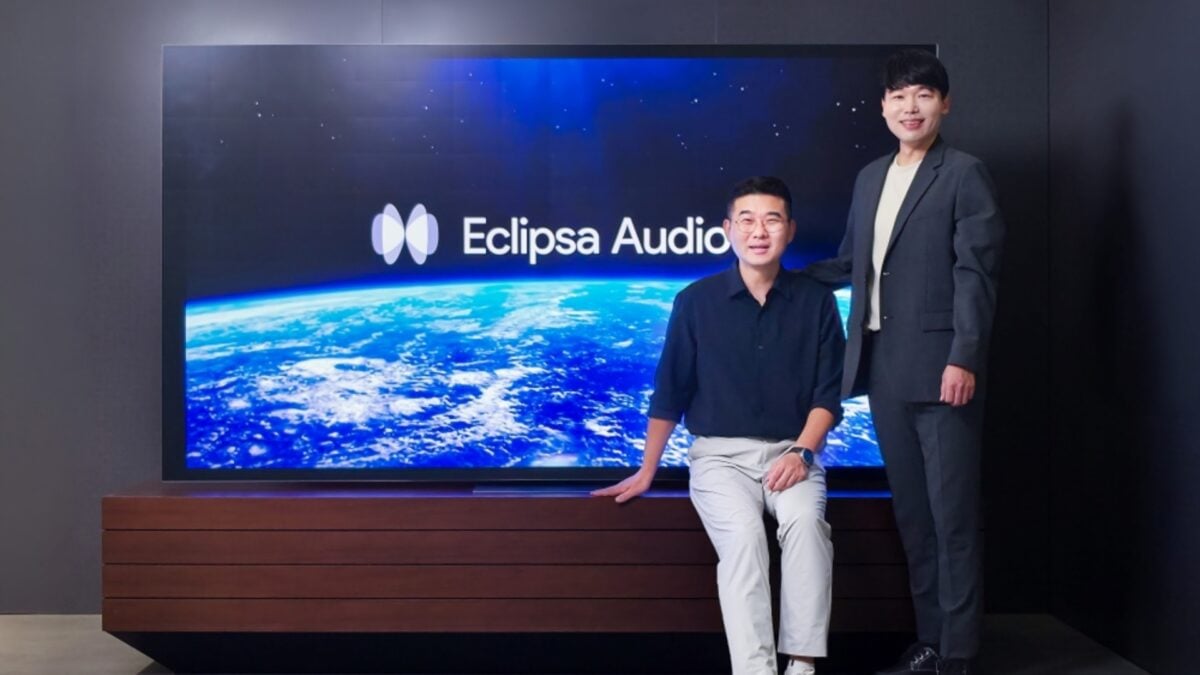
Samsung has finally explained how Eclipsa Audio, its open answer to Dolby Atmos, works — and why it tested the whole pipeline in a 280-seat concert venue before letting it near your TV.
Eclipsa Audio is the spatial audio format Samsung and Google built together, based on the Immersive Audio Model and Formats (IAMF) specification maintained by the Alliance for Open Media. Where Dolby Atmos runs on proprietary licensing, Eclipsa Audio is open and royalty-free. It supports channel-based setups such as 5.1.2 and 7.1.4, and layers spatial metadata on top so sound positions itself around the listener — front, back, left, right and height. Playback adapts to whatever is in the room: a TV on its own, a soundbar, or both. On devices that do not support it, content falls back to plain stereo instead of failing.
The new details, published by Samsung’s newsroom and covered by SamMobile, mostly concern the testing before the format’s commercial debut on Samsung TV Plus last month. Samsung Research captured live spatial audio at a 280-seat venue with a professional sound engineering firm, encoded it, streamed it through a TV Plus channel and played it back on a Samsung TV. The point was to prove the full chain — capture, encode, stream, reproduce — holds up in real time.
The trickiest part was the ad break. TV Plus is free and ad-supported, so the test had to show that switching between spatial audio during a concert and stereo during an advert caused no stuttering and no audio-video sync problems. A show in full surround dropping into a flat stereo commercial is exactly the kind of jarring moment that would break the illusion.
“People can now enjoy the excitement of musicals and live performances from home. While Samsung TV Plus makes this content more accessible, Eclipsa Audio recreates the rich, immersive sound of the venue in the living room.”
— Joonhun Choi, Head of Samsung TV Plus
Samsung’s stated goal for the format is to disappear: “Our goal is to make the technology disappear, allowing users to simply enjoy better sound,” said Woohyun Nam, Head of the Display Innovation Lab at Samsung Research. After concerts and musicals, the plan is to expand Eclipsa Audio to live sports, movies and TV shows. Further out, the spatial metadata could let viewers boost vocals, suppress crowd noise or isolate commentary — control of individual elements rather than just a louder, wider mix.
What it means if you’re watching in the UAE
Samsung TV Plus is already in the region — it became available in the UAE, Egypt and Saudi Arabia, with rollout varying by model year, and runs on Samsung Smart TVs from 2019 onwards. It is free, ad-supported and needs no subscription or card. Eclipsa Audio rides the same service, so concerts and performances arrive on the same TVs at no extra cost. The full spatial effect needs a 2025 Samsung TV or soundbar, where the format debuted, and Samsung recommends earbuds for the best listen. Not ready to buy a soundbar? There is already a way to fake a surround stage at home with an Alexa routine. Samsung has been pushing its streaming services hard in the region lately, most recently bundling OSN+, STARZPLAY and others into one StreamPass subscription.
Which devices support Eclipsa Audio?
Eclipsa Audio ships on 2025 Samsung TVs and soundbars, where it debuted, and content streams through Samsung TV Plus. Samsung and Google plan to bring it to Android phones and tablets, and YouTube already supports the format. On hardware that does not support it, Eclipsa Audio content simply plays in stereo.
Is Samsung TV Plus free in the UAE?
Yes. Samsung TV Plus is a free, ad-supported streaming service with no subscription and no card required. It became available in the UAE, Egypt and Saudi Arabia, with rollout varying by model year, and runs on Samsung Smart TVs from 2019 onwards.
Why is Eclipsa Audio ‘open’ and what does that mean?
Eclipsa Audio is built on IAMF, an open specification maintained by the Alliance for Open Media, the group behind the AV1 video codec. Being royalty-free means no per-device licensing fees, so the format can spread across hardware and content without costs being passed to buyers — the contrast with Dolby Atmos, which uses proprietary licensing.