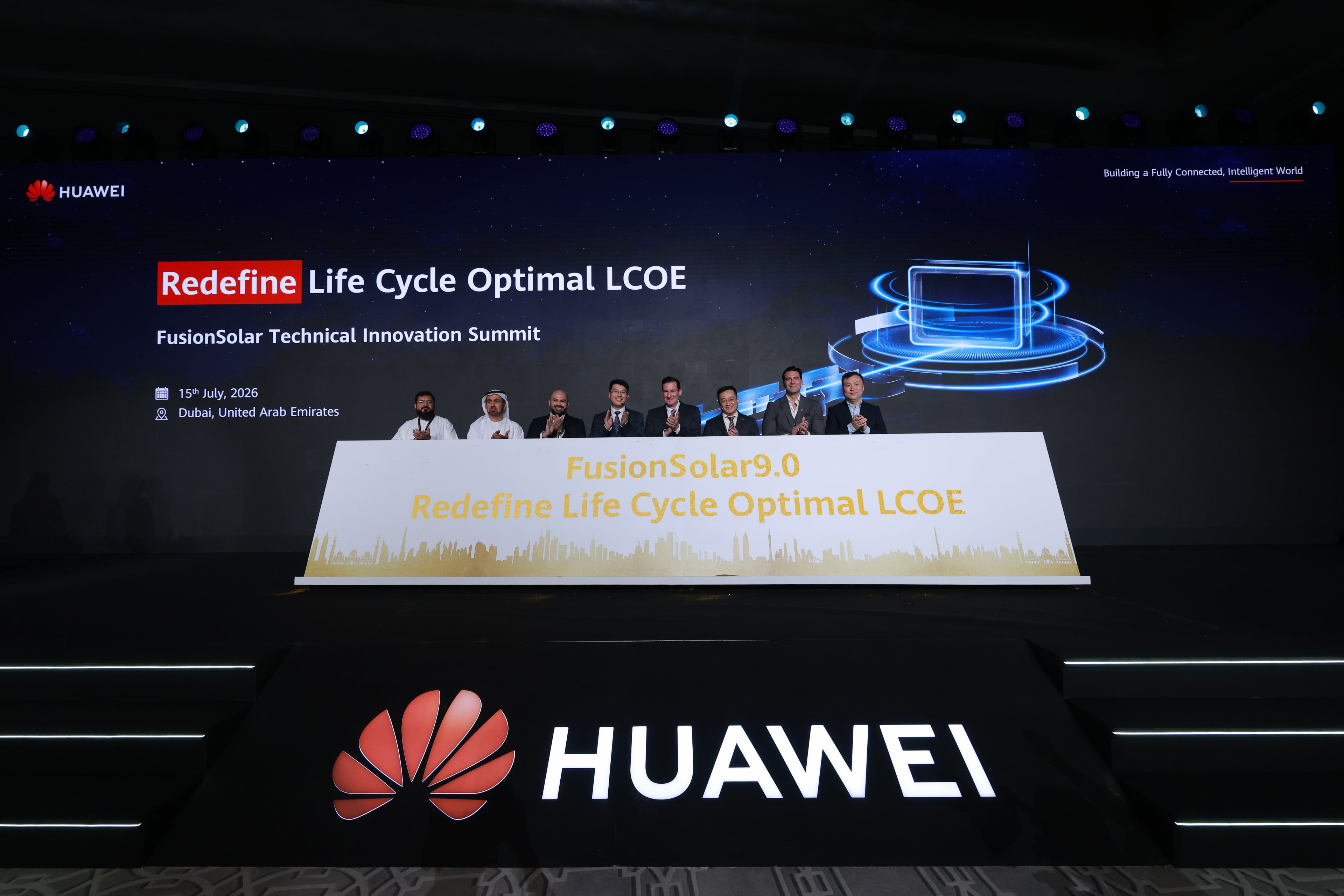
Huawei’s pitch in Dubai was a quiet admission that the region’s solar story has moved on. Building capacity was the easy chapter. Keeping the grid stable while that capacity balloons is the harder one, and that is precisely the problem FusionSolar 9.0 is built to sell against.
Why is Huawei launching FusionSolar 9.0 now?
Huawei is launching FusionSolar 9.0 because the Middle East and Central Asia have reached the point where more solar creates more grid-stability risk, not less. At the FusionSolar Technical Innovation Summit in Dubai on 15 July 2026, Huawei Digital Power framed the regional launch around exactly that shift.
Alex Xing, President of Huawei Digital Power Middle East & Central Asia, told attendees the region is “entering a new phase of renewable energy development, where reliability, grid stability, and intelligent digital technologies are becoming just as important as efficiency.” That is a notable reframing from a company that has spent years selling efficiency and yield. When a solar vendor starts talking about stability as much as output, it usually means its customers have started worrying about it.
The technical reason is straightforward. As inverter-based solar displaces traditional thermal plants, grids lose the inertia and fault current that synchronous generators provided, which makes frequency and voltage harder to hold steady. Grid-forming inverters are designed to emulate some of that behaviour, and Huawei describes FusionSolar 9.0’s string inverters as capable of providing virtual inertia, fast frequency response, and oscillation damping to support weak grids, as detailed in trade coverage of the platform. The goal is to turn solar plants from passive power injectors into active grid-support assets.
What is FusionSolar 9.0 and what does it include?
FusionSolar 9.0 is Huawei’s utility-scale and large commercial and industrial Smart PV platform, integrating next-generation string inverters, grid-forming capabilities, intelligent digital management, and improved reliability. Zhang Xingzhong presented the regional launch at the summit.
According to Huawei’s own product materials, the platform is built around a SUN2000-506K smart string high-power inverter and new smart transformer stations rated at 3 MW, 7 MW, and 11 MW, alongside an industry-first 1,000 V AC PV system designed to cut cable losses. Huawei’s European launch communications have stated that more than 10 GW of projects are under construction worldwide using FusionSolar 9.0, and the platform has already rolled out across Asia-Pacific and Europe before this Dubai debut for the Middle East and Central Asia.
The harsh-environment angle matters more here than in most regions. Huawei positions the platform for reliability in heat, humidity, dust, and salt-mist conditions, which describes a Gulf solar site fairly precisely.
Which UAE projects did Huawei cite?
Huawei pointed to two live UAE-linked case studies to argue its string inverter architecture is already proven in the field. The EDF team, represented by Antonio Diaz, shared lessons from the UAE PV3 project, describing how Huawei’s string inverter architecture improved plant performance, simplified system design, and optimised long-term lifecycle value.
Separately, Saleh El Haj Youssef of PowerChina HDEC presented design insights for string inverter applications and highlighted the value delivered in ADQ projects. Huawei’s materials do not confirm that either project runs on FusionSolar 9.0 specifically, so the honest read is continuity: these show Huawei’s string architecture already embedded in major UAE developments, with the new platform as the next generation.
The stability concern was made explicit by Dr. Abdulla Ismail of RIT University Dubai, who discussed the complexities of integrating larger volumes of renewable generation into the UAE’s national grid. IRENA’s Aleksi Lumijärvi added the regional context, pointing to the growing role of 24/7 renewable energy systems and dispatchable clean power. That framing sits alongside the national investment pipeline in the spotlight at events like the World Future Energy Summit in Abu Dhabi, where the scale of planned solar build-out underlines why grid-forming technology is arriving now rather than later.
Does the grid-forming claim hold up?
Huawei brought in outside assessors to back its grid-forming claims, which is the right instinct for technology that lives or dies on whether utilities trust it. Dr. Carlos Alvarez presented advancements including simulation studies in Saudi Arabia and validation testing in Germany.
The summit closed with a Third-Party Consulting Report Release Ceremony. Nikola Djeric, Associate Director at Go2Power, provided an independent evaluation of Huawei’s grid-forming capabilities for string inverter solutions, while Pranav Patel of DNV assessed long-term string inverter performance and reliability. Both released independent technical reports validating the claims. Independent validation does not settle every question about how the technology behaves across a full national grid, but it is a stronger footing than a vendor’s own datasheet, and for the transmission operators Huawei needs to convince, that distinction is the whole sales pitch.