ArtCraft developer Brandon Thomas has expanded his open-source software push to Microsoft Office, with WordCraft, GridCraft, and DeckCraft taking on Word, Excel, and PowerPoint. The three Rust-based apps offer familiar desktop workflows without a subscription, but their developers still describe them as alpha software rather than finished Office replacements.
The WordCraft repository sets out the distinction clearly: having much of Word’s ribbon available isn’t the same as reliably replacing Word for professional work. Its roadmap puts the app at roughly 60% of that broader goal, with document fidelity, stability, and printing still on the to-do list. GridCraft and DeckCraft make similarly cautious assessments.
This is a follow-up to ArtCraft’s seven open-source Adobe alternatives, not another announcement of the same creative apps. The new targets are everyday documents, spreadsheets, and presentations, where keeping someone else’s files intact can be more important than matching the interface.
Three familiar workflows, three unfinished replacements
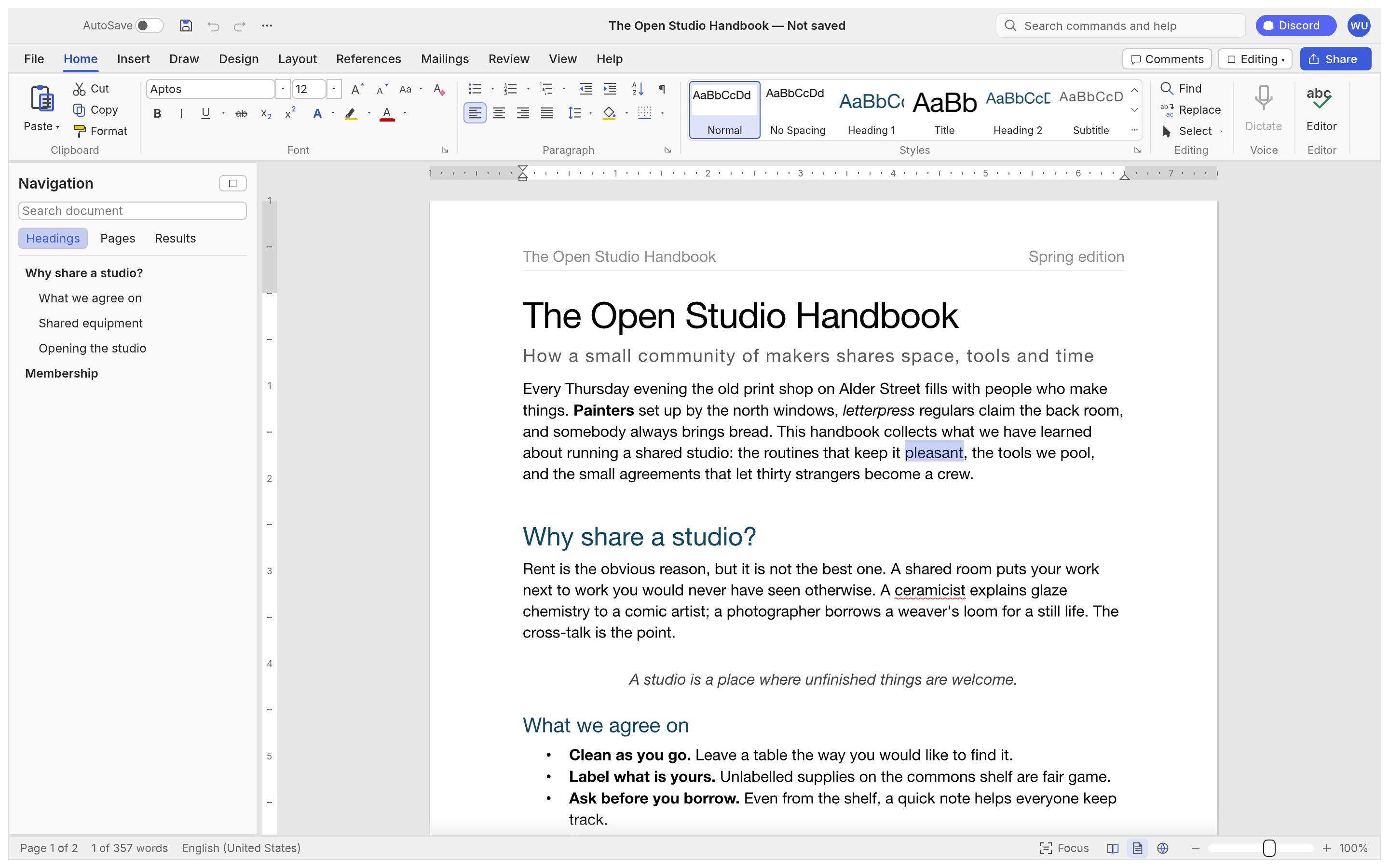
WordCraft recreates the ribbon-led word processor workflow, including styles, tables, tracked changes, references, and mail merge. Its documentation lists support for reading and writing DOCX, alongside formats including ODT, RTF, HTML, and Markdown. PDF exports are designed to retain selectable text, links, and bookmarks.
The project also describes native builds for Windows, macOS, Linux, and BSD, plus a browser version through WebAssembly. The repository says spelling and grammar tools work offline. That gives it a different proposition from a service accessed primarily through a browser: a local application whose source code is available to inspect and modify.
There are limits behind the familiar controls. WordCraft’s roadmap calls for more testing with real-world DOCX files, better preservation of charts and SmartArt when opening and saving documents, pagination closer to Word’s, and native printing. Those are practical gaps for anyone exchanging reports or submitting a document whose page breaks must stay put.
The GridCraft project tackles spreadsheets, using XLSX as its native format. Its documented features include formulas, tables, conditional formatting, charts, PivotTables, and print settings. The team lists more than 500 worksheet functions, including LET and LAMBDA, alongside dynamic arrays and structured table references.
That sounds substantial, but the project makes a useful distinction between counting functions and being ready for work. Its roadmap says it covers 501 of Excel’s 523 worksheet functions and 89% of the ribbon commands in its catalogue, while estimating overall readiness for real work at about 50%. These are the developers’ assessments, not independent compatibility scores.
GridCraft’s remaining priorities include XLSX fidelity with real files, very large workbooks, multi-threaded recalculation, deeper chart support, and XLS import. It also documents a narrower form of XLSB and ODS import: worksheet data using saved values rather than formulas. Opening a file therefore doesn’t necessarily mean retaining its working calculations.
For presentations, the DeckCraft repository lists slide masters, layouts, themes, shapes, pictures, tables, charts, transitions, and animations. It opens and saves PPTX files, offers a full-screen slide show and presenter view, and exports PDFs, slide images, and outlines.

Here, the team’s current estimate is about 55% of the way towards replacing PowerPoint for real work, despite covering 79% of features by breadth. The repository labels DeckCraft alpha, heading towards beta. A long feature list is promising, but it isn’t a guarantee that a presentation created elsewhere will look or behave identically.
AI agents can use the same commands as people
The apps aren’t just attempts to reproduce familiar ribbons. All three expose commands through a command-line interface, a JSON control channel, and an MCP server, allowing AI agents to operate the same underlying actions as a person using the interface.
WordCraft lists operations for typing text, inspecting a document, rendering pages, and saving files. GridCraft exposes tools for reading and writing cell ranges, evaluating formulas, formatting data, and inserting charts. DeckCraft makes more than 200 commands scriptable, with undo support.
This could let a script or agent create a workbook or presentation through the application rather than rely solely on mouse clicks. It doesn’t establish that an agent will produce correct calculations or a well-designed deck. The command interface supplies access; checking the output remains a separate job.
ArtCraft’s development story also sits within the wider push around AI-assisted software. Tbreak recently covered Claude’s live dashboards and animated explainers, although those features are separate from these independent Office alternatives.
Free downloads don’t mean a finished Office migration
All three repositories link to GitHub releases with ready-made builds and describe their code as dual-licensed under MIT or Apache-2.0. They also state that the projects are independent and aren’t endorsed by Microsoft. ArtCraft’s branding and bundled assets have separate terms, so the software licence doesn’t automatically cover every logo or included resource.
In its 9 October coverage, Thurrott described GridCraft as pre-alpha and DeckCraft as still approaching its first alpha. The repositories now describe all three as alpha. For anyone deciding whether to try them, the current project documentation provides a more useful picture than treating those earlier status labels as fixed.
The practical approach is to test copies of representative files before switching: a document with tracked changes and complex layout, a workbook with the formulas and charts actually used, or a presentation with media and animations. Checking the result after reopening it in the original application is more revealing than whether a familiar button exists.
Tom’s Hardware also reports community interest in a CADcraft alternative to Autodesk tools. That remains a discussion in its account, not a confirmed Autodesk-replacement launch. For now, the concrete development is three downloadable Office-style projects whose own roadmaps make clear how much work remains.