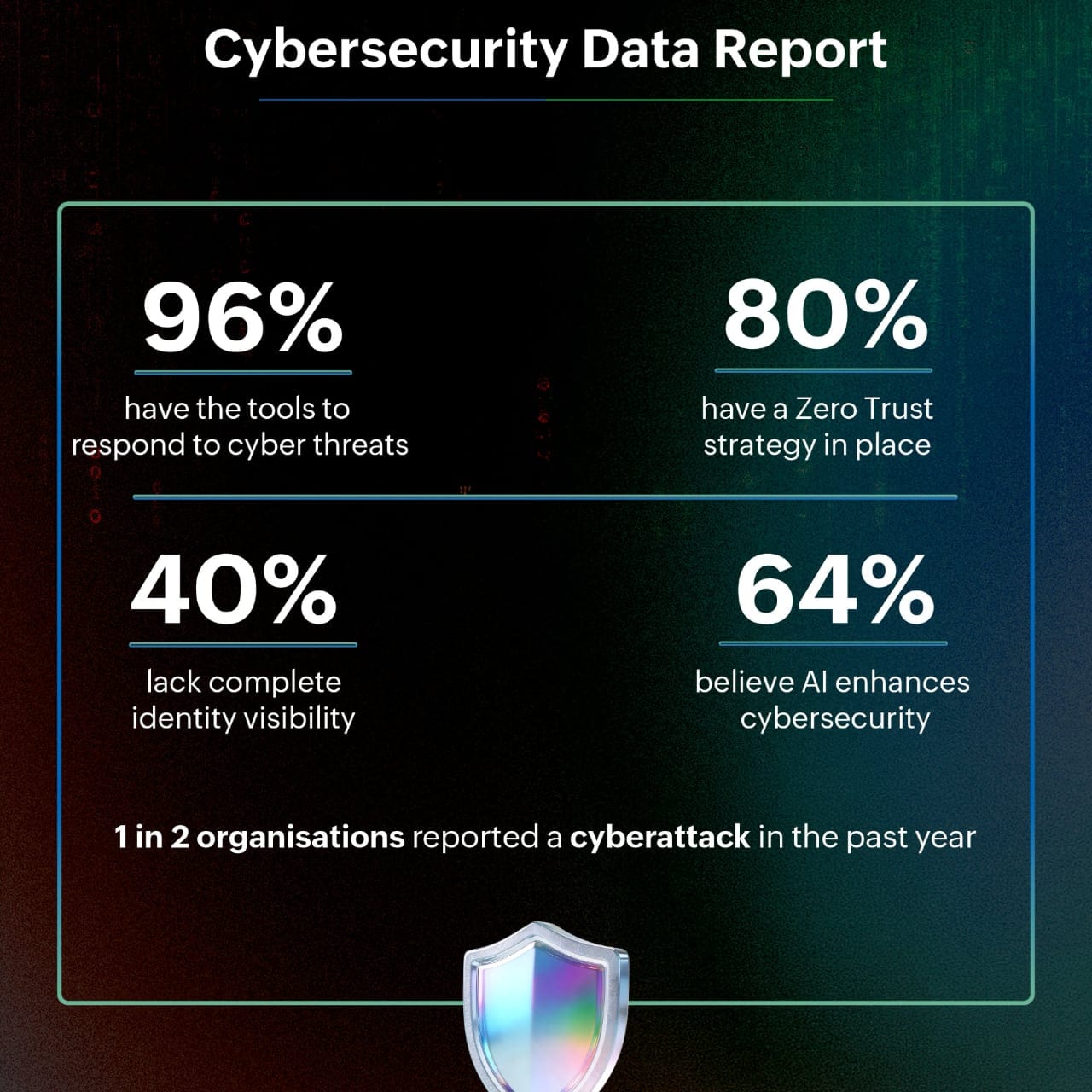
Over 45% of UAE organisations experienced cyberattacks in the past year—exceeding the wider Middle East and Africa average of 36%—yet 96% have the tools to respond effectively. According to Zoho Corp.’s 2026 State of Workplace Password Security report, the UAE demonstrates remarkable cybersecurity maturity alongside concerning vulnerabilities, particularly in identity security.
Key Takeaways
- Over 45% of UAE organizations experienced cyberattacks in the past year, higher than the 36% regional average.
- UAE leads in Zero Trust adoption with 80% of enterprises having strategies in place.
- Critical identity security gaps persist, with 43% lacking proper identity and access management.
- UAE businesses plan to increase security budgets by 76.4% over the next five years.
- AI-powered cybersecurity tools have been adopted by 53% of UAE organizations.
What makes UAE a cybersecurity target?
According to Hyther Nizam, CEO at Zoho Middle East and Africa, the UAE’s position as a regional digitalisation and AI leader makes it an attractive target for cybercriminals. The country’s rapid technological advancement creates both opportunities and vulnerabilities that attackers seek to exploit.
The report reveals a complex security landscape in which 96% of organisations have response capabilities, including real-time threat detection and endpoint security measures. However, this defensive strength contrasts sharply with the frequency of successful attacks, suggesting that prevention—particularly around identity security—remains the critical challenge.
UAE organisations face three primary identity-based threats: phishing attacks affecting 25.5% of businesses, malicious insider threats at 20%, and social engineering attacks targeting 16.4% of enterprises. These statistics underscore why identity security has become the battleground where the UAE’s cybersecurity success will ultimately be determined.
Zero Trust adoption leads the region
UAE enterprises demonstrate exceptional Zero Trust maturity, with 80% having implemented comprehensive strategies, exceeding global benchmarks. This positions the country as a regional leader in advanced cybersecurity frameworks that verify every access request, regardless of location or user credentials.
The implementation depth varies significantly across organisations. Approximately 60% report being close to achieving zero standing privileges—a core Zero Trust principle—while only 22% have fully eliminated persistent administrative access. The remaining 18% acknowledge they remain far from this goal, highlighting the gap between strategy adoption and complete implementation.
This uneven progress reflects broader industry challenges. According to the report, 42% of businesses cite unmanageable identity growth as a primary obstacle, while an equal percentage points to inadequate tools and processes. These findings suggest that while UAE organisations understand Zero Trust principles, operational execution remains challenging.
Critical gaps in fundamental security controls
Despite advanced Zero Trust adoption, UAE organisations show concerning gaps in basic security measures. Over 43% lack proper identity and access management (IAM) systems, while more than 45% have not implemented multi-factor authentication or password management solutions.
The security control adoption pattern reveals a clear hierarchy of implementation. While organisations invest in sophisticated threat detection, fundamental controls lag significantly. Email security remains absent in 38% of organisations, creating obvious attack vectors for phishing campaigns that affect one in four UAE businesses.
Advanced security controls show even wider adoption gaps. Recent cybersecurity trends show that 53% lack secure browsers, 58% lack device management, and over 65% have not implemented passkeys. Log management—crucial for incident response—remains missing in 67% of organisations, potentially hampering forensic capabilities during security incidents.
How are UAE businesses leveraging AI for security?
Artificial intelligence has emerged as a cornerstone of the UAE’s cybersecurity strategy, with 64% of organisations believing AI enhances security capabilities. This confidence translates into substantial adoption, with 53% already implementing AI-powered cybersecurity tools across their infrastructure.
Real-time threat detection dominates AI implementation priorities, with 70.6% of organisations deploying these capabilities. User behaviour analytics ranks 52.9%, reflecting a focus on identifying anomalous activity that could indicate insider threats or compromised accounts. This aligns with broader AI adoption trends across UAE businesses.
The strategic focus on AI-driven security tools makes operational sense given the threat landscape. With 25.5% of organisations facing phishing attacks and 20% dealing with malicious insiders, AI’s ability to analyse patterns and detect anomalies provides crucial defensive capabilities that traditional security measures cannot match.
Investment commitment signals long-term strategy
UAE enterprises demonstrate remarkable commitment to cybersecurity investment, with 76.4% planning to increase security budgets over the next five years. This financial commitment suggests organisations view current gaps as temporary challenges rather than acceptable risks.
The investment pattern reflects the changing nature of work in the UAE. The survey reveals that 47% of organisations operate fully in-office, 41.8% use hybrid models, and 10.9% maintain fully remote workforces. Each model presents distinct security challenges that require different technological approaches and budget allocations.
Industry representation provides context for these investment decisions. Technology companies comprise 30.9% of respondents, followed by financial services at 21.8%, healthcare and other sectors at 16.4% each, government at 9.1%, and education at 5.5%. The technology and financial services concentration explains the sophisticated security postures and substantial budget commitments observed across the survey.
Frequently Asked Questions
What are the key findings of Zoho's UAE cybersecurity report?
The report shows 45% of UAE organizations faced cyberattacks in the past year, yet 96% have response tools available. While 80% have Zero Trust strategies, critical gaps remain in identity security with 43% lacking proper IAM systems.
How prevalent are cyberattacks in UAE organizations?
Over 45% of UAE organizations reported experiencing cyberattacks in the past year, which exceeds the wider Middle East and Africa region’s average of 36%. The UAE’s rapid digitalization makes it an attractive target.
What is Zero Trust maturity like in UAE enterprises?
UAE demonstrates strong Zero Trust adoption with 80% of enterprises having strategies in place. However, only 22% have fully achieved zero standing privileges, while 60% report being somewhat close to this goal.
What are the main cybersecurity gaps in UAE businesses?
Key gaps include lack of identity and access management (43%), multi-factor authentication (45%), secure browsers (53%), device management (58%), passkeys (65%), and log management (67%). Email security is also missing in 38% of organizations.
How are UAE businesses leveraging AI for cybersecurity?
Approximately 64% of organizations believe AI enhances security, with 53% already adopting AI-powered tools. Real-time threat detection (70.6%) and user behavior analytics (52.9%) are the most popular AI applications.