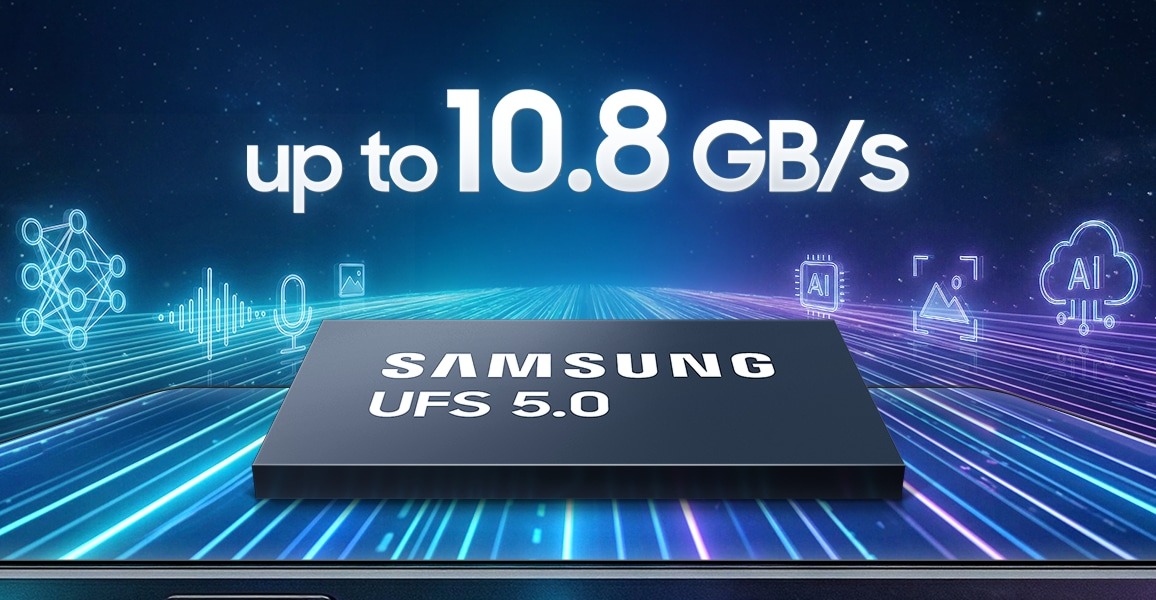
Samsung has developed its first UFS 5.0 storage solution, promising sequential read speeds of up to 10.8GB/s and sequential writes of up to 9.5GB/s. That is more than twice the performance of the company’s previous UFS 4.1 storage and puts future mobile devices within the performance territory normally associated with high-speed PC SSDs.
The new embedded storage is primarily intended for future flagship smartphones and other compact devices that need to process increasingly large amounts of data locally. Samsung is placing particular emphasis on non-device AI, where language models and other features must continuously retrieve data without relying entirely on cloud servers.
Mobile storage speeds are catching up with PC SSDs
UFS, or Universal Flash Storage, is an embedded storage standard commonly used in smartphones and other portable devices. Unlike an NVMe SSD installed inside a PC, it is packaged as a compact chip that can be built directly into a phone, wearable or XR headset.
Samsung’s UFS 5.0 supports up to 10.8GB/s sequential read speeds and 9.5GB/s sequential writes. Both figures are more than twice those of its UFS 4.1 generation.
Random read performance is also claimed to be five times faster than UFS 4.1. That may be particularly relevant to everyday responsiveness and AI workloads, which often involve retrieving many smaller pieces of data rather than moving one large continuous file.
The technology is based on the UFS 5.0 standard and uses the newer UniPro 3.0 and M-PHY 6.0 interfaces. Samsung says optimised PAM4 signalling and a more efficient protocol architecture help increase bandwidth while reducing processing overhead.
While the headline speeds rival or exceed many consumer SSDs, UFS 5.0 is not intended as a direct replacement for desktop NVMe drives. Its focus is on providing high performance within the tighter power, heat and physical-size restrictions of mobile hardware.
Samsung is also promising better power efficiency
The performance increase is accompanied by a claimed improvement of more than 40% in power efficiency compared with Samsung’s UFS 4.1 solution under equivalent sequential-read conditions.
Samsung attributes the reduction in power usage to technologies including clock gating and support for multiple operating voltages. These allow parts of the storage hardware to reduce activity or power consumption when their full performance is not required.
That efficiency could be important if UFS 5.0 is used for demanding local AI workloads. Higher storage speeds are useful, but sustained data transfers cannot come at the cost of excessive battery drain or heat in a smartphone-sized device.
Samsung has also reduced the size of the storage package. UFS 5.0 measures 7.5mm by 13mm by 0.9mm, making it 16.7% smaller than the previous design.
The smaller footprint gives device manufacturers more flexibility when arranging internal components. Any recovered space could potentially be allocated to parts such as batteries, cooling systems or additional camera hardware, although the final design decisions will depend on each device manufacturer.
Mass production begins in late 2026
Samsung plans to begin mass-producing UFS 5.0 during the fourth quarter of 2026. The company will initially offer the storage in capacities including 512GB and 1TB.
The manufacturer expects the technology to be used across flagship smartphones, XR headsets and AI-focused wearables. However, Samsung has not confirmed which consumer device will be the first to ship with UFS 5.0.
That production schedule means the technology is unlikely to appear in widely available devices immediately. Its first commercial implementations will probably arrive after manufacturing begins towards the end of the year, depending on the development schedules of Samsung and its hardware partners.
FAQ
How fast is Samsung UFS 5.0?
Samsung UFS 5.0 supports sequential read speeds of up to 10.8GB/s and sequential write speeds of up to 9.5GB/s. Samsung says both are more than twice as fast as its UFS 4.1 storage.
Is UFS 5.0 faster than an SSD?
Its maximum sequential speeds are higher than those of many existing consumer SSDs, although UFS and PC NVMe drives are designed for different devices, power limits and workloads. Real-world performance will also depend on the phone or device using it.
When will Samsung UFS 5.0 enter production?
Samsung plans to begin mass production in the fourth quarter of 2026. It has not announced which consumer product will use the storage first.
What capacities will Samsung UFS 5.0 offer?
Samsung lists 512GB and 1TB versions of its UFS 5.0 storage. Additional capacities have not been announced.