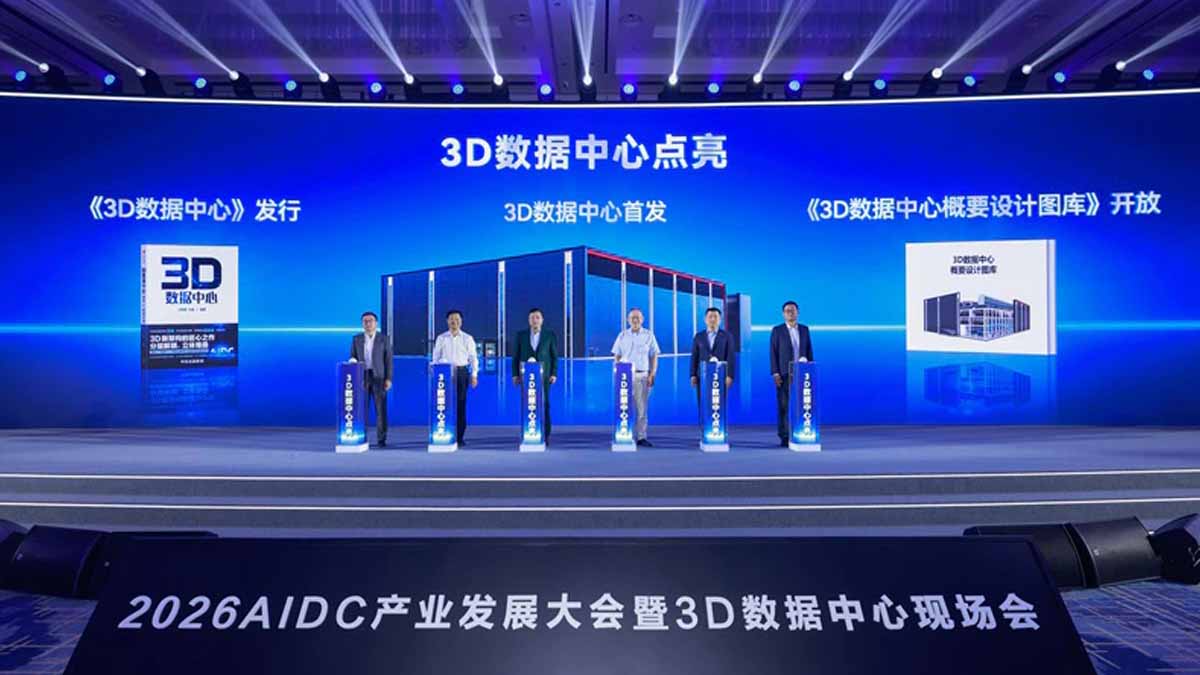
Huawei has unveiled what it calls the world’s first 3D data centre, The Huawei 3D data centre uses a four-layer design to support AI clusters built around more than 100,000 Ascend cards. The design was presented at an AI data-centre conference in Wuhu, Anhui, on 15 September.
Huawei’s 3D data centre stacks the facility’s cooling, IT equipment, power supply and backup power vertically rather than arranging those systems across a conventional horizontal layout. Huawei says the approach is intended to shorten power and cooling routes, improve isolation between zones and make high-density computing easier to scale.
The company’s Wang Tao said the demand created by trillion-parameter models and rising token use means Ascend supernode clusters with more than 100,000 cards will become a basic configuration. That is a description of Huawei’s expected infrastructure scale, not a claim that every current AI facility has reached it.

Huawei 3D data centre design has four layers
| Layer | Purpose |
|---|---|
| Cooling | Removes heat from high-density computing equipment |
| IT equipment | Houses the computing systems |
| Power supply | Delivers electricity to the computing layer |
| Backup power | Provides resilience during power interruptions |
Huawei Central reported that cabinet power has risen to 100kW and 200kW as AI workloads become denser. TechNode separately reported that Huawei says the design can halve electromechanical delivery time through standardised prefabrication, although the report did not provide a project-level measurement.
Why Huawei is changing the data-centre layout
Traditional data-centre designs are under pressure from the heat, power and space requirements of modern AI hardware. Huawei says the vertical model allows shorter connections between power and cooling systems, while layered separation is intended to limit fault propagation and simplify operations.
Huawei Cloud is building 3D data centres in Guizhou, Inner Mongolia and Anhui, according to TechNode. The announcement does not identify a UAE site or provide a commercial availability date. UAE readers following local AI infrastructure can compare the approach with Mubadala’s reported interest in an AI data centre in Japan and Khazna’s data-centre operations in Dubai.
The Huawei 3D data centre announcement is a design reference for large Ascend clusters rather than a customer launch. Its practical test will be whether the layered layout delivers the promised gains in cooling, construction time and operational reliability when deployed at scale.
What is Huawei’s 3D data centre design?
It is a vertically stacked data-centre architecture separating cooling, IT equipment, power supply and backup power into four layers.
How many Ascend cards is the design intended to support?
Huawei presented it as a reference architecture for Ascend supernode clusters with more than 100,000 cards.
Is Huawei building this 3D data centre design in the UAE?
No UAE deployment was identified in the announcement. TechNode reported projects in Guizhou, Inner Mongolia and Anhui.