
UAE Leads MEA Internet Speed Rankings as 5G Transforms North Africa
UAE dominates global internet rankings at 2nd place for fixed broadband, while Morocco jumps 22 spots after 5G launch. GCC countries sweep regional leaderboard as North Africa's new 5G networks create dramatic speed improvements across MEA.


The UAE has cemented its position as the Middle East and Africa's internet speed champion, ranking 2nd globally for fixed broadband and maintaining top-10 mobile performance throughout 2025. According to Ookla's Speedtest Global Index analysis, whilst most MEA countries saw little change in rankings, significant improvements emerged from 5G launches across North Africa and regulatory pushes in Bahrain and Oman.
GCC maintains dominance with UAE leading the pack
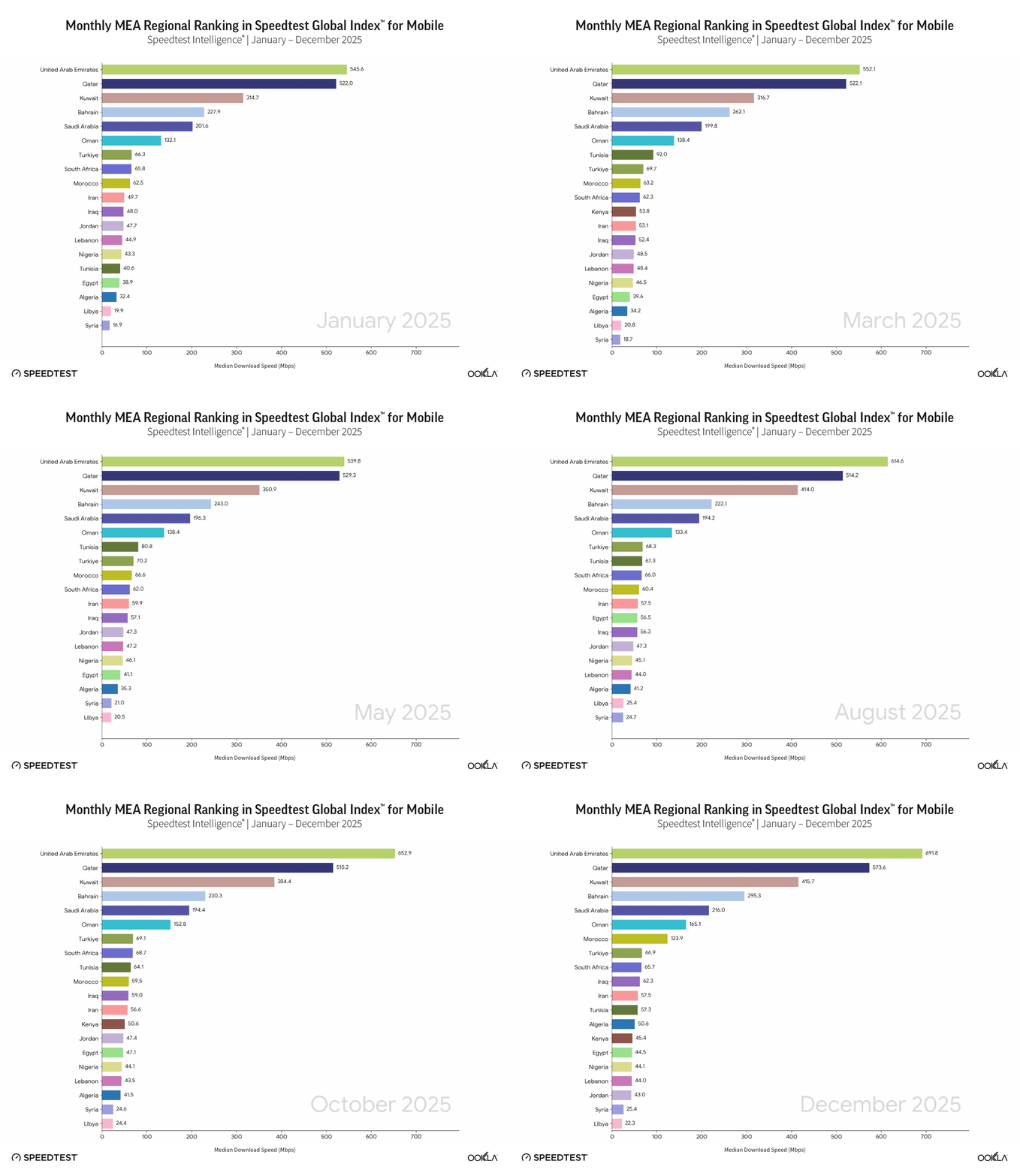
The Gulf Cooperation Council countries continued their stranglehold on MEA internet performance, with the UAE posting a three-month moving median download speed of 691.76 Mbps for mobile in Q4 2025. Kuwait, Qatar, and Saudi Arabia joined the UAE in the global top 10 for mobile throughout the year, whilst most GCC nations also dominated the fixed broadband rankings.
On the fixed side, the UAE's 2nd global ranking was complemented by Kuwait (25th) and Qatar (38th), creating a clear GCC sweep of the regional leaderboard. The UAE's consistent performance reflects ongoing investments in 5G-Advanced infrastructure, with operators like du deploying 64T64R dual-band systems that significantly boost throughput through multi-carrier aggregation.
North Africa's 5G transformation creates dramatic shifts
The launch of 5G services across four North African countries in 2025 created the year's most dramatic ranking changes. Morocco recorded the largest mobile improvement globally, jumping 22 places to 39th after launching 5G in November 2025, whilst Algeria rose 11 places to 78th following its December launch.
However, the impact of 5G varied significantly. Tunisia, despite launching 5G in February, peaked at 47th in April before dropping to 72nd by December, as infrastructure struggled to keep pace with growing demand. Egypt's June 5G launch produced only modest gains, with operators using only 20-30 MHz of the 2.6 GHz band, which is shared between 4G and 5G, constraining capacity for growing 5G user bases.
The recency effect explains much of Morocco and Algeria's dramatic improvements—strong consumer interest in new 5G services increased the share of higher-speed test samples, artificially boosting median speeds in the short term.
Regulatory intervention drives Bahrain's fixed broadband surge
Bahrain demonstrated how regulatory policy can rapidly transform internet performance, jumping 16 places in fixed broadband rankings after government intervention. In March 2025, regulators mandated that ISPs increase the minimum speeds from 100 Mbps to 300 Mbps, while industry efforts made faster plans more affordable.
Oman also showed significant mobile improvements, moving up five places to 18th globally, thanks to accelerated operator investments, the launch of new carriers, and the refarming of 3G spectrum for 5G deployment. The country's three-month median download speed reached 165.07 Mbps by Q4 2025.
Saudi Arabia outperforms major G20 economies
Within the G20 group of major economies, Saudi Arabia demonstrated exceptional mobile performance, ranking 9th globally in December 2025. This placed the Kingdom 3rd among G20 countries for mobile internet, ahead of the USA, China, Australia, Canada, and Japan.
The comparison highlights the infrastructure gap between leading Gulf states and other major economies. On fixed broadband, Saudi Arabia maintained 10th place among G20 nations, whilst Turkey and South Africa ranked in the bottom quarter at 16th and 18th respectively, despite Turkey's plans to introduce 5G services in April 2026 following October spectrum auctions.
Sub-Saharan Africa shows mixed progress
Sub-Saharan Africa remained largely behind other MEA regions, with only South Africa (64th), Kenya (80th), and Nigeria (85th) reaching the global top-100 for mobile in December 2025. South Africa and Nigeria both dropped five and seven places, respectively, recording median download speeds of 65.7 Mbps and 44.14 Mbps.
Fixed broadband showed more promise, with Côte d'Ivoire leading SSA at 103rd globally despite relatively low fibre coverage of 10-15%. The country's success stems from concentrating users on higher-speed connections, with Orange offering entry-level packages starting at 50 Mbps. Mauritania recorded the region's largest improvement, jumping 24 places to 106th after expanding its fibre backbone by 5,500 km.
Infrastructure investment drives performance gaps
The analysis reveals that urbanisation alone doesn't determine mobile performance—structural factors such as investment capacity, political stability, and the timing of spectrum allocation often override demographic advantages. Countries like Lebanon, Libya, and Syria show substantially lower speeds than their levels of urbanisation suggest, reflecting broader market conditions and limited investment capacity.
The combination of operator network modernisation with regulatory initiatives—including 5G spectrum auctions, legacy network switch-offs, and minimum speed mandates—proved the most effective approach for improving connectivity across the region.
Frequently Asked Questions
Which MEA countries have the fastest internet speeds in 2025?
The UAE leads with 691.76 Mbps mobile speed and 2nd global ranking for fixed internet. Other GCC countries including Saudi Arabia (9th globally), Kuwait, and Qatar consistently ranked in the global top-10 for mobile throughout 2025.
How did 5G impact internet speeds in North Africa in 2025?
5G launches dramatically improved mobile rankings, with Morocco jumping 22 places and Algeria rising 11 places after launching services in November and December respectively. However, Tunisia and Egypt saw mixed results due to infrastructure capacity constraints.
What factors contributed to improved internet speeds in Bahrain in 2025?
Bahrain jumped 16 places in fixed broadband after government regulation mandated ISPs increase minimum speeds from 100 Mbps to 300 Mbps in March 2025, coupled with industry efforts to make faster plans more affordable.
How does Saudi Arabia's internet speed compare to other G20 nations?
Saudi Arabia ranked 9th globally for mobile in December 2025, placing it 3rd among G20 countries ahead of the USA, China, Australia, Canada, and Japan. For fixed broadband, it ranked 10th among G20 nations.
Written by

Subscribe to our newsletter
Subscribe to our newsletter to get the latest updates and news












Member discussion