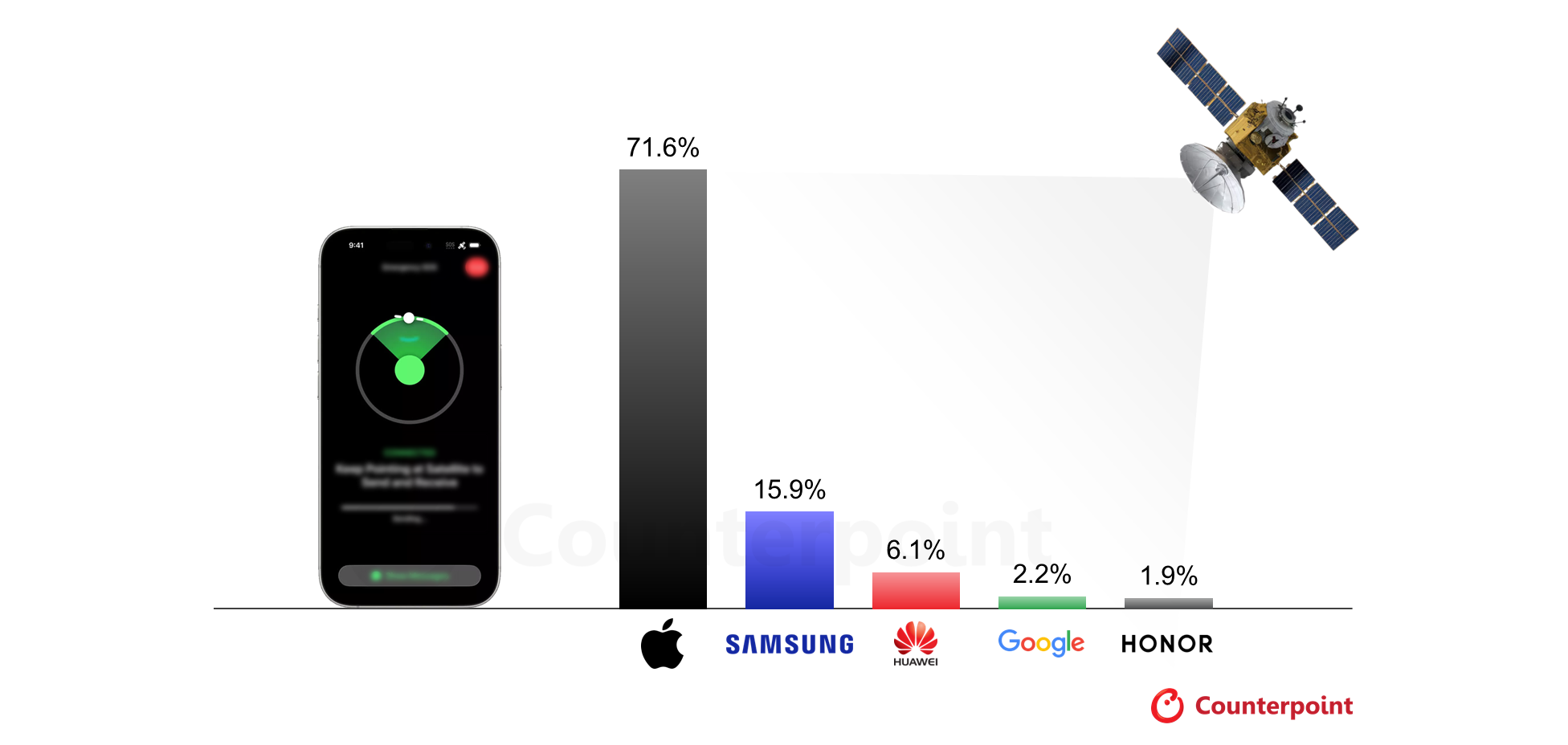
According to Counterpoint Research’s latest Smartphone Satellite Connection Report, nearly one in two smartphones will support satellite connectivity by 2030. The research firm projects NTN-capable devices to account for 46% of global smartphone shipments within six years, marking a dramatic shift from today’s premium-only availability.
Key Takeaways
- Counterpoint Research projects 46% of global smartphone shipments will be NTN-capable by 2030.
- Apple leads with Globalstar partnership whilst Samsung dominates Android satellite market.
- Amazon’s acquisition of Globalstar opens connectivity-as-a-service revenue opportunities.
- 3GPP NTN faces challenges around chipset readiness and operator certification.
- Premium segments drive current adoption, but mass market needs Release 19 for mid-price penetration.
What is driving smartphone satellite connectivity growth?
Apple pioneered mainstream satellite connectivity by partnering with Globalstar for the iPhone 14 in 2022. According to Principal Analyst Soumen Mandal at Counterpoint Research, Apple remains the leading smartphone OEM in terms of NTN-capable smartphone shipments. More than 10 brands now offer satellite connectivity in smartphones, representing rapid industry adoption since Apple’s initial breakthrough.
Amazon’s recent acquisition of Globalstar provides immediate scale and opens new revenue streams around connectivity-as-a-service. This development could fundamentally change how satellite connectivity is packaged and sold to consumers, potentially bundling it with services like Amazon Prime.
The technology addresses a genuine need for emergency communications in areas without cellular coverage. However, current 3GPP Release 17-based use cases remain limited to SOS and messaging, which explains why mass adoption hasn’t materialised despite the clear utility.
Which brands lead the satellite smartphone market?
Samsung leads the Android ecosystem whilst Apple dominates overall NTN-capable smartphone shipments. However, the industry has split into two distinct approaches for implementing satellite connectivity.
Apple, Huawei, and Google follow proprietary NTN approaches, creating closed ecosystems with specific satellite partners. Meanwhile, Samsung, Xiaomi, OPPO, HONOR, and vivo have aligned with 3GPP NTN standards to enable broader scalability and interoperability across the Android ecosystem.
This division reflects different strategic priorities. Proprietary solutions offer immediate deployment and tighter integration but limit scalability. The 3GPP approach promises broader compatibility but faces challenges related to chipset readiness, operator certification, and service maturity, which have slowed rollout.
What chipset vendors enable satellite connectivity?
According to Senior Analyst Shivani Parashar at Counterpoint Research, Qualcomm leads among Android chipset players through its Snapdragon X80 and X85 modems. The company has been at the forefront of enabling satellite connectivity, followed by Huawei, Google, and Samsung’s in-house solutions.
MediaTek is advancing NTN integration through its MT6825 5G SoC, adding competitive pressure that should help drive scalability. The research suggests that more participation from chipset players will increase competition whilst potentially reducing costs for smartphone manufacturers.
The smartphone market’s shift toward premium devices aligns with satellite connectivity’s current focus on high-end segments. However, broader chipset support will be crucial for extending these capabilities to mid-range devices.
Why hasn’t satellite connectivity achieved mass adoption?
Research Vice President Peter Richardson notes that satellite offerings are mostly driven by the premium segment, but the lack of killer use cases is limiting mass adoption. Current 3GPP Release 17-based functionality is restricted to SOS and messaging, which doesn’t justify the added cost for most consumers.
3GPP Release 18 will help further adoption across brands in the premium segment, but mass adoption in the mid-price segment is expected only with Release 19. This suggests satellite connectivity will remain a premium feature for several more years before reaching mainstream price points.
The technology also faces practical constraints, including design complexity, cost increases, limited use cases, regulatory complexities, and network immaturity. Solving these issues requires collaboration across the entire ecosystem, from smartphone OEMs to satellite operators.
What this means for the industry
According to Richardson, Apple, Google, and Samsung will lead in overall penetration by 2030, but Android brands targeting entry- and mid-price segments will initially see lower penetration. Satellite offerings from more Android players and telecom operators, beyond developed markets, will play a key role in accelerating global adoption.
North American telecom partnerships have driven early leadership, with T-Mobile partnering with SpaceX, AT&T partnering with AST Mobile, and Rogers partnering with SpaceX. While telecom operators in Europe and China aren’t rushing to offer satellite connectivity, satellite operators are increasing capacity to serve the mass market.
The satellite smartphone connectivity space promises to create opportunities across the entire ecosystem. Beyond traditional players, it will unlock new service models and bundled offerings, enabling companies like Amazon to integrate satellite connectivity into platforms such as Prime to enhance the consumer experience.
Regional adoption and market outlook
North America leads satellite smartphone adoption thanks to partnerships between major carriers and satellite operators. T-Mobile’s collaboration with SpaceX, AT&T’s tie-up with AST Mobile, and Rogers’ partnership with SpaceX have established the region as an early testing ground for satellite connectivity services.
The pace of global growth will depend on ecosystem collaboration to address current limitations. Companies must solve design and cost constraints, expand use cases beyond emergency services, navigate regulatory complexities, and mature satellite networks to support mass deployment.
In the UAE and the broader Middle East, where smartphone adoption continues to grow, satellite connectivity could enhance emergency services and communication options for outdoor activities or remote areas. However, specific local partnerships and regulatory frameworks remain to be established.
Frequently Asked Questions
What is an NTN-capable smartphone?
NTN-capable smartphones are devices equipped with Non-Terrestrial Network technology, allowing them to connect directly to satellites for communication, typically for emergency SOS or messaging services when cellular networks aren’t available.
Which brands offer satellite connectivity in smartphones?
Apple (iPhone 14), Huawei, and Google currently offer proprietary satellite connectivity solutions. Android brands like Samsung, Xiaomi, OPPO, HONOR, and vivo are implementing 3GPP NTN standard approaches for broader compatibility.
What are the main use cases for satellite connectivity in smartphones?
Currently, 3GPP Release 17-based use cases are limited to SOS emergency services and basic messaging. Future releases are expected to expand capabilities, but mass adoption requires more compelling use cases beyond emergency communications.
Who are the key players in the satellite smartphone chipset market?
Qualcomm leads among Android chipset players with its Snapdragon X80 and X85 modems. Huawei, Google, and Samsung also have satellite solutions, whilst MediaTek is advancing with its MT6825 5G SoC.
When will satellite connectivity become mainstream in smartphones?
Counterpoint Research projects 46% of smartphones will support satellite connectivity by 2030. However, mass adoption in mid-price segments is expected only with 3GPP Release 19, keeping it premium-focused for several more years.