At AED 1,719, the Samsung Galaxy A37 brings a sharp 6.7-inch AMOLED, a 5,000mAh battery good for a day of mixed use, and Samsung’s promise of six years of OS updates. The problem is the daily experience — laggy animations, an unreliable fingerprint reader, and an Exynos 1480 that struggles to justify the price when the Honor 600 and Nothing Phone 4a both undercut it at AED 1,599 with smoother performance. It’s a phone for Samsung ecosystem loyalists, and not really anyone else.
The Galaxy A37 costs AED 1,719 in the UAE, and at that price, it immediately runs into a problem: both the Nothing Phone 4a and the Honor 600 are sitting at AED 1,599 – AED 120 cheaper. In the mid-range, that gap tends to buy you something tangible, and Samsung needs to make the case that the A37 is worth the premium.
On paper, the case isn’t all that strong. The A37’s biggest change over the A36 is a chipset swap – Snapdragon 6 Gen 3 is out, replaced by Samsung’s own Exynos 1480. Beyond that, the main camera sensor has been upgraded, and the water resistance rating has gone from IP67 to IP68. The display, battery, charging speeds, and overall design are largely carried over from the last year.
This is fairly standard A-series territory. Samsung’s mid-range formula works, it sells, and the company doesn’t feel a particular urgency to shake things up dramatically year over year. Whether the A37 is a good phone is a separate question from whether it is a meaningful upgrade, and the two don’t necessarily have the same answer.
Specifications
| Spec | Samsung Galaxy A37 | Honor 600 | Nothing Phone 4a |
|---|---|---|---|
| Dimensions | 16.29 x 7.82 x 0.74 cm | 15.6 x 7.47 x 0.78 cm | 16.4 x 7.76 x 0.86 cm |
| Weight | 196 g | 185g, 190g | 204.5 g |
| Colours | Graygreen, Charkoal, White, Light Violet | Golden White, Black, Orange | Pink, White, Black, Blue |
| Display | 6.7 inches Super AMOLED, 120Hz, 1080 x 2340 pixels, 1200 nits (HBM), 1900 nits (peak), Corning Gorilla Glass Victus+ | 6.57 inches AMOLED, 120Hz, 1264 x 2728 pixels, 8000 nits (peak), Mohs level 4 | 6.78 inches AMOLED, 1224 x 2720 pixels, 120Hz, up to 4500 nits peak brightness, Corning Gorilla Glass 7i |
| Cameras | Main: 50 MP (wide) OIS, 8 MP (ultrawide), 5 MP (macro) Selfie: 12 MP (wide) |
Main: 200 MP (wide), 12 MP (ultrawide) Selfie: 50 MP (wide) |
Rear: 50 MP wide, 50 MP periscope telephoto (3.5x optical zoom), 8 MP ultrawide Front: 32 MP wide |
| Processor | Exynos 1480 (4 nm) | Qualcomm Snapdragon 7 Gen 4 | Qualcomm Snapdragon 7s Gen 4 |
| RAM | 6GB, 8GB, 12GB | 8GB, 12GB | 8GB, 12GB |
| Storage | 128GB, 256GB | 128GB, 256GB, 512GB | 128GB, 256GB |
| Battery | 5000 mAh | 7000 mAh, 6400 mAh | 5080 mAh, 5400 mAh |
| Charging | 45W wired | 80W wired, 27W reverse wired | 50W wired, 7.5W reverse wired |
Design, Display, and Features
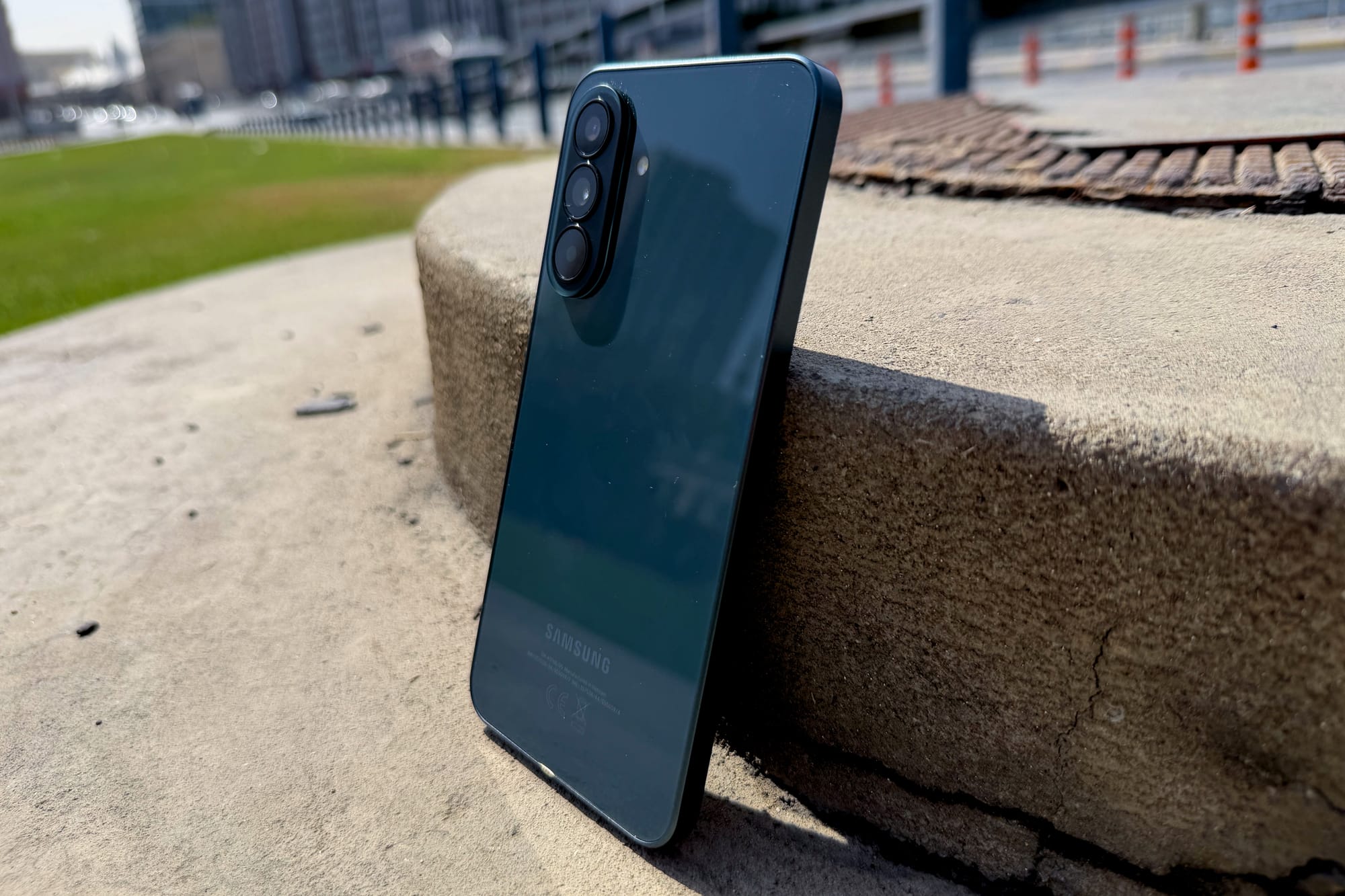
The Galaxy A37 follows Samsung’s established design language to the letter – recognisable, predictable, and not trying to stand out. We received the Graygreen colourway, one of four options alongside Charcoal, White, and Light Violet, and it’s a pleasant shade in person. Muted and understated, and quite classy if I may add.

The construction is glass on both the front and back with a plastic frame. Both sides are covered by Gorilla Glass Victus+, and despite the plastic frame, you have to step up to the A57 to get aluminium – the phone feels solid and well put together. There’s no flex in the chassis, no hollow knock when you tap the back, and the slightly flat sides make it comfortable to hold. What you do give up with glass is fingerprint resistance. The A37’s back collects prints and dust constantly, and if you are fussy about that sort of thing, you will be wiping it down a lot.

The camera island on the upper-left houses three lenses in Samsung’s familiar arrangement, and the module doesn’t protrude far enough to make the phone rock noticeably when laid flat on a desk. At 196g and 7.4mm thick, it’s a comfortable phone to handle for extended periods, and the IP68 rating – up from A36’s IP67 – means accidental splashes and drops in the sink are not a concern. It can handle up to 1.5m of submersions for 30 minutes.

The 6.7” Super AMOLED display is one of the A37’s stronger points. Running at 1080×2340 resolution with a 120Hz refresh rate, it looks sharp and punchy in everyday use. Colours are vibrant without feeling over-saturated, and the brightness holds up well under direct sunlight. Samsung’s AMOLED panels are consistently reliable at this price, and the A37 doesn’t fall too far from the Galaxy’s orbit.
There is one thing I noticed that I haven’t come across on a modern display before. Viewing the screen at an off-centre angle produces a faint rainbow-like sheen across the panel (only noticeable on white backgrounds). It’s subtle enough that it has no impact on normal use when you are looking at the phone straight on, but it was the first thing I caught when I picked the device up and tilted it. Whether it ever bothers you will depend on personal sensitivity, but it is worth flagging.

On the features side, a couple of things stand out, and not for particularly good reasons. The under-display optical fingerprint reader is unreliable. It fails to register on the first attempt a significant portion of the time, and when it does work, the unlock animation is slow enough that the whole process feels sluggish regardless. Pressing harder on the display tends to help it read, but that’s not something you want to think about every time you unlock your phone. The face unlock performs similarly. It’s actually a pain to unlock the phone, to be honest.

The stereo speakers are adequate in volume, but the quality behind that volume isn’t great. The sound is hollow and thin, with very little depth or bass response. For background audio while scrolling or a quick YouTube video, it does the job. Anything that calls for more than that, and you will want earbuds.
On the camera front, the A37 carries a 50MP main sensor with OIS and PDAF, paired with an 8MP ultrawide and a 5MP macro, plus a 12MP front camera. We will get into how all of that performs in the next section.

As for connectivity, the 5G, NFC, WiFi 6, and Bluetooth 5.4 are all present. The phone ships with Android 16 and OneUI 8.5, and Samsung is promising six major OS updates, which remains one of the strongest arguments for buying into the A-series over much of the competition. There is no charger in the box, which is standard Samsung practice at this point, so you will need to source a compatible 45W PD adapter separately.
Camera
The A37’s camera setup consists of a 50MP main sensor at f/1.8 with a 1/1.56″ sensor size, PDAF, and OIS – a sensor comparable in size to what Samsung uses in the base Galaxy S26. Alongside it sits an 8MP ultrawide at f/2.2 with a 123-degree field of view, and a 5MP macro lens at f/2.4. Up front, there’s a 12MP selfie camera. There is no telephoto lens, so anything beyond 1x is handled by cropping from the main sensor.


In daylight, the cameras are capable enough, but with a ceiling that becomes apparent once you start looking closely at the results. The main sensor pulls in good light and produces images that are bright and punchy with solid colour representation, but Samsung’s post-processing leans heavily on sharpening to hold the image together, and it starts to show – particularly in areas of fine detail where the oversharpening introduces an artificial, almost over-rendered look to the image.
Step up to 2x or 4x zoom and the problems compound: detail drops off fairly quickly, and the compression that creeps in can make shots look noticeably noisier than you’d want.


After dark, the 1x shots do a reasonable job of pulling in enough light to produce accurate, well-exposed images. The colours are a touch punchier than I would prefer in low light – there’s a tendency to saturate the scene more than what the eye actually sees – but it’s not egregious. Push it beyond 1x at night, though, and the camera quickly loses the plot. Details fall apart, noise climbs, and the results become increasingly unreliable the more you ask of it.
As a whole, these are a fairly average set of cameras that don’t do much to distinguish the A37 in a competitive mid-range field. Both the Honor 600 and the Nothing Phone 4a struggle with some of the same tendencies – oversharpening, digital zoom limitations – but both produce better overall results, with the Nothing Phone 4a in particular offering a more versatile and consistent camera experience.
Performance and Software
The Galaxy A37 is powered by Samsung’s Exynos 1480, a 4nm chip that first appeared in the Galaxy A55 back in 2024. It’s paired with LPDDR5X RAM and UFS 3.1 storage, and comes in three configurations: 128GB with 6GB or 8GB of RAM, and 256GB with 8 GB of RAM. There is no storage expansion.
The Exynos 1480 is not a new processor, and it wasn’t at the top of its class when it debuted two years ago either. Paired against two phones that have been through our hands recently – the Nothing Phone 4a and the Honor 600, both of which cost AED 120 less than the A37 – it tells an interesting story depending on which numbers you look at.
| Benchmark | Samsung Galaxy A37 | Honor 600 | Nothing Phone 4a |
|---|---|---|---|
| Geekbench 6 CPU – Single Core | 1,131 | 1,308 | 1,247 |
| Geekbench 6 CPU – Multi Core | 3,198 | 4,076 | 3,345 |
| Geekbench 6 GPU | 4,024 | 4,775 | 3,548 |
| Geekbench AI | 2,143 | 3,370 | 1,599 |
| 3DMark Steel Nomad Light | 481 | 757 | 397 |
| 3DMark Wildlife Extreme | 1,041 | 2,057 | 1,104 |
| 3DMark Sling Shot Extreme | 6,049 | Maxed Out | 5,513 |
Against the Nothing Phone 4a, the picture is genuinely mixed. The A37 pulls ahead in GPU-heavy tests – it scores 4,024 in Geekbench 6 GPU against the 4a’s 3,548, and posts 481 in 3DMark Steel Nomad Light compared to the 4a’s 397. But on the CPU side, the Nothing 4a’s Snapdragon 7s Gen 4 holds the edge: 1,247 in single-core and 3,345 in multi-core versus the A37’s 1,131 and 3,198, respectively. In 3DMark Wild Life Extreme, the 4a also edges it out at 1,104 against the A37’s 1,041. So on paper, neither phone is definitively faster than the other – they trade blows depending on the workload.
The Honor 600 is a different conversation entirely. Running the Snapdragon 7 Gen 4, it posts 1,308 in Geekbench single-core, 4,076 in multi-core, 4,775 in GPU, and 2,057 in 3DMark Wild Life Extreme. That’s a clear and consistent lead over the A37 across every test, and the Honor 600 does this for AED 1,599 – AED 120 less. The value argument for the A37 on performance grounds simply doesn’t hold up when you put the numbers side by side.

One genuine positive from our testing is the thermal performance. In the 3DMark Wild Life Extreme Stress Test, the A37 posted a best loop score of 1,045 and a lowest of 1,035, landing at 99% stability across 20 loops – an almost perfectly flat curve. Device temp only climbed from 32C to 34C throughout. The Exynos 1480 runs cool and throttles almost nothing. The problem is that the ceiling it’s maintaining so consistently isn’t particularly high to begin with, but if you do plan on running the phone for extended periods, at least it won’t cook itself.
Where the benchmarks fail to tell the full story is in daily use. The A37 feels sluggish across the board. Animations stutter, bringing down the notification shade or the settings panel produces a visible lag, and switching between apps is cumbersome enough to notice every single time. Compared to the Nothing Phone 4a and the Honor 600 – which were relatively smooth – the A37 falls noticeably short.
On the software side, the A37 ships with One UI 8.5 on top of Android 16, which is the same version running on the Galaxy S26 Ultra. It’s the familiar Samsung experience. Samsung is also promising six major OS updates, which, at this price point, is one of the more compelling reasons to buy into the A-series, although how the performance will hold up over the years…I am not too positive about that.
What the A37 does not get is the full Galaxy AI suite. Several features remain exclusive to Samsung’s S26 flagship lineup – the enhanced Photo Assist tool that lets you edit images by describing changes to an AI, Now Brief and Now Nudge, and more. What you do get includes a more capable Bixby with improved contextual awareness and live web search, Circle to Search via Google, some AI editing tools in the Gallery App – object eraser, AI remaster, erase reflections – and AI-powered screenshot search that can index and find content within your saved screenshots. It’s a reasonable subset for the price tier, and expecting the full Galaxy AI experience on a mid-range Exynos chip was never really on the table.

Battery Life
The A37 packs a 5,000mAh battery – the same capacity Samsung has been putting in the A-series for several generations running. The A33, A34, A35, and A36 all had the same cell, and the A37 continues the tradition of its forefathers. That said, the phone manages to squeeze decent endurance. In mixed day-to-day use – browsing, social media, messaging, some camera use – the A37 easily gave me a day or so, and maybe even more when I did waste time watching food videos on Instagram.
Charging is handled at 45W via Samsung’s Super Fast Charge 2.0. You are looking at roughly 62% in 30 minutes and a full charge in just over an hour, which is pretty decent. There is no wireless charging, which is expected at this price, and as is standard Samsung practice, there is no charger in the box – so if you don’t already own a compatible charger, factor that into the cost.
Should You Buy the Samsung Galaxy A37?
The Galaxy A37 isn’t a bad phone in any catastrophic sense. It makes calls, takes photos, and gets through a day on a single charge. But the mid-range bar in 2026 has moved high enough that “functional” no longer justifies AED 1,719 — especially when the daily experience is this rough around the edges.
Buy the Galaxy A37 if:
- You’re locked into the Samsung ecosystem and want a phone that pairs seamlessly with your Galaxy Watch, Buds, and SmartThings setup.
- Six years of OS updates is the single most important thing on your list at this price.
- You prefer One UI’s polish and feature depth over raw responsiveness.
Don’t buy the Galaxy A37 if:
- You care about how a phone actually feels day to day. The laggy animations, stuttering notification shade, and unreliable fingerprint reader add up fast.
- You want the best cameras for the money. The Nothing Phone 4a does it better, for AED 120 less.
- You want the strongest performance at this price. The Honor 600 outpaces it across every benchmark, also for AED 120 less.
For most buyers, either the Honor 600 or Nothing Phone 4a is the more rational pick at AED 1,599 — and our guide to the best phones under AED 3,000 in the UAE covers the rest of the field if you want to look wider. The A37 is a hard sell for everyone else.
Galaxy A37 FAQs
Is the Samsung Galaxy A37 worth buying in the UAE?
At AED 1,719, the Galaxy A37 is a hard sell. It offers a sharp 6.7-inch AMOLED display and Samsung’s promise of six years of OS updates, but daily performance is sluggish thanks to the dated Exynos 1480 chipset and an unreliable fingerprint reader. Both the Honor 600 and Nothing Phone 4a are AED 120 cheaper at AED 1,599 and deliver smoother performance, making the A37 worth buying only for committed Samsung ecosystem users.
How long will the Samsung Galaxy A37 get software updates?
Samsung is promising six major Android OS updates for the Galaxy A37, which means the phone should be supported through 2032. That’s one of the longest update windows in the AED 1,500–2,000 mid-range segment and remains one of the strongest arguments for buying into the A-series.
Is the Samsung Galaxy A37 waterproof?
The Galaxy A37 carries an IP68 rating, an upgrade from the A36’s IP67. That means it can survive submersion in up to 1.5 metres of fresh water for up to 30 minutes, which covers accidental drops in the sink, splashes by the pool, and getting caught in the rain.
Does the Samsung Galaxy A37 come with a charger?
No. As is now standard practice for Samsung, there is no charger in the box. The A37 supports 45W wired charging via Samsung’s Super Fast Charge 2.0, so you will need to source a compatible 45W PD adapter separately to hit those speeds.
Galaxy A37 vs Honor 600: Which is better?
The Honor 600 is the better phone for most buyers. It costs AED 120 less at AED 1,599, runs the more capable Snapdragon 7 Gen 4, posts higher scores across every benchmark, and ships with 80W charging, compared to the A37’s 45W. The Galaxy A37 only wins on software longevity — six years of updates versus Honor’s typical four — and on Samsung ecosystem integration if you already own a Galaxy Watch or Buds.