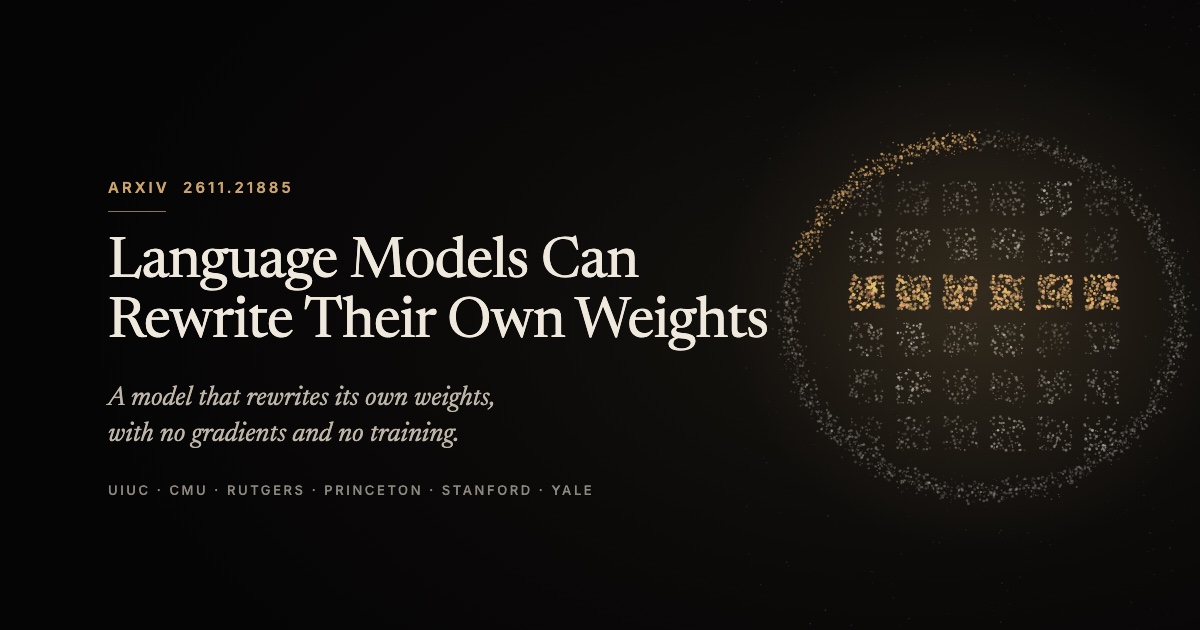
An open 27B Qwen3.5 language model rewrote its own weights and scored 6.6 points higher on problems it hadn’t seen, without a training run.
Earlier work used a frontier model to edit a much smaller one, but the 27B model made its own edits without a bigger model helping. The result comes from an arXiv preprint led by Jiajun Fan, a PhD student at the University of Illinois Urbana-Champaign, with Ge Liu as last author. The paper hasn’t been peer reviewed.
In 1947, Alan Turing said letting a machine alter its own instructions “provides the mechanism” for learning from experience, but “does not get us very far”.
How the model edited itself
The researchers gave the model access to its weights, its graded answers, and the ability to run itself. It examined its answers to work out why it failed, then edited the weights it identified without using gradients.
The model tested its changes on practice problems and kept only the edits that worked. Its accuracy rose across eight consecutive sessions, and the researchers measured the 6.6-point gain on problems the model hadn’t seen during those tests.
In a separate experiment, a damaged copy could solve almost nothing. The model restored it to more than 80% of its original accuracy on unseen image tasks without retraining or reading the original weights.
In one demo on the team’s project page, the unedited model repeated the same sentence 549 times and hit a 16,384-token limit without answering a counting problem. After the edit, it got the answer, 110, right in 5,341 tokens.
Only the largest model improved itself
The researchers gave four Qwen3.5 models the same task and tools, including access to their own weights. Only the 27B model improved.
| Qwen3.5 size | Result |
|---|---|
| 2B | Made no edit |
| 4B | Performed worse after editing itself |
| 9B | Did not improve |
| 27B | Improved after editing itself |
The 2B model replied that, as a text model without actual neural network weights, it was unable to edit its weights directly. The 27B model instead proposed a specific change: “The differences grow with depth. Let me try a very small edit on an earlier layer (layer 8) to see if that helps.”
What it costs to make an edit
The team says the editing process took a few hours on one GPU and adds no cost per answer. That’s different from test-time scaling, which uses extra computation each time the model answers, but the project’s cost chart is schematic and its cost lines aren’t measured.
The authors envision models that can keep upgrading themselves without a larger model or changes to their prompts or testing setup. They argue that self-rewriting is a necessary step towards “recursive self-improvement”.