
From Channels to Tiles: The New Rules of Media Power
At The Bridge Summit in Abu Dhabi, Vox, Bloomberg and S4 Capital unpack how Netflix, HBO, AI and aggregators are reshaping what 'iconic' media brands mean.

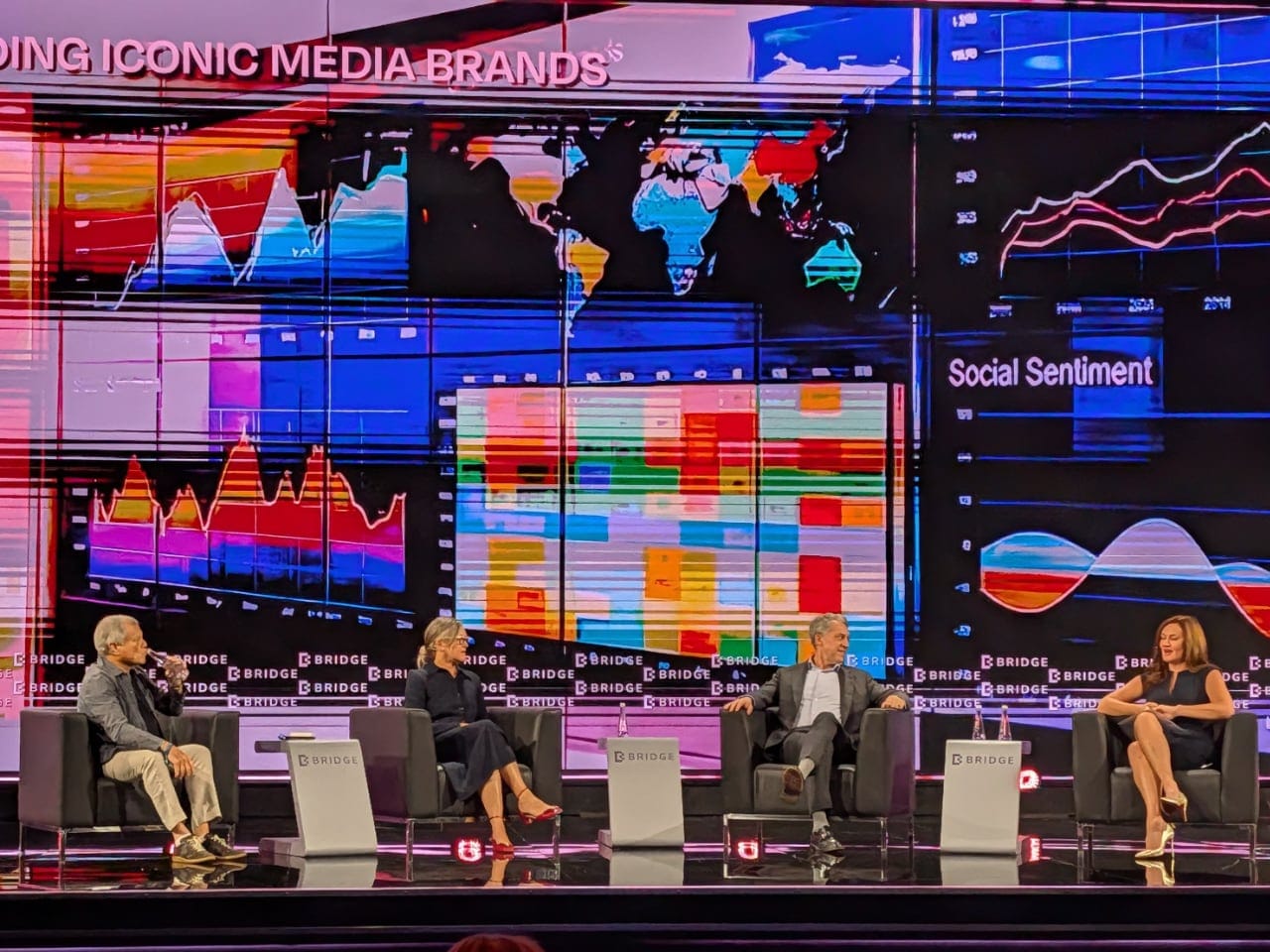
At The Bridge Summit in Abu Dhabi, a panel on “Building Iconic Media Brands” featured three people who, collectively, sit across the entire media value chain:
- Jim Bankoff, co-founder & CEO of Vox Media
- Christine Cook, CCO of Bloomberg Media
- Sir Martin Sorrell, executive chairman of S4 Capital
On the surface, this was another conference panel about “brands,” “storytelling,” and “quality content.” Underneath, the conversation was about something else: what it means to build any kind of media company in a world where distribution and advertising are increasingly controlled by a handful of hyperscale platforms, and where AI is set to amplify that concentration.
Aggregation Theory & the Media Squeeze
In the old media world:
- Distribution was scarce (print runs, broadcast spectrum, cable bundles).
- Editors and programmers decided what audiences saw.
- Advertisers paid a premium to sit next to that scarce attention.
In the new world:
- Distribution is effectively infinite.
- The constraint is user attention, mediated by aggregators: products that own the user relationship, control discovery, and monetise through data and ads or subscriptions.
Platforms like Netflix, YouTube, TikTok and social feeds are aggregators in this sense. They don’t depend on any single content supplier, but every content supplier depends on at least some of them.
This is the context in which the Abu Dhabi discussion about Netflix and Warner Bros. Discovery (and by implication HBO) actually matters. It’s not simply about “great shows” or “legacy brands”; it’s about how far aggregation can go.
Moderator Hadley Gamble framed it directly, pointing to “this Netflix move to buy Warner Brothers” as the deal everyone in the industry was talking about. One of the first questions to the panel: would a deal like that actually go through?
Netflix, HBO, and the Logic of Up-Market Bundling
The more interesting question than regulatory odds is why Netflix would want WBD in the first place, and what that implies about where we are in the streaming cycle.
Netflix’s current situation looks something like this:
- Differentiation is harder: Every major media conglomerate now has a streaming service with a recognisable logo and reasonably deep catalogue. Netflix’s original advantage was “everything, in one place, with a great interface.” Now, “everything” is fragmented across multiple apps.
- Content costs are rising faster than pricing power: Original programming is expensive. International expansion adds complexity. Price increases are possible, but only up to a point before churn spikes.
- Advertising scale is relative: Netflix’s ad business is growing, but in the context of global digital advertising, it is still a mid-sized player compared to the biggest platforms.
HBO, by contrast, is shorthand for prestige: if a series carries the HBO logo, the probability it’s worth watching is higher than almost any other label in television.
From the panel, Hadley Gamble put it bluntly:
“Advertising aside, HBO has been the high watermark for quality content production and entertainment.”
Historically, HBO’s limitation has been distribution: it lived inside cable bundles, regional deals and a messy streaming transition. Netflix has the opposite profile: world-class distribution and discovery, with more variable content quality.
In Aggregation Theory terms:
- HBO has high-value, hard-to-replicate content but weak, fragmented distribution.
- Netflix has world-class distribution and discovery, but content that is less consistently premium.
Bundling HBO into Netflix:
- Strengthens Netflix’s position as the default entertainment aggregator.
- Gives Netflix a deeper catalogue of “cultural moments” (shows people talk about together, not just watch alone).
- Enhances Netflix’s ad product with more obviously premium inventory.
Martin Sorrell also stressed the structural pressure driving deals like this, noting:
“Ad revenues are a trillion dollars. There’s a 300 billion that’s in the traditional business and 700 billion in the digital business.”
In other words, Netflix is not just buying shows; it is buying positioning in a market where scale and premium status both matter.
If a deal like this ultimately happens, the streaming landscape will solidify into:
- A small number of global aggregators (Netflix, Disney, Amazon, Apple to some extent).
- A set of powerful brands (HBO, ESPN, Disney, etc.) increasingly living inside those aggregators.
- Everyone else competing as niche specialists or upstream suppliers.
From the outside, the question becomes: when does an “iconic media brand” stop being a company and start being a tile?
Advertising: The Gravity of Scale
If content is one side of the story, advertising is the other.
On stage, Sorrell used the global ad numbers to explain why so many media and agency deals feel inevitable. Digital is growing; traditional is shrinking; the largest platforms capture a disproportionate share and reinvest into data, targeting, and infrastructure.
“What it epitomizes from my point of view is this pressure, you know, ad revenues are a trillion dollars.”
The consequences for media brands:
- Pricing power weakens. Publishers selling ads don’t just compete with other publishers; they compete with performance-driven, highly targeted platform ad systems.
- Intermediation grows. Even when advertisers care about a specific context (e.g. HBO, Bloomberg), the buying is often routed through platform tools and metrics.
From an Aggregation Theory perspective, advertising markets reward:
- Control of user attention at scale.
- The ability to measure and optimise outcomes.
Both dynamics tend toward concentration. A panel about “iconic media brands” naturally slides into a discussion about survival as suppliers to these systems rather than alternatives to them.
Brands as Filters in an Infinite Feed
None of this means brands are irrelevant. Infinite feeds arguably make brands more important as filters.
In the linear era:
- You watched what was on.
- The channel number and timeslot were built-in filters.
In the on-demand era:
- You choose what to watch or read.
- The default filter is the feed or recommendation engine.
- Within that, brand marks signal quality, worldview or taste.
Christine Cook pushed back on the idea that brands like CNN or HBO simply disappear:
“CNN has a brand reputation. Bloomberg Media has a brand reputation. It means a particular thing.”
She later tied this to user behaviour:
“I do think that as consumers have so many more things at their touch points, going back to a trust of quality entertainment will remain.”
Brands still matter, but what has changed is where they sit:
- Historically, the brand sat on top of the distribution system (a newspaper masthead, a channel, a magazine).
- Now, the brand sits inside a larger distribution system (a tile inside Netflix, a show feed inside a platform, a section inside an app).
The aggregation point moved down a layer. Power moved with it.
Institutions, Creators, and the Return of the Network
Jim Bankoff’s perspective from Vox complicated the usual “institutions vs creators” story.
He framed platforms as quasi-sovereign environments:
“We have to understand what’s happening on these platforms that are nation states in terms of their breadth.”
The reality for anyone starting or running a media brand is uncomfortable:
- You cannot avoid the platforms; they are where the audience is.
- The platforms “change the rules to suit themselves, not to suit those of us who are building and distributing through them,” as Bankoff put it.
His prescription is not to dream of exiting the system, but to become indispensable within it:
“Work on making yourself essential, not so much to them, but essential to the end audience… to be immune to the whims of the algorithms.”
This is where the creator discussion comes in.
- Individual journalists, podcasters and commentators build direct audiences.
- As they scale, they hit operational limits: sales, production, legal, HR, growth.
- Institutions that can offer infrastructure, monetisation and cross-promotion, without suffocating the individual voice, become attractive again.
Instead of the old hierarchy (institution → anonymous staff → brand), you get a network (institution → named talent → audience), with the institution acting as a talent platform.
The strategic tension for institutions is obvious:
- Offer enough upside and autonomy that star talent stays.
- Capture enough value that the institution itself is sustainable.
Bloomberg: Platform First, Media Second
Bloomberg’s presence on this panel pointed to a different archetype altogether.
Christine Cook described Bloomberg’s positioning very clearly:
“Bloomberg Media sits at an interesting point as a media company because our primary audience are global business leaders… you have proprietary data.”
She went on:
“With proprietary data, we produce a particular stream of information following global news around the world. You wake up with our Tokyo and Sydney bureau… in the Middle East, on to London and then New York.”
Bloomberg’s core product is the terminal:
- A workflow and data platform for finance professionals.
- Sold as a high-ARPU subscription.
- Deeply embedded in daily decision-making.
On top of this platform sit:
- Bloomberg News
- Bloomberg TV and digital video
- Bloomberg events and summits
The loop is straightforward:
- Terminal revenue funds an extensive newsroom.
- The newsroom’s credibility and speed reinforce the terminal’s indispensability.
- Events deepen relationships with the same high-value audience.
From a strategic perspective, Bloomberg looks much more like an aggregator within its niche:
- It owns the workflow.
- It controls the primary interface for a key professional audience.
- Media is a feature of a larger product, not the entire product.
In this model, the “iconic” status of the media brand is downstream of the product’s indispensability.
Events, Geography, and Non-Fungible Media
Another thread that kept resurfacing in Abu Dhabi was the growing importance of events and live experiences.
Bankoff referenced Alexis Ohanian’s remarks about human connection, and then made a simple point:
“Live experiences are very difficult to replicate, through a digital algorithm.”
This matters for two reasons:
- Events resist commoditisation. Platforms can market them, but the value is in the room: who you meet, who you sit next to, what conversations happen off-stage.
- Events anchor geography. Summits like The Bridge in Abu Dhabi turn a media brand into a convening power rooted in a specific place and ecosystem.
Bloomberg sees this directly in its client relationships. Cook noted that brands increasingly “want that relationship either at a live event or for us to produce adjacent content,” with agencies coming in around that direct connection.
For media companies, this suggests that:
- Live convening is not just marketing; it is a product.
- Geography and community are hedges against purely digital, platform-mediated competition.
- The ability to convene the “right” few hundred people can be more valuable than reaching millions of anonymous viewers.
The Bridge Summit itself is an example: a regional event in Abu Dhabi that pulls together global and regional media, tech and capital, and gives them a physical context to operate in.
AI, Capex, and the Next Phase of Concentration
Hovering behind all of this is AI.
The largest platforms are investing tens of billions of dollars into:
- Data centres
- Custom chips
- AI models and infrastructure
AI affects media on two axes.
On the supply side:
- It lowers the cost of generating text, images, audio and eventually video.
- Content volume explodes.
- Undifferentiated content becomes even less valuable.
On the distribution side:
- AI-mediated interfaces (assistants, summarisation layers, generative search) sit between users and sources.
- The owner of the interface decides which brands appear, in what order and how often.
- Measurement and attribution become more deeply embedded in the platform itself.
Put bluntly: AI accelerates aggregation.
For media brands, the strategic question shifts from “how do we use AI to produce more?” to “what do we have that AI-driven aggregators cannot easily copy or replace?” Possibilities include:
- A proprietary workflow or data product (Bloomberg).
- Deep, long-term trust with a specific audience segment.
- A real-world network, convened through events and communities.
- A portfolio of distinctive voices that audiences seek out proactively.
The panel circled these answers without fully resolving them. That reflects where the industry is: between realising the old model is gone and fully articulating the new one.
So What Is an “Iconic Media Brand” Now?
If we strip away the nostalgia and apply the lens of Aggregation Theory to what was discussed at The Bridge Summit, an “iconic media brand” in the 2020s and 2030s is unlikely to look like a 20th-century channel or newspaper.
Instead, it is more likely to be one of the following:
- A Workflow Owner with a Media Layer
- Bloomberg is the canonical example.
- The brand is iconic because the product is indispensable.
- Media exists to reinforce and expand that product.
- A Talent Network Inside the Platforms
- Companies that assemble portfolios of creators and shows.
- The brand is iconic because it repeatedly discovers, develops and packages voices audiences care about.
- Economics depend on aggregators, but the brand has bargaining power via audience and talent.
- A Convening Power Tied to a Geography or Vertical
- Summits, conferences and communities where physical presence matters.
- The brand is iconic because it represents a real-world network capital, policy and culture flow through.
- Digital media becomes the funnel into these high-value offline interactions.
In all three cases, the brand is not defined primarily by a format (newspaper, channel, website), but by a function in a larger system: workflow, network or convening power.
That is the deeper lesson of the Abu Dhabi conversation. When we talk about Netflix potentially buying HBO, about Bloomberg’s terminal model, or about Vox mediating between platforms and talent, the real subject is the re-wiring of the media value chain:
- Aggregators at the top.
- Brands as filters, not gatekeepers.
- Workflows and networks as the true moats.
“Iconic” has not disappeared. It has migrated from surfaces to structures.
Written by

Subscribe to our newsletter
Subscribe to our newsletter to get the latest updates and news








Member discussion