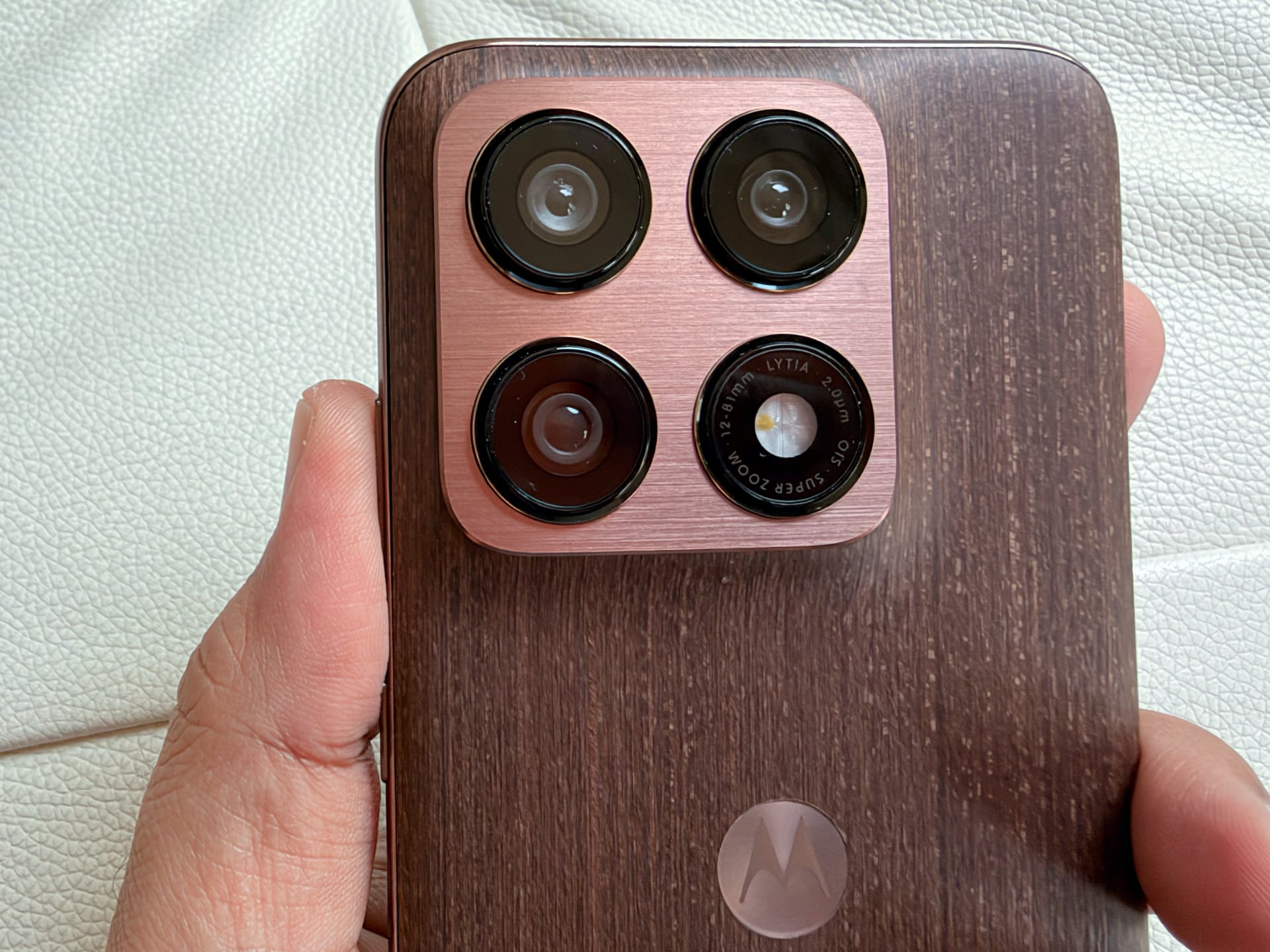
Four 50MP Cameras — But What Does That Actually Mean?
Every phone maker loves a spec-sheet number, and “quad 50MP” is a big one. But the Motorola Edge 70 Pro’s camera claim isn’t just resolution inflation — each of the four sensors serves a distinct purpose, and the main shooter uses a Sony sensor that’s been earning its reputation in phones costing twice as much. Let’s break down what each lens does and whether the system as a whole delivers.
Main Camera: Sony LYTIA 710 With OIS
The star of the show is the 50MP Sony LYTIA 710 sensor with an f/1.88 aperture and optical image stabilisation. The LYTIA 710 sits in Sony’s newer sensor family — the one that’s been appearing in phones like the Xiaomi 15 Ultra and other premium devices. At this price point, it’s an unusually capable sensor.
What does that translate to in practice? Expect strong detail retention in daylight, accurate skin tones (Motorola’s Pantone Validated colour processing helps here), and noticeably better low-light performance than typical mid-range sensors. The f/1.88 aperture lets in a good amount of light, and OIS keeps handheld shots stable — particularly useful for the longer exposures that night mode demands.
Where you’ll see the Dimensity 8500’s processing limits is in computational photography speed. Flagship phones with Snapdragon 8 Gen 4 chips process Night Sight and HDR stacks noticeably faster. The Edge 70 Pro will take a beat longer, but the final image quality should be competitive.
Ultrawide and Macro: Two Jobs, One Lens
The 50MP ultrawide (f/2.2) doubles as a macro lens — a practical approach that means you get genuinely usable close-up shots instead of the 2MP dedicated macro lenses that plague most mid-range phones. At 50MP, the ultrawide has enough resolution to crop aggressively while still retaining detail, which is useful for architecture, landscapes, and the kind of sweeping interior shots that look good on Instagram.
Macro mode shifts to a close-focus distance that lets you capture small subjects — food details, textures, insects — with significantly more clarity than budget macro lenses. It won’t match a dedicated macro camera, but it’s a meaningful upgrade over what most phones in the AED 2,000–3,000 range offer.
Periscope Telephoto: 3.5x Optical, Up to 50x AI Zoom
This is where the Edge 70 Pro punches well above its weight. A 50MP periscope telephoto with 3.5x optical zoom and OIS is the kind of hardware you typically find in phones north of AED 4,000. The f/2.8 aperture is standard for periscope lenses, and the OIS is essential for keeping telephoto shots sharp.
At 3.5x, you get genuine optical zoom — no digital cropping, no quality loss. This matters for street photography, concerts, wildlife, and any situation where you can’t physically get closer to your subject. Most mid-range competitors offer 2x optical zoom at best, or rely entirely on digital crop from the main sensor.
Motorola extends the zoom range digitally through Super Zoom Pro, which uses generative AI to enhance images from 20x up to 50x. AI-enhanced zoom is inherently artificial — the phone is essentially filling in detail that doesn’t exist in the optical data — but at social media resolutions, the results can be surprisingly usable. Don’t expect miracles at 50x, but 10x to 20x should produce shareable images.
Front Camera: 50MP With 4K Video
The 50MP front camera (f/2.4) is more capable than most selfie shooters at any price. The resolution means cropping and reframing are viable without destroying quality, and 4K video recording from the front camera is a genuine perk for content creators, vloggers, and anyone who uses their phone as their primary video tool.
Pantone Validated skin tone processing applies to the front camera too, which should help with the colour accuracy issues that plague many phone selfie cameras — particularly with darker skin tones in challenging lighting.
AI Camera Features
Motorola bundles its full AI imaging suite:
| Feature | What It Does |
|---|---|
| Super Zoom Pro | Generative AI enhancement from 20x to 50x zoom |
| AI Eraser | Remove unwanted objects from photos |
| AI Upscale | Enhance resolution of older or lower-quality images |
| Image-to-Video 2.0 | Convert still photos into short animated clips |
| Pantone Validated | Colour-accurate processing for skin tones and environments |
These features are processed on-device using the Dimensity 8500’s NPU. They’re nice to have, though how often you’ll use AI Eraser or Image-to-Video depends entirely on your workflow. The Pantone colour processing is the one that makes a daily difference — it runs in the background on every shot.
How Does It Compare to Rivals?
| Camera Spec | Edge 70 Pro | Samsung Galaxy A56 | OnePlus 13R |
|---|---|---|---|
| Main | 50MP Sony LYTIA 710, OIS | 50MP, OIS | 50MP Sony LYT-700, OIS |
| Ultrawide | 50MP (macro capable) | 12MP | 8MP |
| Telephoto | 50MP periscope, 3.5x optical, OIS | 5MP macro | 50MP, 2x optical |
| Front | 50MP, 4K video | 12MP | 16MP |
| AI Zoom | Up to 50x (generative AI) | 10x digital | 20x digital |
On paper, the Edge 70 Pro’s camera system is the most complete in its price range. The periscope telephoto alone sets it apart — neither the Galaxy A56 nor the OnePlus 13R offers genuine optical zoom beyond 2x. The 50MP ultrawide/macro is also a clear upgrade over the 8MP and 12MP ultrawides in competing phones.
The real question is whether Motorola’s image processing can match Samsung’s and OnePlus’s more mature computational photography. Samsung has years of refinement in skin tones, HDR, and scene detection. OnePlus benefits from Hasselblad colour tuning. Motorola’s Pantone approach is different — arguably more scientifically rigorous — but processing matters as much as hardware in mobile photography.
Bottom Line: Camera Worth Considering
The Motorola Edge 70 Pro’s camera system is, on specs, the strongest in the AED 2,000–3,000 segment. The Sony LYTIA 710 main sensor, the periscope telephoto, and the 50MP front camera are all genuinely premium components at a mid-range price. Whether Motorola’s software processing can extract the full potential of this hardware will determine if the spec-sheet advantage translates to real-world results.
For the full spec breakdown and pricing details, see our specs analysis and pricing guide. For the complete overview, visit the Motorola Edge 70 Pro hub.
Frequently Asked Questions
What camera sensor does the Motorola Edge 70 Pro use?
The main camera uses the Sony LYTIA 710 sensor with 50MP resolution, f/1.88 aperture, and optical image stabilisation. It’s the same sensor family found in several flagship phones.
Does the Motorola Edge 70 Pro have optical zoom?
Yes — the 50MP periscope telephoto lens provides 3.5x optical zoom with OIS. Digital zoom extends to 50x using Motorola’s Super Zoom Pro generative AI enhancement.
Can the Motorola Edge 70 Pro record 4K video from the front camera?
Yes — the 50MP front camera supports 4K video recording, making it a strong choice for vloggers and content creators.
How does the Motorola Edge 70 Pro camera compare to Samsung Galaxy A56?
The Edge 70 Pro has a significantly more versatile camera system: a Sony LYTIA 710 main sensor (vs Samsung’s generic 50MP), a 50MP ultrawide (vs 12MP), and a 50MP periscope telephoto with 3.5x optical zoom (vs a 5MP macro). The front camera is also 50MP with 4K vs Samsung’s 12MP.