The Honor X7e Plus gets quite a few things wrong. It is slow, the display is an LCD, MagicOS is stuffed with bloatware, and there is only one proper camera on the back despite how hard the camera island tries to convince you otherwise.
But at a starting price of AED 899…I like it!
The X7e Plus makes its compromises in places you would expect from a phone at this price, and spends the money elsewhere. It has an enormous 8,100mAh battery, is rated to survive drops from up to 2.5 metres, and comes with IP68/69/69K protection against dust and water. You are not going to find that combination on many phones below AED 1,000 (and hey, not even above that).
The durability is not all marketing talk, either. I dropped the phone hard a couple of times during testing, scratched the front and back with keys and nails, and carried it around without a case. None of it left a visible mark. Not even a small scratch.
So while the X7e Plus is not the phone to buy if you want the fastest processor, the best screen or a versatile camera system, it makes a great case for itself as a dependable secondary phone. It is also suited to anyone who works in rough conditions, regularly drops their phone or just wants something that can last an entire day and then some without constantly worrying about it.
Honor X7e Plus 5G
The Honor X7e Plus offers excellent battery life and a rugged build at an affordable price, but its weak camera, unreliable fingerprint sensor and frustrating buttons keep it from being a better budget all-rounder.
- Excellent two-day battery life
- Strong drop and scratch resistance
- Pleasant design despite the rugged build
- Useful AI features for the price
- Good value for buyers who prioritise endurance
- Unreliable fingerprint sensor
- Spongy power and AI buttons
- Too much preinstalled bloatware
- Camera quality is below average
Tbreak Media UAE may earn a commission on purchases made through these links — it never affects our scores.
Specification
Specifications
Honor X7e Plus 5G
Body
Display
Camera
Hardware
Battery
Design, Display and Features
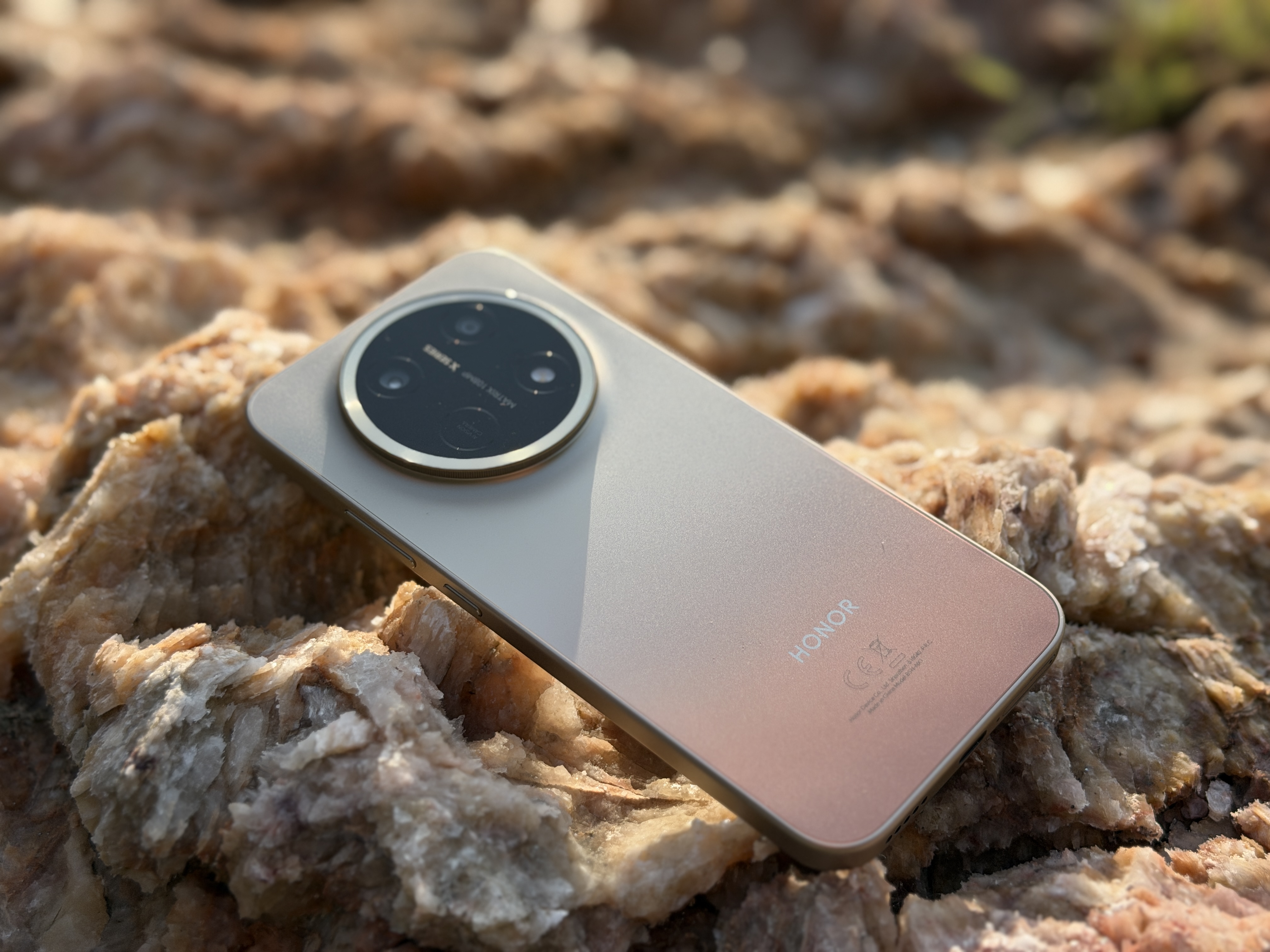
The Honor X7e Plus does not look like a rugged phone, which I appreciate. There are no oversized rubber bumpers, exposed screws or a body that looks like it was designed to survive a small explosion. It looks like a regular budget phone, albeit a rather large and heavy one.

My review unit is the Meteor Silver version with 256GB of storage. The rear panel has a soft matte finish that feels reasonably grippy, while silver accents run around the frame and camera island. It is a pleasant-looking phone, and although nothing about it feels particularly premium, it does not come across as cheap, either.
Both the frame and the rear panel are made from plastic, which makes sense considering the durability angle. Glass might have made the phone feel more expensive, but it would also introduce another surface that could crack the moment it lands badly on the floor. The plastic body feels solid, with no obvious creaking or flex when handled normally.

The X7e Plus weighs 216.5g, which is not particularly heavy, but the chunky frame makes it feel heavier than it is. It is 8.3mm thick, although considering there is an 8,100mAh battery inside, it could have been much chunkier. You will notice the weight the moment you pick it up, but the phone is balanced well enough that I did not find it uncomfortable during longer periods of use.
The camera island is probably the flashiest part of the design, and also a little misleading. It appears to have two enormous camera lenses, but only the upper ring contains the 50MP main camera. The lower ring houses the LED flash, with a much smaller auxiliary sensor sitting beside it.

I am not entirely sure what meaningful work the auxiliary sensor is doing, as Honor does not clearly explain its purpose. The end result is still effectively a single-camera phone, dressed up to look like something more expensive. It looks nice, but it is doing a bit of acting. No Oscars for this one.
Durability is the real highlight here. Honor says the phone can survive drops from up to 2.5 metres onto a smooth granite surface under controlled laboratory conditions. It also carries an SGS 5-Star Premium Performance Certification for drop and crush resistance.
Then there are the water and dust ratings. IP68 covers dust protection and immersion in water, while IP69 and IP69K extend that protection to high-pressure and high-temperature water jets. Honor does not make it clear that this protection can weaken through regular wear and tear, so I would still avoid treating the phone like an underwater camera.
I did not perform anything quite that extreme, but I was not gentle with it, either. I dropped the phone hard on the floor a few times just for kicks and giggles, and deliberately tried to scratch the front panel using keys, and also dunked the phone in water and ran a tap over it for good measure. And the body came away looking exactly as it did out of the box – however I do have to mention that the display has a small dead pixel now. I am not entirely sure if it was there before I harassed it, however.

There is also another slightly concerning thing I noticed, however. My review unit appears to be bent. It does not sit completely flat when placed face-down on a table, and there is a small amount of movement when I press on either end.
Again, I cannot say whether it arrived this way or if one of my drop tests caused it. I only noticed it after I had already started testing the durability, so it would be unfair to blame the build quality outright. Still, it is something worth mentioning on a phone that heavily markets its physical toughness.
The buttons are another weak point. The volume rocker is clicky and easy to press, but the power and dedicated AI buttons sit slightly recessed inside the frame. This might be part of the rugged design, but both buttons feel spongy and require more effort to press.
There were several occasions when I pressed the power button and could not tell whether it had registered. The lack of proper tactile feedback makes something as simple as waking the phone more annoying than it needs to be.

The fingerprint sensor is built into the same button and proved equally frustrating. It regularly failed to recognise my finger unless I placed it at an angle that it liked. Re-registering the same finger more than once did nothing to improve the situation either. It worked 40% of the time, every time.
The front of the phone is dominated by a large 6.87” LCD with a resolution of 720 x 1592 and a 120Hz refresh rate. The resolution sounds low for a display this size, but text remains sharp enough and I never found the screen unpleasant to look at during normal use.
Colours are reasonably balanced, videos look fine and the 120Hz refresh rate makes scrolling feel smooth whenever the processor can keep up. Performance-related stutters are a separate problem that we will get to later, but the panel itself does operate at 120Hz as advertised.
It still has all the weaknesses you would expect from an LCD. Black levels are poor, darker scenes look grey and the contrast cannot compete with even a basic OLED panel. There is also noticeable smearing when scrolling through websites, particularly around text and high-contrast elements.

I would have preferred an OLED, of course. They are no longer exclusive to premium phones and can now be found on several affordable devices. But adding one would have either increased the price or forced Honor to make compromises elsewhere, most likely with the battery or reinforced construction.
The display is reasonably legible outdoors. It does not cut through strong UAE sunlight particularly well, but I was still able to read messages, browse websites and use the camera without having to find shade. Automatic brightness also worked reliably and adjusted quickly when moving between indoor and outdoor environments.
The stereo speakers are fine for the price. They sound thin and do not have much depth, but they are clear enough for watching reels, listening to WhatsApp voice notes or playing a quick YouTube video. There is also a 400% volume mode, which pushes the speakers considerably louder. Sound quality takes a beating when it is enabled, with voices and music becoming shrill and prone to tearing. It is useful when the original recording is unusually quiet, but I would not leave it enabled for regular media.
Camera Performance
The X7e Plus keeps things basic on the camera front. The rear setup is led by a 50MP f/1.8 main camera with autofocus, accompanied by an auxiliary sensor that Honor does not explain in much detail. Video recording tops out at 1080p at 30fps, while the front houses a 5MP f/2.2 selfie camera that also records at 1080p/30fps. Despite how ambitious the camera island looks, this is effectively a single-camera phone.

And when I said “basic”, I meant it. It is a run-of-the-mill, extremely low-budget lens that just about does the job, but barely. In daylight, the shots look fine, if a little desaturated, but the noise and compression even at 1x zoom are quite apparent. If you go to 2x and beyond, the quality instantly drops and is unusable for even the most basic framing.


It is not any better at night — in fact, it is quite a bit worse. The colours are lacklustre, there is plenty of noise, compression and artifacts, and it also manages to make straight lines look squiggly.
I am not sure if this is good enough for the price – it can take pictures reasonably fast, I suppose – but do not expect grand things out of it.
Performance, MagicOS and AI
The X7e Plus is powered by the Snapdragon 4 Gen 4 processor with Adreno 613 graphics, paired with 8GB of RAM and 256GB of storage. It runs MagicOS 10 based on Android 16.
Benchmarks
Honor X7e Plus 5G
Geekbench
3DMark
These are entry-level numbers, which should not come as a surprise considering the processor inside. The Wild Life result in particular makes it clear that the X7e Plus is not built for demanding 3D games, although the stress test showed that it can maintain whatever limited performance it has quite well.

The phone scored between 774 and 777 across the Wild Life Stress Test, resulting in 99.6% stability. Temperatures also stayed between 36°C and 37°C throughout the run, with no meaningful thermal throttling. So while it is not particularly fast, it is at least consistently not particularly fast.
In regular use, apps open quickly enough and I was never left waiting around for something basic to happen. But the overall experience is sluggish, with animation stutters appearing throughout MagicOS. Returning to the home screen, opening menus and moving between apps rarely feels completely smooth, even with the display set to 120Hz.
Once an app has loaded, it generally works fine. Messaging, web browsing and watching videos presented no major issues, although media-heavy feeds such as X would stutter occasionally while scrolling. There is simply not much performance headroom here, and I do wonder how well the phone will hold up after a few years of app and software updates.
MagicOS deserves some credit, though. It looks and behaves much like it does on Honor’s premium phones, with the same general layout, menus and features rather than a stripped-down version made for cheaper hardware. The software is reasonably well optimised around the Snapdragon 4 Gen 4, even if it cannot completely hide the limitations of the processor.
What it does not hide is the bloatware.

The X7e Plus arrived with Facebook, TikTok, Booking.com, ReelShort, LinkedIn, Instagram, Netflix, Amazon Shopping and Temu already installed. There are enough apps here to fill an entire home-screen page before you have installed anything yourself. I do understand why this needs to be done – the cheaper price needs to be subsidized somewhere – but relax Honor. Thankfully, the third-party apps can be uninstalled normally, so you can clean most of it up without too much effort.
The dedicated AI button on the left side opens Honor’s AI Mobile Assistant by default. Despite the name, this is less of an assistant and more of a quick-access menu with shortcuts for Cleanup, Do Not Disturb, My Day, Screenshot, Flashlight, Calculator, Notes and Screen Recording.
You can also customise the button to directly launch AI Memories, Google Lens, Sound Mode, the flashlight or Google Gemini, or disable it entirely. The idea is useful, especially if you assign it to something you regularly use, but the recessed and spongy button does not make it particularly satisfying to press.
The rest of the AI features work about as well as they do on Honor’s more expensive phones. Gemini integration and the knuckle-based search gesture worked without any issues, while the Recorder inside Notes can transcribe speech with reasonable accuracy.
The Gallery app also includes tools such as AI Eraser and Honor’s other image-editing features, and none of them appeared to be cut down because this is a cheaper device. They worked about as well as they have on other Honor phones I have used.
Battery Life
The X7e Plus packs an enormous 8,100mAh battery, which is easily one of the largest you will find on a regular-looking smartphone. It supports 45W wired charging and 7.5W reverse wired charging, allowing you to use the phone as a power bank for smaller devices and accessories. Wireless charging is not supported, although that is hardly surprising at this price.
Battery life is every bit as good as the capacity suggests. I was able to get through two days of use quite easily, and that was not with the phone sitting idle on a desk (although, overnight, it sipped maybe 1-2% which is excellent). I spent plenty of time watching videos and reels, taking pictures, chatting and generally using it as I would any other phone.
Even with that kind of use, I never felt the need to be careful with the battery percentage or switch on power-saving features early. By the end of the first day, there was still enough charge left that plugging it in overnight felt unnecessary.
The 45W charging speed is not particularly fast when paired with such a large battery, especially when much smaller phones are now pushing considerably higher wattages. But the X7e Plus does not need to be charged as often in the first place, which makes the slower top-up easier to live with.

The Verdict
The Honor X7e Plus is built around two things: battery life and durability, and it does both remarkably well for a phone that starts at AED 899. The 8,100mAh battery easily lasted me two days, while the rugged build survived hard drops and deliberate scratching without picking up any visible damage. It is also a perfectly usable everyday phone, with apps opening quickly enough, a decent 120Hz display and most of the same AI features found on Honor’s more expensive devices.
There are better all-round phones available if you are willing to spend a little more, though. The camera is merely acceptable in daylight, with visible noise in darker areas and plenty of compression, while anything beyond 1x sees the quality fall apart quickly. The unreliable fingerprint sensor, spongy buttons and excessive amount of preinstalled bloatware are also more annoying than the regular performance stutter.
Still, if battery life and build quality matter more to you than having the best camera or the smoothest performance, the X7e Plus makes sense. It is not trying to beat every phone in this price range, but it knows what it is good at and delivers where it matters.