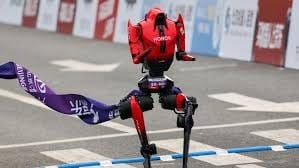
Honor’s humanoid robot “Lightning” has shattered the human half-marathon world record, completing the 21.1km Beijing course in 50 minutes and 26 seconds on April 19, 2026. The autonomous robot beat Ugandan runner Jacob Kiplimo’s world record of 57 minutes and 20 seconds set just one month earlier in Lisbon, averaging an impressive 25km/h throughout the race.
Key Takeaways
- Honor’s Lightning robot completed the Beijing half-marathon in 50 minutes 26 seconds, beating the human world record by nearly 7 minutes.
- The autonomous robot averaged 25km/h using self-navigation, with no remote control assistance.
- Last year’s winning robot took 2 hours 40 minutes, showing a dramatic 70% improvement in Chinese robotics capabilities.
- Honor swept the podium with all three top finishers being Lightning robots.
- Over 100 robot teams competed in 2026, up from just 20 teams in the inaugural 2025 race.
How did Lightning achieve this record-breaking performance?
Lightning’s victory represents a quantum leap in robotics engineering, combining several breakthrough technologies. The robot features legs measuring 90-95cm (35-37 inches) specifically designed to mimic elite human runners’ biomechanics. Honor adapted liquid cooling technology from their smartphone division to prevent overheating during the intense 50-minute run.
The autonomous navigation system proved equally impressive, with Lightning completing the entire course without remote control assistance. Nearly half of the 100+ participating robots managed autonomous navigation, a dramatic improvement from last year’s largely human-controlled field.
What sets this achievement apart is the speed consistency. Maintaining 25km/h for over 50 minutes requires not just mechanical precision but sophisticated AI systems managing balance, terrain adaptation, and energy distribution in real-time.
The dramatic transformation from 2025’s failures
Last year’s inaugural Beijing robot marathon tells a starkly different story. The 2025 winning robot limped across the finish line in 2 hours and 40 minutes — more than three times slower than Lightning’s record. Most robots didn’t finish at all, with frequent crashes and mechanical failures plaguing the field.
The improvement represents more than a 70% time reduction year-over-year, signalling systematic advances across China’s robotics sector. The participant count alone tells the story: from 20 struggling teams in 2025 to over 100 competitive robots in 2026.
This transformation reflects coordinated investment in Chinese robotics, with companies like Honor leveraging existing technological expertise. Honor’s background in smartphone manufacturing provided crucial advantages in miniaturisation, thermal management, and AI processing — skills directly transferable to humanoid robotics.
Honor’s complete podium domination
Honor didn’t just win — they swept the entire podium. All three top finishers were Lightning robots, showcasing the consistency of their platform rather than a one-off prototype success.
Interestingly, a separately entered remotely-controlled Honor robot actually crossed the finish line first at 48 minutes and 19 seconds. However, the race’s weighted scoring system favoured autonomous operation, giving Lightning the championship despite finishing two minutes later.
This scoring decision reflects the event’s focus on genuine AI advancement rather than pure speed. Remote-controlled robots, whilst faster, don’t demonstrate the autonomous navigation and decision-making capabilities that represent the true frontier of humanoid robotics development.
What this means for Chinese robotics ambitions
The Beijing marathon serves as more than a publicity stunt — it’s a proving ground for technologies crucial to China’s robotics strategy. The autonomous navigation, real-time balance control, and endurance capabilities demonstrated here directly translate to manufacturing, logistics, and service applications.
However, significant gaps remain. Despite Lightning’s physical prowess, Chinese robotics firms still struggle with AI software enabling humanoids to match human factory worker efficiency. The marathon showcases locomotion mastery but highlights the complexity of dexterous manipulation and complex task planning.
For the UAE market, this progress signals accelerating competition in robotics applications. As Chinese firms like Honor transition from smartphones to robotics, expect rapid advancement in autonomous systems across multiple sectors, from delivery robots to manufacturing automation.
Commercial availability and implications
Honor hasn’t announced commercial availability or pricing for Lightning robots. The company positions this as research and development rather than a consumer product, though the technology will likely filter into commercial applications over the coming years.
The real significance lies in the technological demonstration. Companies worldwide are watching China’s robotics progress, with Lightning’s performance representing a benchmark for autonomous humanoid capabilities. For businesses considering robotics integration, this achievement suggests the technology is advancing faster than many predicted.
Frequently Asked Questions
How fast did Honor's Lightning robot complete the half-marathon?
Lightning finished in 50 minutes and 26 seconds, beating the human world record by nearly 7 minutes while maintaining an average speed of 25km/h.
Was the robot remotely controlled during the race?
No, Lightning completed the entire 21.1km course using autonomous navigation without any remote control assistance, making the achievement even more impressive.
How much did robot performance improve from last year?
The winning time improved by over 70%, dropping from 2 hours 40 minutes in 2025 to just 50 minutes 26 seconds in 2026.
Will Honor's Lightning robots be available for purchase?
Honor hasn’t announced commercial availability. The robots currently serve as research platforms, though the technology may appear in future commercial applications.