At AED 2,999, the Honor 600 Pro enters a very competitive part of the market. It lines up against the Samsung Galaxy S25 and the Nothing Phone (4a) Pro, two phones with very different strengths but broadly the same asking price. On paper, Honor makes the most immediate impact, with a bigger battery, faster charging, and more ambitious camera hardware than either of its closest rivals.
This is the follow-up to last year’s Honor 400 Pro. There was no Honor 500 Pro, so Honor has skipped a number and carried on as if nothing happened. The phone itself, meanwhile, feels more like a refinement than a full reset. You get the jump from Snapdragon 8 Gen 3 to Snapdragon 8 Elite, a much bigger 7,000mAh battery, a new 50MP 3.5x periscope telephoto, and a display that now peaks at 8,000 nits instead of 5,000. The materials have also changed from glass and plastic to fibreglass and metal. Shame, then, that the design has gone in the opposite direction and ended up looking a bit too eager to borrow from Apple’s homework.
Against the Samsung Galaxy S25, the Honor 600 Pro wins the numbers game almost everywhere. You get a 200MP main camera instead of a 50MP one, a 50MP 3.5x periscope instead of Samsung’s 10MP 3x telephoto, a far bigger battery, and much faster charging at 80W wired and 50W wireless. Samsung, as usual, fights back in the less flashy ways. The Galaxy S25 feels more polished, looks more refined, and comes with long-term software support Honor.
The Nothing Phone (4a) Pro is the trickier rival. Its Snapdragon 7 Gen 4 is nowhere near the Snapdragon 8 Elite in raw performance, and its 5,080mAh battery looks modest next to Honor’s 7,000mAh pack. But Nothing plays a different game. It has a genuinely distinctive design, a 50MP tetraprism periscope with the same 3.5x optical reach, a 6.83-inch 144Hz display, the Glyph Matrix on the back, and Nothing OS, which still has more personality than most Android skins combined. The Honor 600 Pro is selling muscle. The Nothing is selling character. Which one matters more depends entirely on whether you buy phones with your head or your inner magpie.
Honor 600 Specs
| Spec | Honor 600 Pro |
|---|---|
| Dimensions | 15.6 x 7.47 x 0.78 cm |
| Weight | 195g, 200g |
| Colours | Golden White, Black, Orange |
| Cameras | Main: 200 MP (wide), 50 MP (telephoto), 12 MP (ultrawide) Selfie: 50 MP (wide) |
| Processor | Qualcomm Snapdragon 8 Elite |
| RAM | 12GB, 16GB |
| Storage | 256GB, 512GB, 1TB |
| Battery | 7000 mAh, 6400 mAh |
| Charging | 80W wired, 50W wireless, 27W reverse wired |
Design and Features
I don’t think there is a more polite way to say this, and it is evident just by looking at it, but the Honor 600 series has a design problem. The orange colorway, which Honor has been pushing quite heavily, wears its iPhone 17 Pro inspiration a little too openly – the color, the camera island shape, the overall silhouette. Honor is capable of better; the Magic series is proof of that, and even the Honor 400 Pro had its own identity. I get why they do it at the mid-range level, but I would much rather see them carve out something of their own that lean on what another manufacturer has already done.

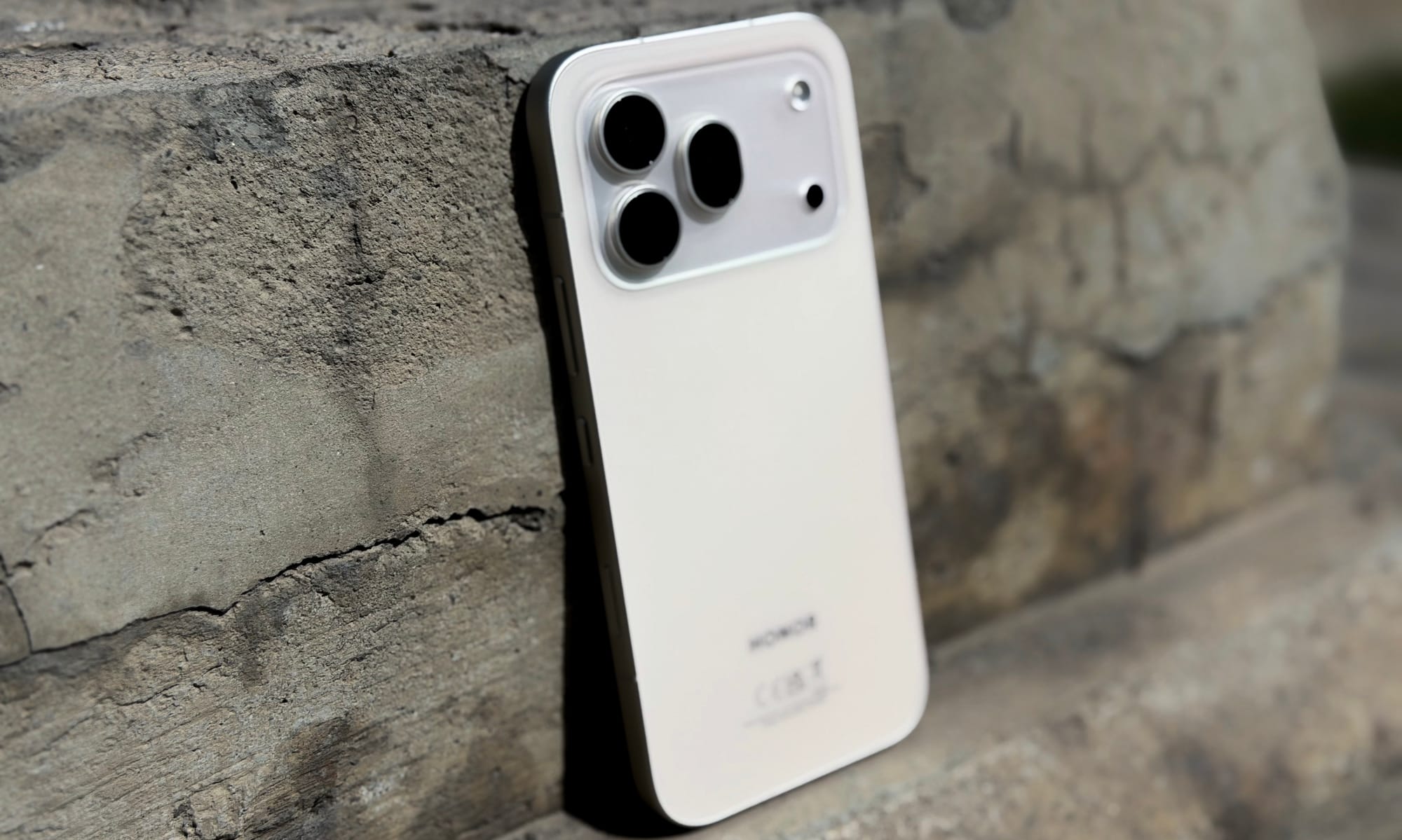
The Golden White model we received does a better job of standing on its own. It is clean, understated, and much less likely to make you think of another phone at first glance. The fibreglass back has a soft sheen, the light grey metal frame pairs well with the finish, and the whole thing feels more premium than the materials list might suggest. At 200g, there is a bit of heft here, but it carries its weight well and sits comfortably in the hand. Honestly, if Honor had given the camera island more of its own identity, this would have been a very good looking phone.

Around the back sits the triple-camera setup: a 200MP main sensor with OIS, a 50MP 3.5x periscope telephoto with OIS, and a 12MP ultrawide, plus a colour temperature sensor. Up front, the selfie camera is a 50MP unit tucked into a centred hole-punch cutout. We will get into image quality in a bit.

The display measures 6.57 inches, which is slightly smaller than the 6.7-inch panel on the Honor 400 Pro. In practice, I actually prefer this size. It makes the phone feel a little easier to manage one-handed without really sacrificing the viewing experience. The panel runs at 2728 x 1264, refreshes at 120Hz, supports 1.07 billion colours and DCI-P3, and can hit a claimed peak brightness of 8,000 nits. More importantly, it looks good outdoors. Visibility under direct sunlight was solid, colours stayed lively, and the camera viewfinder remained easy to use.

The bezels are impressively thin at a claimed 0.98mm all around, and it makes for a screen that feels bigger than the phone’s footprint would suggest. There is also a whole suite of eye comfort features baked in – 3840Hz PWM dimming, Natural Tone Display, AI Defocus, Circadian Night Display, hardware-level low blue light – which are nice to have for those longer sessions where you are glued to the screen.

The dual stereo speakers are a notch above what the standard Honor 600 offers. The volume is about the same between the two, but the 600 Pro carries a bit more body in the sound, which makes watching reels and Youtube content a more pleasant experience. It is still on the thinner side if you are looking for rich, full-bodied audio, but for casual media consumption, it does the job well enough.

All the physical controls sit on the right side: a single-piece volume rocker, the power button, and the dedicated AI Button. The left edge is completely clean, while the SIM tray lives at the bottom. The AI Button can be customised for single press, double press, and long press actions, letting you assign it to things like the camera, AI Screen Suggestions, AI Photos Agent, Honor AI, or AI Memories. You can also switch it off entirely, which may be wise if, like me, you keep hitting it by mistake while picking up the phone and briefly questioning your own coordination.
Camera
The Honor 600 Pro shares its main camera with the standard Honor 600: a 200MP sensor with a 1/1.4-inch size, f/1.9 aperture, and OIS rated at CIPA 6.0. It can also produce 4x lossless crops from the high-resolution sensor, while digital zoom stretches to 30x. Alongside that sits a 12MP ultrawide that doubles as a macro camera, plus a colour temperature sensor that works with Honor’s AI Colour Engine to improve white balance and skin tones under mixed lighting. The 50MP front camera handles selfies and portraits.
Where the 600 Pro separates itself from its non-Pro sibling is the addition of a 50MP periscope telephoto. It sits on a 1/2.75-inch sensor with an f/2.8 aperture, its own OIS with a CIPA 6.5 rating – which is actually higher than the main camera’s – and provides 3.5x optical zoom. From there, digital zoom can stretch all the way to 120x, which uses AI to reconstruct images.
On the software side, Honor has gone big on AI camera processing. The company says the phone uses a 12.4-billion-parameter model trained for night photography, powering features like AI Ultra Night Engine, AI Ultra Night Portrait, and AI Super Zoom 2.0. Unlike on the standard Honor 600, Super Zoom here also works in low light, where it tries to clean up noisy long-range shots after dark. You also get the AI Colour Engine, Super Moon 2.0, and a few extras like bokeh shape effects. Some of it is actually useful.


Alright, enough exposition. How do the cameras fare, though? Pretty well. Daytime shots are excellent, delivering crisp details, natural colours, and good dynamic highlights. There is a touch of oversharpening when you zoom into details, but nothing that is immediately apparent or deters from an otherwise great photo. 2x and 3.5x zoom is expectedly as good, retaining the same sharpness and colour space as the standard 1x shot.
Past 7x, things start to slip. Detail drops off, sharpness takes a hit, and once digital zoom and AI reconstruction take over, that familiar over-processed look becomes hard to ignore. It is usable in a pinch, but not the kind of zoom you reach for if you care about texture and realism.


Night photography is a bit more mixed, though still mostly good. The phone pulls in plenty of light and tends to produce bright, punchy shots with pleasing colours and decent shadow control. Look closer, however, and the cracks show. Fine detail is often smoothed over to avoid visible noise, and that softening is easy to spot in both 1x and 3.5x shots. Push further into digital zoom and the problem gets worse. This is not a bad night camera by any stretch, but it is also not quite as clean or natural as the phone’s impressive spec sheet might have you hoping..
Performance and Software
The Honor 600 Pro runs on Qualcomm’s Snapdragon 8 Elite, paired here with 12GB of RAM, 512GB of storage, and an Adreno GPU. It is a clear step up from the Snapdragon 8 Gen 3 in the Honor 400 Pro, and the benchmarks reflect that. Compared with the Nothing Phone (4a) Pro and its Snapdragon 7 Gen 4, this is not a close contest at all. The Honor is playing in proper flagship territory, while the Nothing is aiming for upper-midrange and hoping charm makes up the rest.
| Benchmark | Honor 600 Pro | HONOR 400 Pro | Nothing Phone (4a) Pro |
|---|---|---|---|
| Geekbench 6 CPU – Single Core | 2,754 | 2,097 | 1,333 |
| Geekbench 6 CPU – Multi Core | 7,228 | 6,479 | 4,239 |
| Geekbench 6 GPU | 18,003 | 13,101 | 4,721 |
| Geekbench AI | 1,744 | 3,255 | 3,412 |
| 3DMark Steel Nomad Light | 2,476 | 1,479 | 742 |
| 3DMark Solar Bay Extreme | 1,088 | — | — |
| 3DMark Wildlife Extreme | 6,270 | 4,479 | 2,094 |
| 3DMark Sling Shot Extreme | Maxed Out! | — | Maxed Out |
Compared to the Honor 400 Pro, the 600 Pro posts roughly 30% higher single-core and 12% higher multi-core scores in Geekbench 6, while the GPU performance jumps by around 37%.
Compared to the Nothing Phone 4a Pro, which runs the Snapdragon 7 Gen 4, the gap is, as expected, much wider. The 600 Pro more than doubles the Nothing’s single-core score, nearly doubles the multi-core, and absolutely blows past it in GPU performance.
3DMark benchmarks tell a similar story — the Snapdragon 8 Elite is in a completely different league from the 7 Gen 4. Whether that gap translates into a noticeably better daily experience is debatable, since both phones handle regular tasks without issue, but for anything demanding — gaming, video editing, heavy multitasking — the Honor has far more headroom.
The gaming stress test paints a less flattering picture, though, and this is where the Snapdragon 8 Elite’s well-documented thermal tendencies come into play. In the 3DMark Wild Life Extreme stress test, the Honor 600 Pro posted a best loop score of 23,514 and a lowest of 11,884, resulting in a stability rating of 50.5%. That means the phone is shedding roughly half of its peak GPU performance by the time it gets through 20 loops of sustained load. The graph shows a steep drop-off after the first two loops, with the score settling in the mid-15,000s for a stretch before dipping further towards the end as the phone heats up.
And yes, it gets hot. During testing, the phone’s temperature rose from 26 °C to 49 °C, which is very noticeable in the hand. Frame rates tell the same story, dropping from the 120 to 150fps range at the start down to around 60 to 70fps by loop 17. None of this is especially shocking for the Snapdragon 8 Elite, which has made a habit of being very fast and very warm, but it is worth noting if you spend long stretches playing demanding games.
In daily use, though, the Honor 600 Pro is buttery smooth. Jumping between apps, downloading files, watching content, chatting, using pop-up windows, transferring media through Magic Portal, and using the camera – everything ran stable and responsive with no stutter in sight.
The AI Creative Editor 2.0 is the headline software addition. The standout feature is AI Image to Video 2.0, which can generate short 5-second animated clips from still photos. It has been upgraded from the version on the Honor 400 series – you can now use up to 3 images, write free-form prompts to guide the animation, and even add sound to the output. There are two modes to work with: Freestyle, where you feed it images and a text prompt and let the AI interpret them however it sees fit, and pre-set templates like Pet Roleplay, The Embrace, and Life Morph that come with preconfigured prompts for more controlled results.
Beyond the video generation, the suite also packs a wide collection of photo editing tools – AI Eraser, AI Moving Photo Erase, AI Upscale, AI Outpainting, AI Composition, AI Color Enhancement, AI Light Enhancement, Magic Color, AI Blur Background, and more. There is also the AI Photos Agent, which lets you enhance photos through a single tap or via voice and text commands.

Battery Life
Battery life is one of the Honor 600 Pro’s strongest arguments. The 7,000mAh silicon-carbon battery is huge by flagship standards and comfortably ahead of most rivals in this price bracket. Whether you compare it with the Galaxy S25 or the Nothing Phone (4a) Pro, the Honor simply has more capacity to work with, and in daily use that advantage shows up quickly.
With my regular use – scrolling through reels, watching Youtube, chatting on Whatsapp, taking photos, downloading files, and the general app-hopping that fills a normal day – I was comfortably getting around two days of use out of a single charge, or roughly 8-9 hours of screen-on-time before the battery pinged me to charge it up.
Charging is nearly as strong as the battery life. The 600 Pro supports 80W wired charging, which is technically a step down from the 100W on the Honor 400 Pro, but still fast enough that you are not stuck by the wall for long. Wireless charging goes up to 50W, which is excellent for this class, and reverse charging is here too if you need to top up earbuds or a smartwatch. The only truly silly bit is that reverse wired charging goes up to 27W for Apple devices but drops to 5W for other brands, including Honor’s own. Make that make sense.
Should You Buy the Honor 600 Pro?
Despite the derivative design that I wish Honor would simply move past, I ended up liking the Honour 600 Pro quite a bit. It does a lot of things well – the Snapdragon 8 Elite keeps everything running smoothly, the 7,000maAh battery is comfortably a two-day phone, the 200MP camera takes great pictures all things considered, and the display is bright and crisp enough to use in any condition. It feels great and premium in the hands too if you can look past the design (or maybe you came seeking it – but I will only listen and not judge).
At AED 2,999, the Honor 600 Pro makes a strong case for itself, but the choice depends on what you value most. If raw hardware is the priority, Honor has the edge. It offers more battery life, faster charging, stronger camera hardware, and better overall performance than both the Galaxy S25 and the Nothing Phone (4a) Pro. If you care more about long-term software support, ecosystem polish, and a safer all-around pick, Samsung still has a very strong argument. And if you want your phone to have a bit of personality instead of looking like it came out of the premium copying machine, the Nothing remains the standout.
For my money, the Honor 600 Pro makes a strong case for itself, and it would be my pick among the three. It is not a perfect phone, but at this price, it is giving you a lot to work with, and if Honor can sort out its design identity and tighten up the night photography, the next one could be a proper contender.
FAQs
Is the Honor 600 Pro worth buying?
Yes, especially if you want strong performance, excellent battery life, and fast charging at a price below most flagship phones. Its design may not be to everyone’s taste, but the hardware value is very strong.
How good is the Honor 600 Pro camera?
The Honor 600 Pro takes very good daylight photos with strong detail and reliable colour. Night shots are bright and punchy too, though image processing can smooth away fine detail.
Does the Honor 600 Pro have good battery life?
Yes. The 7,000mAh battery is one of the phone’s standout features and can comfortably last up to two days with regular use.
How fast does the Honor 600 Pro charge?
The phone supports 80W wired charging and 50W wireless charging, which makes it one of the faster-charging phones in its class.
Is the Honor 600 Pro better than the Galaxy S25?
The Honor 600 Pro offers better battery life, faster charging, and more aggressive camera hardware on paper. The Galaxy S25 still has the edge in software support, refinement, and ecosystem polish.
Is the Honor 600 Pro better than the Nothing Phone (4a) Pro?
If performance and battery life matter most, the Honor 600 Pro is the stronger phone. If you care more about design, software personality, and owning something that does not look like every other slab on Earth, the Nothing Phone (4a) Pro has its own appeal.