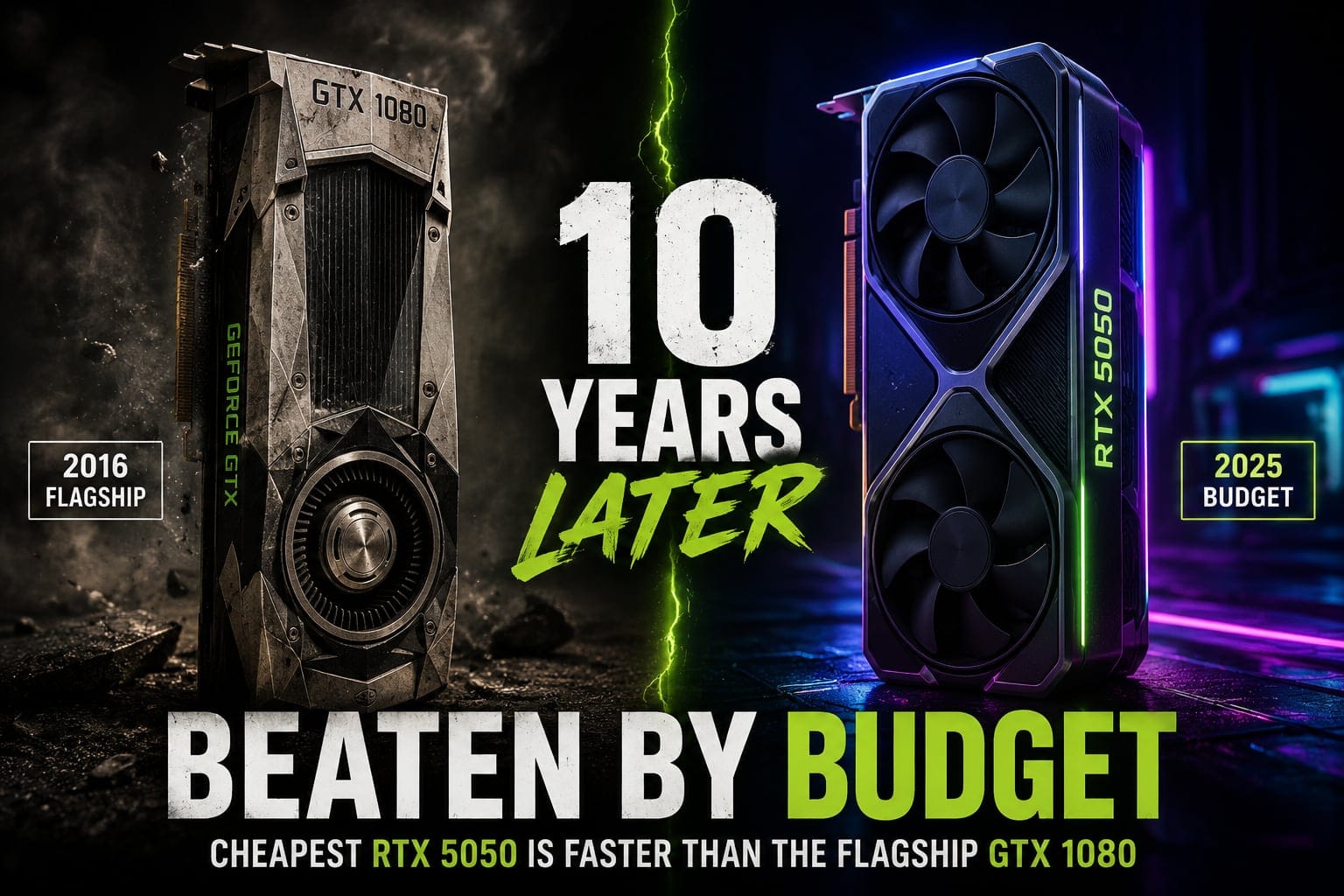
Quick Answer: Ten years after launch, the GTX 1080 (2016) has the same CUDA core count — 2,560 — as the RTX 5050 (2025), the cheapest card in NVIDIA’s 2026 Blackwell lineup. Despite identical core counts, the RTX 5050 outperforms the GTX 1080 by roughly 11% in pure raster, supports DLSS 4 and ray tracing the GTX 1080 cannot run at all, draws 50W less power, and retails in the UAE from around AED 1,100 against the GTX 1080’s 2016 launch price of about AED 2,500.
A decade ago today, NVIDIA announced the GeForce GTX 1080 — Pascal’s flagship and the fastest consumer GPU on the planet. To mark the anniversary, we’ve put it head-to-head with the cheapest card in NVIDIA’s current 2026 Blackwell lineup: the RTX 5050.
The setup is unusually clean. Both cards have exactly the same number of CUDA cores: 2,560. Both ship with 8GB of memory. One is a 2016 flagship that was priced close to $700 at launch. The other launched at $249 and currently sits at the bottom of the RTX50 series.
Specs at a Glance
| GTX 1080 (2016) | RTX 5050 (2025) | |
|---|---|---|
| Architecture | Pascal (16nm) | Blackwell (TSMC 4N) |
| CUDA Cores | 2,560 | 2,560 |
| Boost Clock | 1,733 MHz | ~2,572 MHz |
| Memory | 8GB GDDR5X | 8GB GDDR6 |
| Memory Bus | 256-bit | 128-bit |
| Memory Bandwidth | 320 GB/s | 224 GB/s |
| TDP | 180W | 130W |
| Ray Tracing | None | 20× 4th-gen RT cores |
| DLSS Support | None | DLSS 4 + Multi Frame Gen |
| Launch Price (UAE) | ~AED 2,500 | from AED 1,104 |
Same Core Count, Different Universe
The identical CUDA core count is a coincidence — Pascal’s GP104 and Blackwell’s GB207 weren’t designed to mirror each other — but it makes the comparison unusually clean.
Pascal was a 16nm part with no RT cores, no Tensor cores, no AV1 encoder, and no DLSS in any form. It did one job — rasterise frames — and it did it brilliantly for its time.
Blackwell is built on TSMC’s 4N node, with 4th-generation RT cores, 5th-generation Tensor cores running FP4 precision, and the full DLSS 4 stack including Multi Frame Generation. The RTX 5050 has 20 RT cores and 80 Tensor cores, performing tasks the GTX 1080 simply cannot handle.
Raw Rasterisation: A Surprisingly Close Fight
This is where the anniversary hook gets interesting. With identical core counts, you’d expect the older flagship to at least hold its own in pure raster performance. It doesn’t — but it’s closer than expected.
Aggregated benchmark data puts the RTX 5050 around 11% ahead of the GTX 1080 in aggregate performance. In modern games at 1080p, the gap widens to 15–25% depending on title and engine. The 5050’s higher boost clock and architectural efficiency more than compensate for its narrower memory bus.
The more striking data point: the RTX 5050 also beats the GTX 1080 Ti — the legendary “GOAT” flagship from 2017 — at stock in modern titles, with the 1080 Ti unable to close the gap even with custom liquid cooling and a manual overclock.
The Feature Gap: Where Pascal Falls Off the Map
This is where the comparison stops being close. The GTX 1080 has no RT cores, no Tensor cores, and cannot run DLSS at all — not the original, not Frame Generation, not the DLSS 4 transformer model. It cannot encode AV1. Its driver path for modern features ends at Insha’Allah.
The RTX 5050 supports the entire DLSS 4 stack, including Multi Frame Generation, which can quadruple effective frame rates in supported titles. With those features enabled — which is how anyone actually plays modern games in 2026 — the gap stretches from “11% faster in raster” to “a different conversation entirely.” Cyberpunk 2077 at 1080p with ray tracing and DLSS 4 is a credible experience on a 5050. On a 1080, ray tracing isn’t even on the menu.
Power and Heat
The GTX 1080 was a 180W card. The RTX 5050 is 130W. That’s a 50W swing — significant in absolute terms — and combined with the performance delta, it means the 5050 produces more work for less than three-quarters the power. With DLSS, the work-per-watt ratio gets uncomfortable for the 1080.
Price: What AED 2,500 Bought in 2016 vs AED 1,100 Now
The GTX 1080 launched in the UAE at around AED 2,500–2,800, depending on retailer and edition. The RTX 5050 starts around AED 1,100 for the ZOTAC Twin Edge, with most cards landing between AED 1,100 and AED 1,400.
That’s roughly half of the 1080’s launch price for marginally faster raster, fundamentally better features, lower power draw, and modern driver support. Inflation has been brutal over the past decade, but NVIDIA’s entry-level GPUs are an exception.
The Verdict: Why the Same Core Count Tells a Different Story
The identical CUDA count is what makes this comparison sharp rather than predictable. Two cards with the same number of cores, a decade apart, and the older one — built when “flagship” meant something — loses to a card with “entry-level” stamped on the box.
What this gap really illustrates is how much GPU progress has shifted from raw shader counts to everything that surrounds them. The Pascal-to-Blackwell jump is four process generations, four generations of RT cores, five generations of Tensor cores, and four major DLSS revisions. The same 2,560 cores in 2025 do work that the 2016 cores couldn’t even attempt.
If you’re still gaming on a GTX 1080 in 2026, you’ve stretched your AED 2,500 about as far as anyone has ever stretched an NVIDIA purchase. But it is, finally, time.
FAQ
How does the GTX 1080 compare to the RTX 5050?
Despite having the same 2,560 CUDA cores, the RTX 5050 outperforms the GTX 1080 by roughly 11% in pure raster performance and substantially more once DLSS 4 and ray tracing are factored in. The RTX 5050 also draws 50W less power.
Is the GTX 1080 still good in 2026?
At 1080p with reduced settings, the GTX 1080 remains usable for esports and most pre-2020 games. It cannot run modern ray-traced titles and does not support DLSS in any form.
How much does the RTX 5050 cost in the UAE?
The RTX 5050 starts at AED 1,104 (ZOTAC Twin Edge), with most cards priced between AED 1,100 and AED 1,400. The card launched globally in late July 2025.
Should you upgrade from a GTX 1080 to an RTX 5050?
Yes, if you play modern games. The RTX 5050 is faster, more power-efficient, and supports features the 1080 was never built for. It is a meaningful upgrade rather than a sidegrade.