
Google Aluminium OS still set for 2026 debut, says Sameer Samat — what it means for laptop buyers
Google says Aluminium OS is still coming in 2026, and that matters in the UAE because newer AI-ready laptops may arrive while older Chromebooks are left behind.

KEY TAKEAWAYS
- Google’s Android chief Sameer Samat says Aluminium OS is still expected to show up later in 2026, according to Android Authority’s interview from MWC 2026.
- Chrome OS is not going away, but Aluminium OS increasingly looks like Google’s more ambitious consumer laptop platform for the AI era.
- For UAE buyers, the bigger concern is hardware compatibility, because as I noted in Tbreak’s earlier report on why many Chromebooks may be incompatible, older budget machines may not be built for what Google wants next.
Google says Aluminium OS is still on track for later in 2026, and that matters because this is starting to look less like a software experiment and more like a serious reset for Google’s laptop ambitions.
If the company follows through, the result could be a much stronger Android-led alternative to Windows and Mac laptops — but also a future where plenty of cheap Chromebooks suddenly look like yesterday's compromise.
For years, Google treated Chrome OS and Android like two roomies politely sharing a kitchen and avoiding eye contact. Aluminium OS sounds like the point where the company finally admits that the arrangement was never meant to last.
Why this matters: Google still wants a 2026 moment
In its interview with Android Authority, Sameer Samat said he was “super excited about later this year” when asked if Aluminium OS was still on track for 2026. That does not guarantee a full-scale retail rollout this year, but it does suggest Google wants a real public milestone in 2026 rather than another vague platform teaser.
That is important because recent reporting has raised doubts about the timeline. Samat's wording is not a product-launch announcement, but it is much firmer than the soft-focus future talk tech companies usually wheel out when the roadmap is wobbling.
AI is the real reason
Samat's broader argument is that laptops have become interesting again because AI works better on larger screens with proper keyboards, multitasking, and desktop-style workflows. That lines up neatly with our earlier piece on Google's Aluminium OS as Android for PCs, which framed the platform as Google's attempt to build something more capable than a browser-led Chromebook without simply copying Windows.
For UAE buyers, that matters because “AI PC” has already become the latest retail buzzword across stores like Sharaf DG and Virgin Megastore. The question is whether Google can turn that buzz into a platform people actually want, rather than another branding layer nobody asked for.
What Aluminium OS appears to be More than a Chrome OS refresh
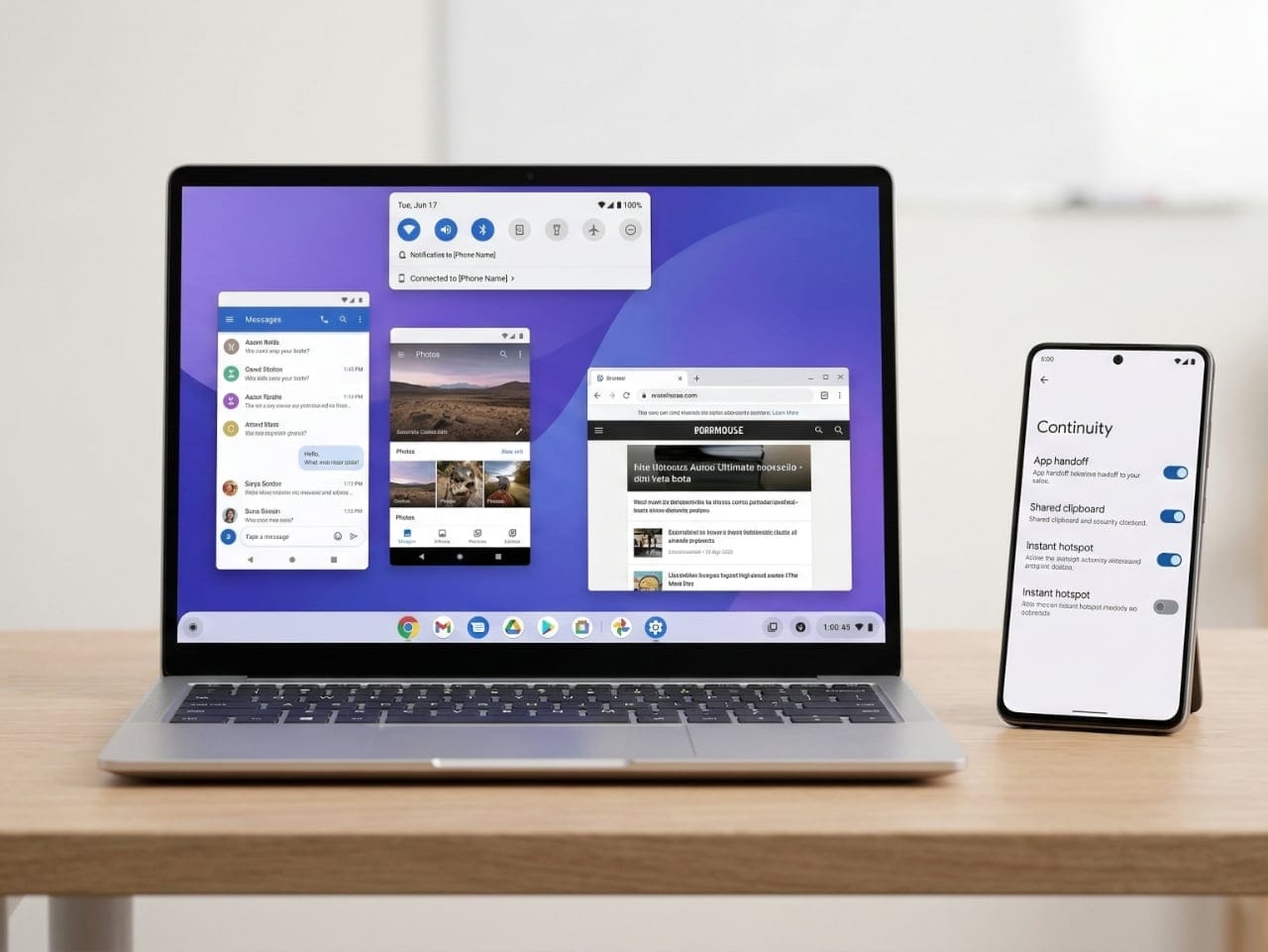
Android Authority describes Aluminium OS as Google's effort to merge Android and Chrome OS into a more unified platform, but Samat's comments suggest the company sees it as something broader than just a Chromebook update. This looks much closer to a full laptop operating system built around Android, AI features, and stronger phone-to-PC continuity.
That distinction matters. A refreshed Chrome OS would be easy to dismiss. A serious Android-based laptop platform is a very different proposition, particularly if Google wants OEM partners to treat it as a genuine alternative to MacBook Neo17's and Windows on premium hardware.
Continuity is part of the pitch
A big theme in the interview is cross-device continuity. Samat made it clear that Google wants phones and larger devices to work together more seamlessly, and Android Authority linked that direction to Android 17's Handoff feature.
If Google gets that right, Aluminium OS could finally give Android users something much closer to the effortless phone-to-laptop flow Apple users already take for granted. It is not exactly a revolutionary ambition in 2026, but for Google’s ecosystem, it would still count as overdue progress.
Chrome OS is not dead, Google says both will continue
Samat explicitly said Chrome OS development will continue and praised its strengths in managed environments, especially education. That suggests Google is planning coexistence rather than an overnight replacement.
For institutions and IT buyers, that matters more than the branding story. Chrome OS still has a clear role in schools and enterprise fleets because it is easy to manage, relatively secure, and simple to deploy at scale.
But the direction is obvious
Even so, Aluminium OS clearly points to Google's longer-term consumer strategy. If Chrome OS remains the practical tool for education and browser-first use, Aluminium OS increasingly looks like the place where Google wants to do the interesting stuff.
That makes buying decisions in 2026 a bit trickier, especially for anyone weighing up cheap laptops. If you are already comparing current options through Tbreak's best laptops in the UAE guide or trying to decide whether a budget machine still makes sense after reading the site’s MacBook Neo vs Chromebook comparison, Google’s shifting platform strategy becomes hard to ignore.
Specs and positioning
| Area | What Google is signalling | Why it matters in the UAE |
|---|---|---|
| Launch timing | Later in 2026 remains the target | UAE buyers should expect announcements first, with local availability likely later |
| Platform goal | A broader Android-led laptop platform with AI and continuity built in | Could give Android users a more credible alternative to Windows and macOS |
| Chrome OS future | Chrome OS continues, especially for education and managed use | Schools and enterprise buyers in the UAE are unlikely to face an immediate forced switch |
| Hardware direction | Earlier reporting points to newer processors and at least 8GB of RAM | Many older budget Chromebooks may miss out |
| UAE pricing | No UAE pricing is confirmed yet | First devices are likely to sit above entry-level Chromebook pricing if AI-ready hardware is required |
Pricing & availability
Google has not yet confirmed pricing, launch timing, or retail partners for the first Aluminium OS devices. Right now, the company is confirming direction rather than product specifics, so anyone hoping for checkout buttons tomorrow should probably keep that optimism on a short leash.
What I would expect, based on Google's AI-first framing and the hardware discussion around Aluminium OS, is that the first wave will skew toward newer and more capable laptops rather than ultra-budget models. In practical terms, that means UAE buyers looking for a laptop today are still better served by current Windows, Mac, and Chromebook options.
Buying recommendation
I would not advise anyone in the UAE to delay a laptop purchase purely for Aluminium OS unless they are already planning a premium buy later in 2026 and care specifically about deeper Android integration. At this stage, the platform is interesting, but it is still more of a roadmap than a product.
Where I would be careful is at the bottom end of the Chromebook market. If you are looking at a very cheap laptop right now, it is worth reading both Tbreak’s earlier Chromebook compatibility warning and the site’s MacBook Neo vs Chromebook comparison before assuming the cheapest option still offers the best long-term value.
FAQs
What is the price of Google Aluminium OS devices?
Google has not yet confirmed pricing for Aluminium OS laptops or PCs. There are no official AED prices, local pre-orders, or UAE retail listings at the time of writing.
Where can I buy Google Aluminium OS devices?
You cannot buy Aluminium OS devices yet because Google has not announced specific hardware or local sales channels. Once the first products are revealed, I would expect availability through major retailers and partner brands active in the region, but this remains unconfirmed.
Is Google Aluminium OS still launching in 2026?
Yes, based on Sameer Samat's comments to Android Authority, Google still expects Aluminium OS to appear later in 2026. The exact form that debut takes is still unclear.
Is Chrome OS being replaced by Aluminium OS?
Not immediately. Google says Chrome OS will continue, especially for education and managed deployments, while Aluminium OS appears positioned as the company's broader long-term laptop platform.
Will existing Chromebooks support Aluminium OS?
Many may not. Earlier reports suggest that Aluminium OS will require newer post-2021 processors and at least 8GB of RAM, leaving many older budget Chromebooks behind.
Why is Google building Aluminium OS?
Google believes AI makes laptops more useful again because larger screens, keyboards, and multitasking are better suited to those workloads than phones alone. Aluminium OS also appears to be part of Google’s effort to build tighter continuity between Android phones and larger computing devices.
Written by

Subscribe to our newsletter
Subscribe to our newsletter to get the latest updates and news












Member discussion