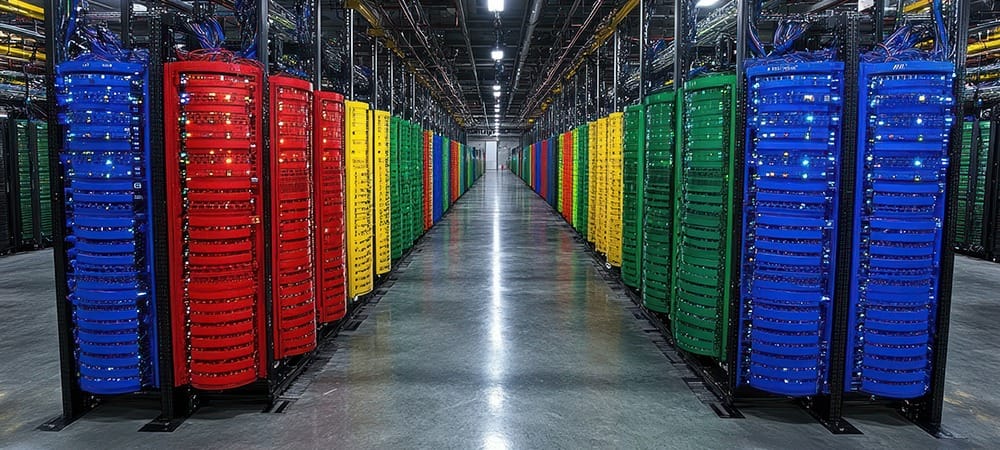
Google controls approximately 25% of the world’s AI compute power, operating 3.8 million Tensor Processing Units (TPUs) and 1.3 million Graphics Processing Units (GPUs). As reported by the Financial Times, based on an Epoch AI analysis. The figures cover Google’s globally deployed AI accelerators across its data centres.
Key Takeaways
- Google controls approximately 25% of the world’s AI compute power, according to Epoch AI analysis.
- Google’s AI infrastructure includes 3.8 million TPUs and 1.3 million GPUs.
- Google Cloud CEO Thomas Kurian said demand and revenue justify the massive investment.
- This dominance powers the AI features UAE users rely on daily across search and cloud services.
What does Google’s 25% AI compute share mean?
Per Epoch AI, Google’s roughly 25 percent share of global AI compute is the largest concentration attributed to any single company in the analysis. The infrastructure powers Google’s own AI products and the Google Cloud services it sells to businesses, including Google Cloud customers.
The breakdown, per the analysis: about 3.8 million TPUs designed for machine-learning workloads and 1.3 million GPUs, for roughly 5.1 million accelerators in total.
How does Google’s TPU and GPU infrastructure work?
Google’s 3.8 million TPUs represent custom silicon designed specifically for machine learning calculations. Unlike general-purpose chips, these Tensor Processing Units excel at the matrix mathematics that power neural networks, delivering faster results with less energy consumption.
The 1.3 million GPUs complement this setup by handling diverse AI workloads that benefit from parallel processing. This dual-chip strategy allows Google to optimise different AI tasks — TPUs for training large language models, GPUs for real-time inference and browser-based AI features.
This infrastructure supports everything from the AI features in Google’s AI Pro service to enterprise customers running models on Google Cloud.
Why is Google investing so heavily in AI compute?
Google Cloud CEO Thomas Kurian’s justification is straightforward: “demand and revenue justify the spend.” The company’s massive AI infrastructure investment reflects the growing enterprise demand for AI services, particularly in regions like the Middle East where businesses are rapidly adopting automation.
Kurian did not provide regional breakdowns. Google Cloud serves customers globally, including in the UAE through its Doha and Dammam regions for nearby coverage.
What this means for UAE businesses and consumers
Google has not detailed how its global AI compute capacity maps to UAE-specific service delivery. UAE customers of Google products like Search, Maps, Gemini, and Google Cloud rely on the company’s wider data-centre network.
Enterprises in the UAE evaluating Google Cloud AI offerings should review Google Cloud’s published service-level agreements and regional availability for the specific products they plan to use.
The Epoch AI figure also draws attention to compute-supply concentration in the AI industry. Google’s holdings sit alongside major buildouts at Microsoft, Amazon, Meta, and dedicated AI infrastructure partners like CoreWeave and Oracle.
Frequently Asked Questions
How much AI compute does Google control globally?
Google controls approximately 25% of the world’s AI compute power, according to Epoch AI analysis reported by the Financial Times.
What hardware does Google use for AI compute?
Google’s AI infrastructure includes 3.8 million Tensor Processing Units (TPUs) and 1.3 million Graphics Processing Units (GPUs) for a total of 5.1 million processors.
Why is Google investing so heavily in AI compute?
Google Cloud CEO Thomas Kurian stated that demand and revenue justify the significant investment in AI compute infrastructure.
What does this mean for AI services in the UAE?
UAE users access Google’s AI services through the company’s global infrastructure. Specific UAE service-level details are governed by Google Cloud’s published terms.