Every new Metroidvania ends up getting compared to Hollow Knight, whether it wants that comparison or not. Maybe that’s unfair, but it comes with the territory now. That game changed expectations around movement, atmosphere, and exploration in a very visible way. Fallen Tear: The Ascension, the debut from CMD Studios, steps into that space with a lot of ambition. And honestly, parts of it already work pretty well. It’s just still rough around some of the edges that matter most in a Metroidvania.
- Fallen Tear: The Ascension is a Metroidvania from Philippines-based CMD Studios, currently in Early Access on Steam
- The hand-drawn art is the game’s strongest suit — watercolor-style environments and detailed character designs stand out
- The Fated Bonds companion system lets you summon allies in combat, but it doesn’t land as hard as it should given how central it is
- Movement feels stiff and grounded compared to genre benchmarks, and the R1 dash in particular never fully clicks
- Fast travel costs currency, map markers are limited, and loading screens between areas break flow more than they should
- Patch 1.1.0 added two new areas — Whirlpool and Ageuan: Water Kingdom — and the team is actively taking QoL feedback on board
- Worth a look if you follow Early Access closely; everyone else can afford to wait
A World Worth Looking At
The setup is pretty familiar stuff. You play as Hira, a boy pulled into the fractured world of Raoah after his home is attacked and his family goes missing. There are corrupt gods, spirits, kingdoms at war, and a mysterious woman named Runa who clearly knows more than she’s saying. The current Early Access build doesn’t do a whole lot with the story yet, though, and what’s here feels more like setup than something emotionally grounded. Right now, Raoah itself is more interesting than the actual plot. The world feels lived in, like there’s history buried underneath everything. The writing just hasn’t fully tapped into that yet.

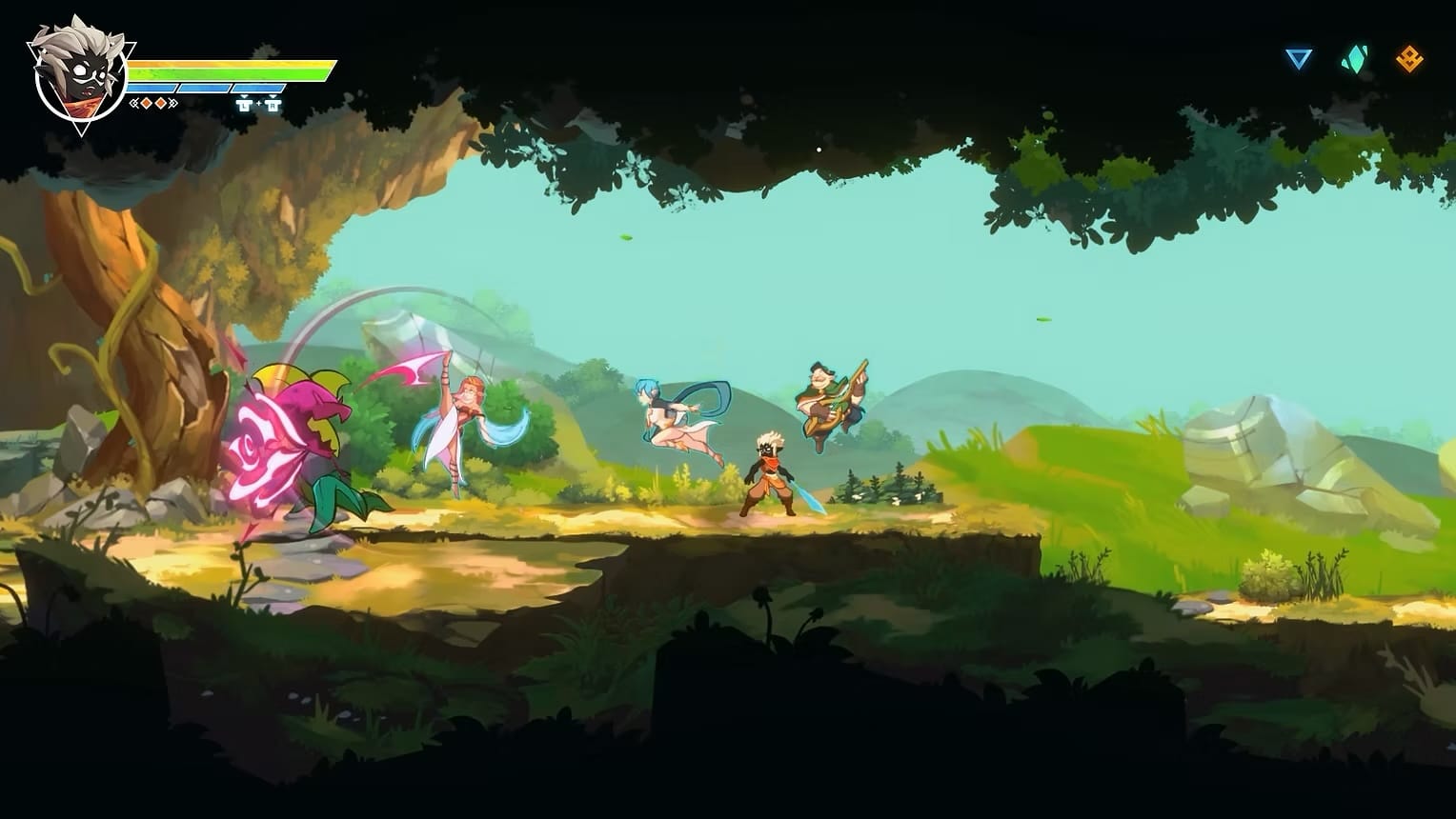
The world itself is easily the game’s strongest hook. Raoah looks fantastic. It’s hand-drawn, colorful, and packed with detail in the right ways. Every area has its own look and atmosphere, and moving into a new zone still feels exciting several hours in. One minute you’re in an overgrown forest full of jagged roots and ruins, the next you’re wandering through a poisoned wasteland drenched in murky purples and yellows, before ending up in a lava-filled factory that genuinely looks like it belongs in a good fantasy anime.

The watercolor-style backgrounds have a lot going on without becoming messy or distracting. NPCs and Fated Bond companions also stand out more than expected. Their designs actually feel considered, with expressive faces, distinct silhouettes, and outfits that look tied to the world instead of generic fantasy templates. That same attention carries into combat animations too. Hit effects pop, companion summons have real energy behind them, and even smaller fights feel lively because the screen is constantly moving in interesting ways. CMD Studios originally started as an art and animation studio and you can tell almost immediately. This team knows how to make a world you want to keep looking at. Even when the gameplay stumbles a bit, curiosity about what the next area looks like keeps pulling you forward.
Staccato Movement and Promising Combat
The slow uncovering of a huge world is half the appeal of a Metroidvania in the first place. Opening the map and spotting a little gap you haven’t explored yet. Doubling back once you get a new ability. Checking every weird corner before finally moving on. That rhythm is the genre. Backtracking has never bothered me because the feeling of a world gradually unfolding is the whole point. Which is also why movement matters so much here, maybe more than in almost any other genre. Not just during combat, but constantly, every second you’re holding the controller. When movement feels off, even slightly, it follows you everywhere.

That’s where Fallen Tear: The Ascension struggles the most right now. Movement has this slightly heavy, staccato feel that becomes harder to ignore the longer you play. Jumping to a ledge takes just a fraction longer than your brain expects. Not floaty exactly, more delayed, like the game pauses for a split second to confirm your input before responding. You press jump, then wait for the action to catch up. Dropping through platforms has that same rhythm. Press down, pause, drop. Wall jumps technically work fine, but they carry that same stop-start cadence where every action feels individually processed instead of flowing naturally into the next one. The game never quite lets you get ahead of your movement. You’re always waiting for it to catch up instead of moving on instinct.

The diagonal pogo attack is probably the most interesting part of the movement toolkit right now, and it’s where the game’s bigger ambitions start peeking through. Bounce off one enemy, chain into another, stay airborne for a few extra seconds, there’s a cool idea buried in there. Coming straight from Hollow Knight, though, the difference in feel becomes really obvious. Hornet’s pogo attacks in that game are so sharp and immediate that even when you mess up, it still feels clean. You instantly want another attempt because the game feels responsive enough to support experimentation. Fallen Tear’s version technically works, but it never settles into that same rhythm. The timing feels a little stiff, a little hesitant. Miss a bounce and the flow just dies completely instead of giving you room to recover or improvise. It’s asking for precision without fully supporting the momentum that makes mechanics like this satisfying in the first place.
The backward dash tied to R1 feels less broken and more awkwardly limited. In normal fights, it mostly does the job. Hira jumps backward, you create some breathing room, combat continues. But once enemies get more aggressive, or bosses start filling the screen with projectiles, the fixed direction starts becoming a real problem. The dash only commits backward relative to where you’re facing, which means your escape option is already decided for you before you even react. For me, movement in metroidvanias usually feels flexible and improvisational, and so rigidity stands out fast. You start noticing moments where you know exactly where you want to move, but the game only gives you one answer, and it’s not always the useful one.
Exploration Friction and System Overload

A lot of the smaller frustrations start stacking on top of each other after a while. The tower-based map reveal system is actually a good idea. Unlocking parts of the map gradually makes new regions feel more mysterious and earned instead of instantly exposing everything. The screenshot pin feature is smart too. Being able to leave an actual image marker of a location you want to revisit feels perfect for a Metroidvania. Then you hit the pin limit. Suddenly the system that was helping exploration starts getting in the way of it. Fast travel also costs currency, which would maybe make sense if resources felt meaningful to manage, but enemies all drop the same tiny amount of shards no matter what they are. So instead of creating strategy, it mostly feels like paying a recurring fee just to move around the world. Add in loading screens between larger areas and the overall flow starts feeling more interrupted than it probably should.

Then there’s the sheer amount of systems layered on top of each other. Multiple currencies, Fated Points, companion upgrades, Masteries, Hunter Skills, Ascensions, eventually your brain stops sorting them individually and just files them under “more progression stuff.” Some of it genuinely works. You can absolutely feel the difference between builds focused on survivability and melee damage versus ones leaning heavily into MP and Fated attacks. There’s real build flexibility somewhere in there but not every system feels equally necessary. Some mechanics come across less like meaningful additions and more like features included because there was space for another progression tree. The grind tied to leveling Fated abilities especially starts dragging pretty quickly. It’s repetition without much momentum behind it, and in a game already struggling with movement rhythm, that extra friction becomes harder to ignore over time.
Final Thoughts
What stops Fallen Tear: The Ascension from feeling dismissible is that CMD Studios very obviously cares about improving it. Patch 1.1.0 recently added two new areas, Whirlpool and the Ageuan Water Kingdom, alongside a bunch of quality-of-life changes. The current roadmap says Early Access represents around 35% of the full game, with a roughly 40-hour experience planned for 1.0. There’s something refreshing about how openly the team is building this thing. They’re patching quickly, communicating clearly, and they seem to be reacting to criticism instead of pretending it doesn’t exist. The bigger question is whether the rougher parts of the experience are the kind of issues patches smooth out over time, or whether they’re tied to deeper design decisions the game was built around from the start.

And to be clear, this isn’t a bad game. For a debut project, especially in a genre as crowded and demanding as the Metroidvania space, it’s actually pretty impressive in a lot of ways. The art direction is strong, the world has personality, and there are flashes of interesting ideas throughout it. You can feel the ambition underneath everything, even when some systems aren’t fully clicking yet. But there’s a difference between a game that’s interesting and a game that fully grabs hold of you, and right now Fallen Tear still sits somewhere in the middle of that gap.
If you like following Early Access projects as they evolve, there’s enough here to make it worth keeping an eye on. You can already see the shape of what the team wants this game to become, and some players will probably enjoy being part of that process while systems get refined and expanded. But if you’re the kind of person who only really wants to dive into a Metroidvania once it feels fully settled and polished, waiting for the full release planned for Q4 is probably the better move.