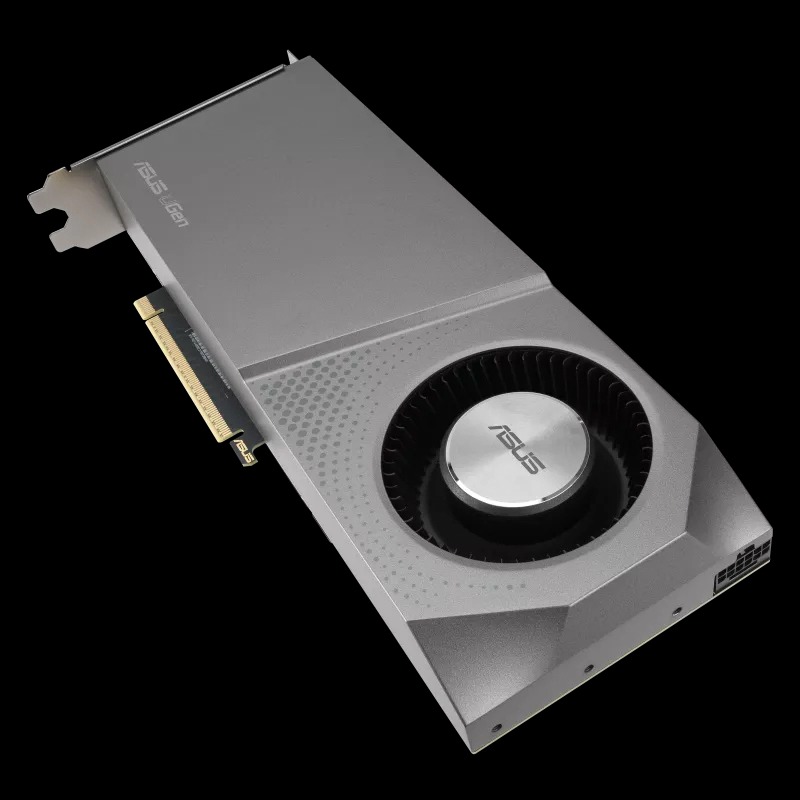
ASUS has announced the UGen Intel Arc Pro B70 32GB, its version of Intel’s workstation AI card, built for running language models and AI agents on a desktop or in-house server rather than in the cloud. The card carries 32GB of ECC GDDR6 and a 310W board power, and ASUS says it scales to 64GB with two cards and 128GB with four. The company announced it on 23 October and says it will sell worldwide through authorised resellers and distributors, but it hasn’t given a price or ship date.
Why ASUS is pitching 32GB
ASUS builds the case around VRAM. It says long-context reasoning inflates KV-cache usage and multi-agent setups run several models at once, so memory runs out quickly. Once it does, data spills into system memory, and ASUS says inference performance can fall by up to 90%. A single card, the company says, handles most models under 27 billion parameters, which is the gap it sees between this and the 16GB cards most prosumers own.
ASUS’s press release claims a context window of up to 128K tokens with Llama 3.1 8B on one card. The product page is more conservative: it lists about 93K tokens at BF16 precision, a figure it credits to Intel. For multi-card builds, ASUS says a four-card, 128GB system is enough for models up to 120B parameters. It also says dual-card setups run 80B-class models at 43.4 tokens per second. The product page attributes that number to a community benchmark on GitHub using Qwen3-Coder 80B on llama.cpp SYCL, not to an ASUS lab test.
ASUS splits the market into three tiers. Single cards target prosumers and independent AI developers, dual cards target small businesses and creative studios, and four-card systems target enterprise departments. For the last two, the pitch is keeping sensitive data in-house and cutting long-term costs against cloud APIs, with ASUS naming law, medicine, government and finance as fields with data-compliance requirements.

Hardware: the ASUS card runs hotter than Intel’s
The GPU is the same Xe2 silicon Intel uses in its own Arc Pro B70, so memory, bandwidth and AI throughput match the reference card. The differences are power, outputs and cooling. ASUS lists 310W, whereas StorageReview’s July review puts Intel’s reference card at 230W, configurable from 160W to 290W. That’s 80W more than Intel’s default, which matters when you plan power and airflow for four cards in one chassis.
| Spec | ASUS UGen Arc Pro B70 32GB | Intel reference card |
|---|---|---|
| GPU | Xe2, 32 Xe-Cores, 256 XMX engines | Same |
| AI performance | Up to 367 TOPS (INT8) | 367 TOPS (INT8) |
| Memory | 32GB GDDR6 ECC, 256-bit, up to 608GB/s | Same |
| Max clock | Up to 2800MHz | 2800MHz |
| Interface | PCIe 5.0 x16 | PCIe 5.0 x16 |
| Board power | 310W | 230W (160-290W configurable) |
| Outputs | 3x DisplayPort 2.1 (UHBR13.5), 1x HDMI 2.1b | 4x DisplayPort 2.1 |
| Form factor | Full-height, 2-slot | Dual-slot |
ASUS’s product page describes a blower design in a two-slot body, with the power connector at the far end of the card for cleaner cable routing. The cooling and build features include dual-ball fan bearings, a phase-change thermal pad, four-corner adhesive reinforcement for the GPU die and a stainless steel bracket. The card has a three-year limited warranty. Maximum output is 7680×4320 at 120Hz, though nobody buying this for inference will lean on that.
Software: the stack is the open question
ASUS lists support for Intel LLM Scaler and vLLM XPU, llama.cpp (SYCL and Vulkan), Ollama, OpenVINO, oneAPI, PyTorch XPU and ComfyUI, with verified models including Llama 3.x, Qwen 3.x, DeepSeek-R1 Distill, Mistral and Mixtral, and OpenAI’s gpt-oss in 20B and 120B sizes. ASUS also says LLM Scaler’s built-in INT4 and FP8 quantisation removes the need for CUDA-based tools, and that known ecosystem limitations don’t affect near-term commercial deployment.
Reviewers have been less settled. StorageReview’s headline verdict is that the hardware is ready but the software stack still needs to catch up, and its reviewer called LLM Scaler a beta at best, with limited model coverage and some quantisation paths that don’t work yet. That review used Intel’s reference cards, not ASUS’s.
On top of the open frameworks, ASUS has two software layers of its own. The product page lists compatibility with ASUS Zenni Claw, a personal agent app that runs on a single card, and an ASUS UGen Console launcher that checks drivers and disk space, tracks VRAM use and installs ComfyUI. For four-card systems it points to Intel’s SuperClaw, which routes work between local and cloud models. Intel claims that cuts cloud token consumption by up to 70%.
Price: still unannounced, and the market has moved
ASUS says pricing will come closer to availability. For context, Notebookcheck reports that Intel launched the B70 on 25 March with a suggested price of $949 for its reference card. As of 27 October, its report puts Newegg listings at up to $2,399, and the cheapest new card sold directly by a US retailer at $1,499.99, around 58% above launch. StorageReview had already noted in July that the memory crunch had pushed street prices over $1,100.
That changes the maths for the multi-card builds ASUS is pitching. Notebookcheck says four B70s cost roughly $3,800 at list, but about $6,000 or more at today’s lowest prices. Those are US figures for Intel and its other partners’ cards, and ASUS hasn’t said where its card will land. ASUS also hasn’t named distributors or timing for the UAE, Saudi Arabia or Egypt, so regional buyers will need to wait for local listings.
HP took a very different route to local AI hardware with the ZGX Nano and other AI gear it showed at Gitex 2025. On the consumer side of Intel’s Arc line, the company’s driver updates have delivered gains of up to 40% in The Witcher 3. The B70 itself is a workstation part and isn’t aimed at gaming.
Is the ASUS UGen Arc Pro B70 available in the UAE?
ASUS hasn’t confirmed this. The release says the card will be sold worldwide through authorised resellers and distributors, with pricing announced closer to availability, but it doesn’t list countries or dates.
How many ASUS UGen B70 cards can I combine?
ASUS says it supports up to four cards for 128GB of total VRAM. Each card needs a full PCIe 5.0 x16 slot and draws up to 310W, so plan the power supply, slot spacing and cooling before you buy.
What can a single 32GB card run?
ASUS says most models under 27 billion parameters, including Llama 3.x, Qwen 3.x, DeepSeek-R1 Distill and Mistral families. Larger models, such as the 80B-class ones ASUS cites, need two or four cards.