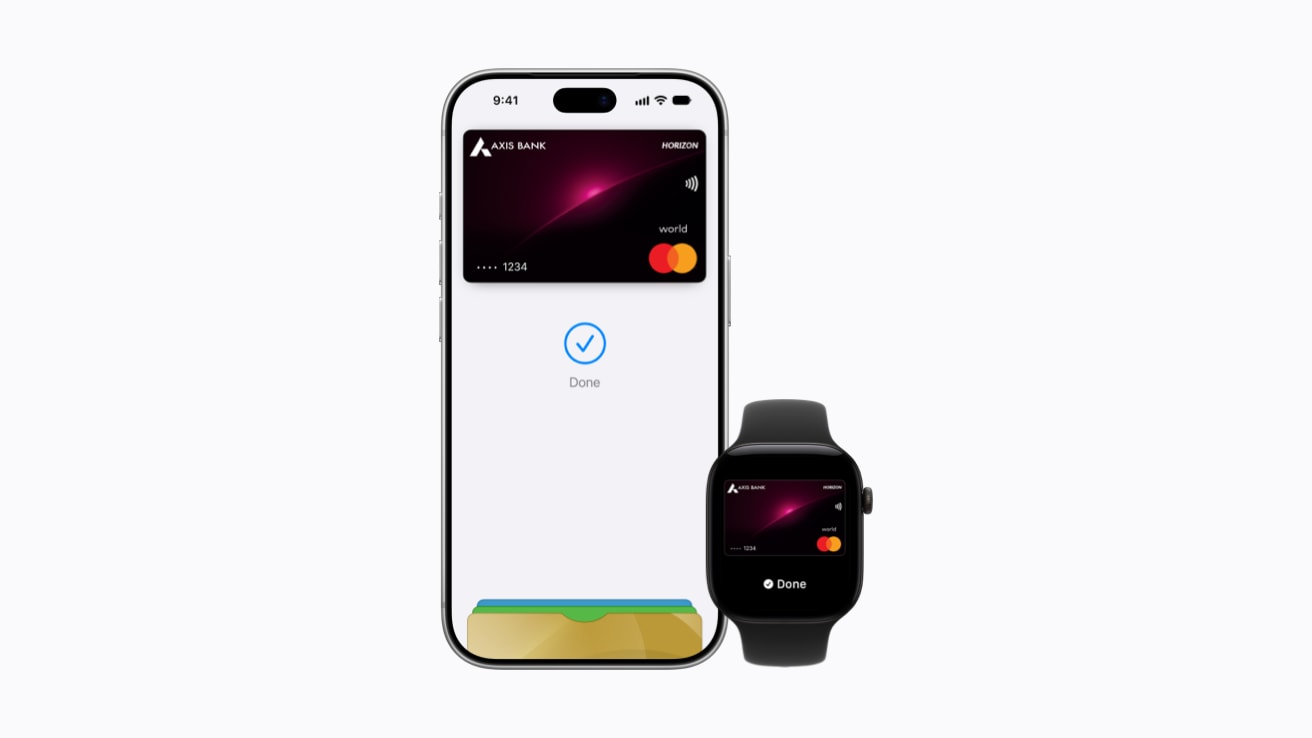
Apple Pay in India is live from 30 September, letting eligible Axis Bank credit card holders pay with an iPhone, iPad or Apple Watch. At launch, the service accepts Axis Bank-issued Visa and Mastercard credit cards; Apple says support for Mac is coming soon.
That is a narrow first step into one of the world’s largest digital-payments markets. Other Indian banks’ cards are not included in the launch, and Apple has not given a date for adding more issuers.
Apple Pay in India: eligible cards and devices
The card restriction is specific: the card must be an eligible credit card issued by Axis Bank and run on Visa or Mastercard. Apple’s announcement does not include debit cards, RuPay cards or cards from other Indian banks. GSMArena’s launch report also says support is limited to Axis Bank’s Visa and Mastercard credit cards.
Apple lists iPhone, iPad and Apple Watch as supported devices, with Mac support to follow. Its launch footnote specifies iPhone XR or later running iOS 18 or later, and Apple Watch Series 6 or later running watchOS 11 or later when paired with an iPhone XR or later. Apple does not list an iPad model requirement in the announcement.
Customers can add an eligible card through the latest Axis Bank app or by opening Wallet on an iPhone and tapping the plus sign. For an in-store payment, users double-click the side or Home button, authenticate with Face ID, Touch ID or a passcode if prompted, then hold the iPhone or Apple Watch near the contactless reader.
Apple Pay also works in supported apps and on websites, where customers can check out without repeatedly entering card and delivery details. Apple says card rewards and benefits continue to apply. At launch, it names Apple Store locations, Blinkit, Chaayos, Croma, Ixigo, Tata 1mg and Zomato among the merchants accepting the service, alongside millions of other merchants and participating payment providers.
A card wallet in a UPI-heavy market
Apple Pay in India is a card-based service, not a new way to scan a UPI QR code. The launch announcement is limited to Axis-issued Visa and Mastercard credit cards and does not announce UPI or RuPay support.
That puts the launch in a crowded market. Reuters reported before the launch that the Unified Payments Interface accounted for 84% of India’s digital-payment volume, with transfers using QR codes, phone numbers and tap-to-pay. Apple Pay therefore adds a way to use eligible bank cards across Apple devices; it does not replace the payment rail many Indian shoppers already use.
The service’s initial reach will also depend on more than the number of Apple devices in use. A bank must issue an eligible card, and a shop’s terminal must accept contactless payments and the relevant card network. Apple said it plans to bring the service to millions of merchants through payment-service providers, while the launch is limited to one bank.
What UAE travellers should check
Apple already lists the UAE among regions where Apple Pay is supported in its country and region list. The India launch does not announce a new UAE bank partnership. For someone travelling from the UAE, the Axis Bank restriction describes which Indian cards can be added under the new launch; it does not guarantee that every UAE-issued card will work at every Indian terminal.
Apple’s acceptance guidance says a shop must accept the card’s network and have NFC contactless enabled. A UAE cardholder should check overseas-use settings and fees with their own issuer before travelling. The issuer-specific nature of payment cards is familiar locally too: tbreak has covered ADIB’s UAE-issued Marriott Bonvoy Visa cards. For more on how Apple Pay protects card details, see our earlier Apple Pay security and fraud-loss explainer.
Apple says the actual card number is not stored on the device or its servers, and is not shared with merchants. Instead, a unique Device Account Number is encrypted and stored in the device’s Secure Element. Apple also says it does not retain transaction information that can be tied back to a user; lost devices can be locked and their payments suspended through Find My.
For Indian Apple users, the service is available now if their card and device qualify. For everyone else, the next expansion to watch is whether Apple and additional banks agree to support more cards.
Can I use a UAE-issued Apple Pay card in India?
Possibly, but the India launch does not guarantee it. Your UAE card issuer must allow overseas use, and the Indian merchant must accept that card network and NFC contactless payments. Check with your bank before travelling.
Does Apple Pay in India replace UPI?
No. The launch supports eligible Axis Bank Visa and Mastercard credit cards. Apple has not announced UPI or RuPay support, so UPI payments remain a separate option.
What should I do if my iPhone with Apple Pay is lost?
Apple says you can use Find My to locate or lock the device and suspend payments from it. The actual card number is not stored on the device, according to Apple.
When will other Indian banks work with Apple Pay?
Apple has not announced a timetable for additional issuers. Reuters reported before the launch that Apple intended to add lenders over time through separate bank agreements, but no dates were given.